Showing posts with label Episode 7. Show all posts

Thursday, May 21, 2015

#85, Little Green Men, Deep Space Nine, Season 4, Episode 7

Now's where we hit the cold hard reality of memory versus actuality. I had very fond memories of 'Little Green Men,' where Quark, Rom, and Nog accidentally travel back in time and crash in Roswell, New Mexico, in 1947. Taken to Area 51, they make contact with the primitive natives. The premise is strong, and we get to see our favorite Ferengi try to hustle forties-era humans out of their planet. It's... well... It's not good. At least, not as good as I thought it was going to be.

I'd remembered it being much, much funnier. As I rewatched it, much of the humor in the episode falls more than a little flat. The jokes were expected and could be seen coming a quadrant away. Nostalgia is a dangerous thing. It convinces us that things in the past were good, when, in fact, there's a good chance they were not. I will never look upon the original Battlestar Galactica, A-Team, Dukes of Hazard, the Transformers, or Big Trouble In Little China because there's a zero-percent chance they hold up. This, however, this episode I was really looking forward to. And I was really disappointed.

Quote-hu-mor-unquote.
Maybe it's that Quark and crew are truly at their best when they're ancillary to the story. Maybe it's that this is the second Ferengi-centered comedic episode in the countdown, and much of the goodwill that I felt for Shimmerman's Quark and his compatriots has already been spent on my review of the Magnificent Ferengi. Maybe it's because that episode had Iggy Pop and this one did not. Maybe it's that nothing could possible equate to "Roswell that Ends Well" from Futurama. Both episodes had similar time-travel-to-Roswell-shenanigans, but Futurama did it a bazillion times better.

"Shut up and take my latinum!" — Fry
Maybe it's that funny is really, really hard.

Really.

So, rather than bash on the episode for not being what I remembered it to be (which in all fairness is probably more on me than it), let's accentuate the positive, shall we? Let's talk about how we got Quark from the pilot to this episode and why that's kind of cool. For all the type of bumpy foreheaded peoples in the Star Trek universe, there are few aliens that are really explored in depth. There are only a handful that break out of the monoculture formula. And through the characters of Quark, Rom and Nog, we get to explore a few different aspects of the Ferengi. The three started out as pretty much the same character, and over the course of the series we saw each of them grow into more than their sniveling, greedy, funny-looking species of origin.
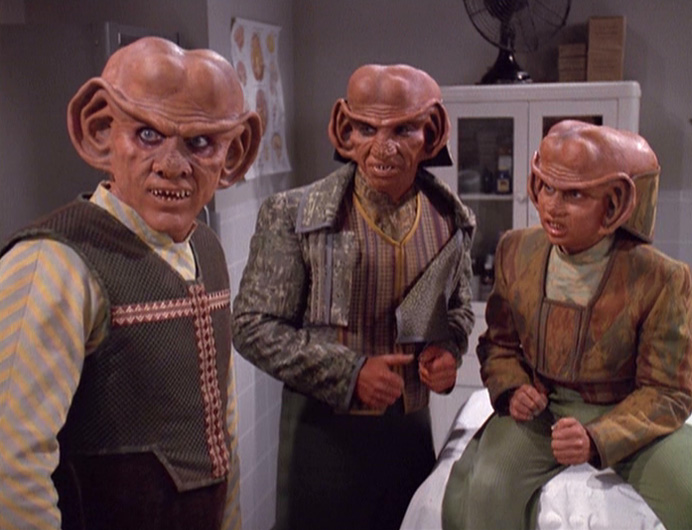
'Look who's calling us funny looking. Stupid hu-mon.' — Quark

Quark here, represents the idealized Ferengi. Opportunity, profit, and thrill. Ferengi love negotiating. And here Quark throws caution to the wind, at the mercy (and gunpoint) of a military base, he sets out to conquer their planet, with no weapons, no plan, nothing really to offer. And he does this because he thinks he can. He goes for it with a bravado and fearlessness that's kind of awesome. He seeks challenge in the only way he knows how. In Ferengi society this is referred to as having the 'lobes,' but let's call it for what it is. Giant, giant brass. But throughout the series, Quark is constantly being called out by other Ferengi for not being ruthless enough. Living amongst aliens for so long, he's had to adapt to cultures outside his own, and finally finds a balance between his Ferengi ideals and those of the Federation. That is, until he unceremoniously throws away years of character development in the series finale, but we'll jump off that bridge when we come to it.

Rom, his idiot-savant brother, is far more interested in making things than money. This makes him an outcast. Because he sees more to life than the acquisition of things, he's considered an 'idiot' by his brother. He's clearly not; he's just not wired in the same way that other Ferengi are. Early in the series, Rom was always nipping at Quark's heels. Always scheming to get the bar from Quark. Not because he really wants it, but because he's lost. He's terrible at business. Terrible at negotiation. Terrible at scheming. Terrible at all the things Ferengi are supposed to be. As the character developed, Rom stops being Quark's incompetent shadow, and starts to become his own man. He marries an alien. He gets a menial job on the station, not because it will make him wealthy, but because he loves it. He follows his passions, regardless of what his kin will think of him. Rom went from being a horribly cartoonish background character to an actual person.

Nog starts the series out as Diet Quark. A ne'er-do-well, no-good-nik and a bad influence on Jake Sisko who's sole function seemed to be to create conflict between Jake and his father. He was mean-spirited, willfully ignorant, a liar, and a tiny jerk. School was dumb. Girls were to be opinionless property. Latinum was all that mattered. He was, in essence, the ideal Ferengi in training. As Nog changed, he became more than a foil for the Siskos and came to represent the future of his species. In this episode, he's off to Starfleet Academy. He sees Starfleet was a way for him to better himself. To see something greater. Not because of profit, but because, like his father, he wanted more from life than the acquisition of things. I mean, he still wants profit, don't get me wrong. But perhaps joining a society that has, in effect, no money, may not have been the ideal way to go about doing it. Nog has ambition, but not in the way that his people usually quantified it, making him a new breed of Ferengi.

These characters have changed over the years, and of all the explorations that Trek has done, it's of character that's the most challenging in interesting. The Ferengi are, after all, odd-looking creatures who may appear homogenous, but are far more complex than just their surface appearance might suggest.

Just like the rest of us.

--

Next up, Worf goes reality skipping in TNG's 'Parallels.'

I like to think, somewhere in the infinite number of parallel realities, Michael Dorn is about to write a review of my performance as Lt. Commander Worf.


Friday, December 19, 2014

#90, The Booby Trap, The Next Generation, Season 3, Episode 7

Before being promoted to Chief Engineer, Geordi Laforge had an interesting career aboard the Enterprise. And by interesting, I mean I'm not sure they really knew what to do with him in the first season. He was the helmsman, sometimes. A command officer, other times. His defining characteristic was the visor that gave him sight. As the season progressed we got to learn more about him. Like, he's Data's friend... and other things? I guess? He had a crush on Tasha Yar? At the same time, the ship's engineering section was also going through an identity crisis. Every episode, it seemed like there was someone new as Chief Engineering, then never to be seen again. Like a drummer in Spinal Tap.

In season two, they promoted him from Conn Officer to Chief of Engineering. But there was no real indication that Geordi was qualified to hold the position of Chief Engineer. He was smart, and capable — even taking command of the Enterprise during a crisis that left the rest of the command crew trapped on a planet in 'The Arsenal of Freedom' — but qualified for Chief Engineer? Experienced enough to take responsibility for the most advanced ship in Starfleet? If you say so, Enterprise HR Director. Because, from the established episodes before the promotion, Data or Wesley seem far more qualified for the position.

So, Geordi suddenly became an expert on all things warp drive, put on the gold uniform and said some absolutely ridiculous technobabble throughout the rest of his tenure aboard the Enterprise. Seriously, kudos to Lavar Burton for getting some of these words out, let alone make them not sound ludicrous. Now in season three, we see the crew settling into their roles and their personalities continue to be explored. Now, there's one other thing we know about Geordi...

First and last date with Lt. Friendzone. 
The episode opens establishing that Geordi is not a ladies man. He's on a date on the holodeck with a woman who, frankly, never should have accepted the date in the first place. When a young man offers to take you on a moonlit caribbean beach, complete with drinks in coconut shells, and a violinist, and you're not into him, say no. Don't wait, presumably hours into the date, to let him down awkwardly. It's not good for anyone. It's painful (and a bit ham-fisted), but immediately puts Geordi in a position of sympathy.

Meanwhile, Data and Wesley are playing a game of chessposition, a game that combines the excitement of chess with the necessary evil of exposition. The Enterprise has found an ancient battle site, between two ancient alien races. Picard is super-excited to discover one of these ancient vessels in tact. Now, it's time to beam over and poke alien stuff. Because nothing ever goes wrong when you beam over to a thousand-year-old ship full of dead aliens.

In chessposition, no one wins. 
As they examine the derelict, the away team accidentally trigger a trap that bombards the Enterprise with radiation and drains any power output. They can't get away, and should they lose power to their shields, everyone on the enterprise would die of radiation poisoning. Having re-watched the episode (twice for this review), I'm not entirely sure I understand how the trap works, was supposed to work, how it affects the systems of the Enterprise, or how the trap was triggered in the first place. The gist is, the more power they use, the more powerful the effect. And if they don't get out, they're all going to die.

Geordi works with a holodeck character to figure out the problem. And things start to get a little weird.

What this episode really had me wondering was, just how smart and powerful is the Enterprise computer? It makes choices about how to interpret Geordi's commands. Has seemingly infinite storage and information. When asked, it extrapolates a personality for a holodeck character based on a real person from symposium records and personal journals and complains of a potential 9.37% margin of error in personality responses in seconds. In seconds. In essence, it makes a holographic life form, as if it's no big deal to make a digital copy of a personality and have it react like a living, breathing human being. In seconds.

This computer interpretation of engineer Dr. Leah Brahms is so real, that Geordi starts to have a relationship with this digital avatar.  It can flirt, offer massages, brag about its cooking skills, and self-aware enough to know that it's a hologram. It's essentially the same concept the computer used to create a holographic Dr. Moriarty, except the basis of this artificial intelligence isn't a fictional villain, but one of the engineers who designed the engines for Galaxy class starships. Do they make out? Not quite, (at least not shown), but they do part on a genuine kiss before Geordi turns her off.

"Silly, you're supposed to do the opposite of that." — Dr. Leah Brahms 
Geordi and his new holodeck lady friend (who looks eerily like the woman who rejected him earlier in the episode, but isn't) spend the entire episode arguing and come up with a plan to turn control of the ship over to the  computer, which no one is really having any part of. Not Riker, not Picard, and not even Geordi. When Geordi comes up with another plan, one that puts the risk in the hands of human beings rather than the computer. With a single burst from the engines before the boobytrap can use that power against them, they should be able to escape. Geordi offers to take the helm and solidify his rightful position as the episode's hero.

Except...

Except Picard (or possibly Stewart) decides he needs to be hero and takes the helm instead. He has to be the one who leads the Enterpise crew to safety. When things go south in Geordi's plan, Picard pulls a maneuver that neither Geordi, Data, nor anyone else with a basic understanding of physics sees coming. Using the gravitational pull of a nearby asteroid, Picard slowly slingshots them out of range of the booby trap. There's a fantastic moment when Data congratulates Picard on his cleverness, and he does so with both surprise and not a small amount of patronization.

The episode ends with a bit of a mixed message. Goerdi says goodbye to the Dr. Brahms hologram with a speech about how it's great to have technology, but we can't entirely rely on it. It can't replace the human factor. Then, in complete contrast to that, he gives her the aforementioned goodbye kiss. Through out the first act, Geordi longs for a connection with another person. He comes across as a little desperate. Then, that need is then fulfilled with a computer's interpretation of a person.

There's a great callback episode to this one, where Geordi meets the Real Dr. Brahms, and she discovers the holodeck program, and the awkwardness ensues. It's portrayed as an invasion. A violation of her as a person. And Geordi has to reconcile his emotional connection to an interpretation of a person, with the actual person.


Next up, we're putting James T. Kirk up for a court martial in the appropriately named Court Martial.

I'm sure it'll turn out fine.