Showing posts with label Deep Space Nine. Show all posts

Sunday, July 12, 2015

77. Our Man Bashir

"Bashir, Julian Bashir." — Bashir, Julian Bashir


#77, Our Man Bashir, Deep Space Nine, Season 4, Episode 9

Star Trek likes playing with genres. From horror, to whodunnits, to courtroom dramas, to slapstick, to war films. The show(s) thrives when it tries something new. TOS took on gangster films. TNG took on Sherlock Holmes and the Old West. Voyager took on 1940s serials. Each one is a deconstruction of the genre, and putting a Star-Trek-y twist on it. At least, they're a break from the usual Federation fair.  Even when the results are mixed, they're usually interesting when Trek breaks itself out of its norm and allows the actors and creators to stretch their legs a bit and play. In Our Man Bashir, we take a look at the spy genre from the 60s with the title character taking on a jet-setting-super-agent based on a certain franchise known for gadgets, femme-fatals, double-crosses, and world domination.

Julian Bashir likes to play James Bond, a registered trademark of MGM, and we get to go along for the ride. The episode examines the tropes of the Bond films and plays with them. 'Our Man Bashir' is far more interested in character than plot. It's more interested in fun than logic. The technobabble surrounding the transporter accident that trapped the crew in his spy-fantasy isn't important. It's background noise. An excuse to make Sisko a villain of epic proportions. To give O'Brien a falcon-based eyepatch. Kira is a Russian double-agent. Dax is the missing geologist. Worf gets to wear a tux and play cards. It's also an excuse to add genuine stakes to what is essentially Bashir playing a spy-themed adventure game.

Each of the crew trapped in the holodeck are an abstraction of their real personalities and true to their nature, yet there's also an inversion of that. Worf is the bodyguard; the gatekeeper for Dr. Noah, but uses subtlety instead of brute force to subdue Bashir and Garrak. Kira, as the Russian Agent, is the foreigner, but she's seductive and silly instead of her usual serious no-nonsenseness. Dax, as Dr. Honey Bear, is the beautiful scientist, yet unsure of her own sexuality and identity. O'Brien's Falcon is the no-nonsense fixit man, but uses violence to get what he wants. And Sisko is the charismatic leader who likes to give epic, epic speeches, yet cast in the role of the villain. The contrasts are played intentionally over the top, and the results are fun to watch.

"Don't let the glasses and the up hairdo fool you. I'm crazy sexy." — Dr. Honey Bear

Also in that abstraction, we look at Julian, and who he wants to be. His alter-ego allows him to play the hero. From his first appearance, Julian has had this desire to be a hero. He's a romantic, coming to Deep Space Nine to be a pioneer on the edge of Federation space. He's super-intelligent, and too smart for his own good. Throughout his holosuit adventures with Miles, they're constantly playing heroes. World War 2 pilots, viking warriors, soldiers art the Alamo. He's constantly playing out his heroic fantasies. Here he goes against a madman with global ambitions.

Dr. Noah's plan is simple. Activate volcanos around the world with lasers to flood the earth somehow and start civilation anew with a few hand-chosen scientists, artists and mercenaries to build a new human race on Mt. Everest. Did I say simple? Because I meant bugfuck crazy, but not necessarily any crazier than any other Bond villain's plan.  Does Avery Brooks as Dr. Noah enjoy cutting loose and giving a devious villain monolog? You bet he does, folks. Every word he utters is forced out with an excited breath, as if he can't wait to say the next line in his diabolical speech.

Because of the circumstances of the transporter accident that left the physical patters of the crew trapped in the holosuite, if he ends the game, they die. If he leaves the game they die. If a character with a crew member's pattern gets killed, their pattern gets erased.

We get the impression that Julian has played this adventure multiple times. Garrak, who joins Bashir on the adventure, mentions that he's been in the holosuite non-stop since the program arrived. Bashir knows the characters, the plot. Even the outcome. He tells Garrak that the game is rigged so that either Anastasia (Kira) or Dr. Bear (Dax) will die, and he will hook up with the other one. Garrak mentions that Dr. Bashir has been playing for hours, so I can only extrapolate that he's played through several times, trying different techniques to get to the finale. He glides through the steps of the game with ease, careful to change his play through only to make sure everyone lives.
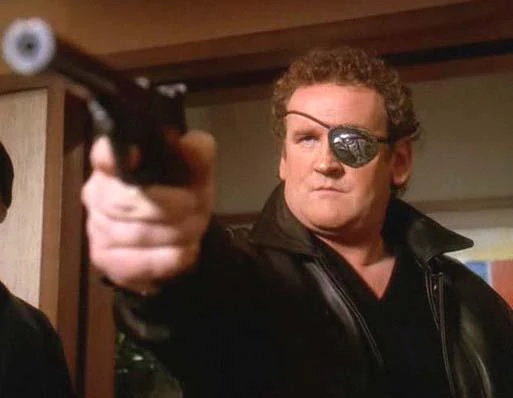
O'Brien get to be a meaney. Get it? Puns are a requirement in Bond-parodies.
Garrak is an interesting companion on Bashir's adventure. We're reminded that Garrak has been the very thing that Bashir wants to be, an intelligence agent. Except Garrak is the real deal. He's infiltrated strongholds. Stolen information from the enemy. Tortured prisoners. Killed without remorse for his country. And he's constantly pointing out the inaccuracy and the lunacy of how espionage is portrayed in Bashir's fantasy. Bashir knows it's silly, and not realistic, he just doesn't care. This is his way to blow off steam and the turn the drama of the Dominion War off for a moment and enjoy himself.

And while Garrak provides kind of anti-Jimminy-Cricket advice to Bashir on how real spies in the real world work, Bashir knows how this fantasy-world works and what's expected of him. The Bond films (and spy television shows) of the era are very much of their time, over-the-top male fantasies with high-tech gadgets and women with both revealing clothing and loose morals. They've evolved into bombastic action films throwing realism out the window in favor of bravado, machismo, and sensationalism.*

More often than not, Star Trek is better at being clever, than funny. And this episode is both a clever look at the spy-genre and ends with a clever twist on it. In order to extend the game long enough for the crew to be rescued — beamed from the holosuite to the Defiant —he presses the big, red doomsday button. He saves the day by letting Dr. Noah destroy the world.

Which is not a thing they taught Garrak about being a spy.

--

Next up, Scotty is accused of murder in 'A Wolf in the Fold.'

*While I loved the Bond films as a kid, they have not aged well. But that's a discussion for another blog.

Wednesday, June 17, 2015

What This Is and What I'm Doing

When io9 posted their list of the Top 100 Episodes of Star Trek as voted on by fans, I took it as an excuse to rewatch me some Trek and to pontificate about it. I've just finished the first 20 on the list, and I'd like to take a moment to reflect. As a reminder, this is not my list. And though I love Star Trek, it is not sacred to me. There are some episodes that I just didn't connect with. Some that have been entertaining but flawed. And some that I've loved.

I'm making a few assumptions with this blog. I'm assuming, dear readers, that you've seen the episodes in question. I haven't been doing extensive recaps of the episodes, and haven't really dived into extensive descriptions of the characters and their general motivations. If you would like to see more of that, please reach out to me and let me know.

Here's the list of episodes that I've reviewed so far:

#100 Bride of Chaotica — A brilliantly madcap episode that pits Voyager against black and white serial villains.

#99 Day of the Dove — Kirk vs. the most bad ass of all bad asses, Kang.

#98 Paradise — Ben Sisko faces off against a cult leader on an alien world.

#97 Borderland, Cold Station 12 & The Augments — The Enterprise stretches an adventure that is a love-letter to Wrath of Khan a little too thin over three episodes.

#96 Lineage — A great character study of B'Elanna and Tom, if you care about either of those people.

#95 The Most Toys — Data is abducted into slavery by a crazy person.

#94 Disaster — Deanna Troi is placed in charge of the Enterprise. Hilarity ensues.

#93 Future's End — A time travel Voyager tale that couldn't end fast enough for me.

#92 The Magnificent Ferengi — A Quark comedy romp that's more entertaining than it sounds.

#91 The Killing Game — The Voyager crew fights Nazis, for some reason that eludes me.

#90 The Booby Trap — Geordi falls for a holodeck physicist, and that's his fantasy? Really?

#89 The Court Martial — Kirk is the manliest man ever to be put on trial for dereliction of duty.

#88 Favor the Bold & Sacrifice of Angels — A two-part microcosm of the best and worst that Deep Space Nine has to offer.

#87 Deja Q — Q returns to annoy the crew of the Enterprise to great effect.

#86 Memorial — The Voyager crew develops PTSD from an alien war they never participated in.

#85 Little Green Men — Quark, Rom and Nog get blasted back in time to 1947 Roswell, New Mexico and hilarity does not ensue. It tries, really hard though.

#84 Parallels — Worf bounces from reality to reality in a mystery that's solved in the episode's title.

#83 Timeless — Harry and Chakotay travel back in time to prevent the destruction of Voyager. I'm not convinced this is the best course of action.

#82 Conundrum — The crew of the Enterprise-D get their minds erased and thrown into a war they have no memory of.

#81 The Enemy Within — Where we get two Kirks for the price of one thanks to a transporter accident.

As we look towards the next twenty, I'm excited about some of the episodes on the list. Thanks for reading, and let's watch some Trek.

Thursday, May 21, 2015

#85, Little Green Men, Deep Space Nine, Season 4, Episode 7

Now's where we hit the cold hard reality of memory versus actuality. I had very fond memories of 'Little Green Men,' where Quark, Rom, and Nog accidentally travel back in time and crash in Roswell, New Mexico, in 1947. Taken to Area 51, they make contact with the primitive natives. The premise is strong, and we get to see our favorite Ferengi try to hustle forties-era humans out of their planet. It's... well... It's not good. At least, not as good as I thought it was going to be.

I'd remembered it being much, much funnier. As I rewatched it, much of the humor in the episode falls more than a little flat. The jokes were expected and could be seen coming a quadrant away. Nostalgia is a dangerous thing. It convinces us that things in the past were good, when, in fact, there's a good chance they were not. I will never look upon the original Battlestar Galactica, A-Team, Dukes of Hazard, the Transformers, or Big Trouble In Little China because there's a zero-percent chance they hold up. This, however, this episode I was really looking forward to. And I was really disappointed.

Quote-hu-mor-unquote.
Maybe it's that Quark and crew are truly at their best when they're ancillary to the story. Maybe it's that this is the second Ferengi-centered comedic episode in the countdown, and much of the goodwill that I felt for Shimmerman's Quark and his compatriots has already been spent on my review of the Magnificent Ferengi. Maybe it's because that episode had Iggy Pop and this one did not. Maybe it's that nothing could possible equate to "Roswell that Ends Well" from Futurama. Both episodes had similar time-travel-to-Roswell-shenanigans, but Futurama did it a bazillion times better.

"Shut up and take my latinum!" — Fry
Maybe it's that funny is really, really hard.

Really.

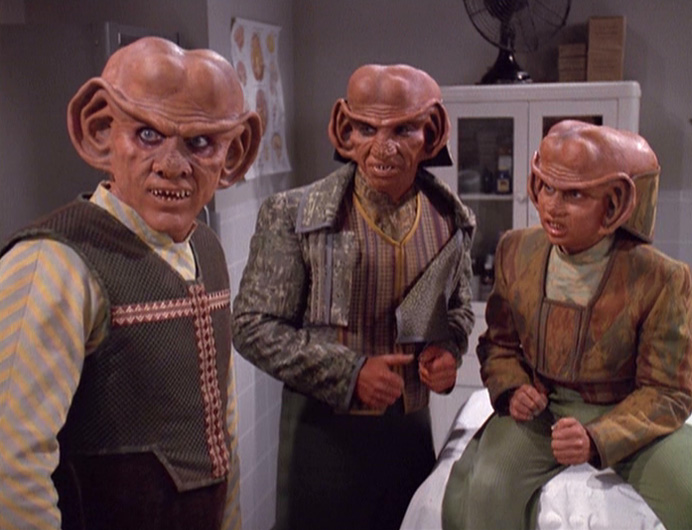
So, rather than bash on the episode for not being what I remembered it to be (which in all fairness is probably more on me than it), let's accentuate the positive, shall we? Let's talk about how we got Quark from the pilot to this episode and why that's kind of cool. For all the type of bumpy foreheaded peoples in the Star Trek universe, there are few aliens that are really explored in depth. There are only a handful that break out of the monoculture formula. And through the characters of Quark, Rom and Nog, we get to explore a few different aspects of the Ferengi. The three started out as pretty much the same character, and over the course of the series we saw each of them grow into more than their sniveling, greedy, funny-looking species of origin.

'Look who's calling us funny looking. Stupid hu-mon.' — Quark

Quark here, represents the idealized Ferengi. Opportunity, profit, and thrill. Ferengi love negotiating. And here Quark throws caution to the wind, at the mercy (and gunpoint) of a military base, he sets out to conquer their planet, with no weapons, no plan, nothing really to offer. And he does this because he thinks he can. He goes for it with a bravado and fearlessness that's kind of awesome. He seeks challenge in the only way he knows how. In Ferengi society this is referred to as having the 'lobes,' but let's call it for what it is. Giant, giant brass. But throughout the series, Quark is constantly being called out by other Ferengi for not being ruthless enough. Living amongst aliens for so long, he's had to adapt to cultures outside his own, and finally finds a balance between his Ferengi ideals and those of the Federation. That is, until he unceremoniously throws away years of character development in the series finale, but we'll jump off that bridge when we come to it.

Rom, his idiot-savant brother, is far more interested in making things than money. This makes him an outcast. Because he sees more to life than the acquisition of things, he's considered an 'idiot' by his brother. He's clearly not; he's just not wired in the same way that other Ferengi are. Early in the series, Rom was always nipping at Quark's heels. Always scheming to get the bar from Quark. Not because he really wants it, but because he's lost. He's terrible at business. Terrible at negotiation. Terrible at scheming. Terrible at all the things Ferengi are supposed to be. As the character developed, Rom stops being Quark's incompetent shadow, and starts to become his own man. He marries an alien. He gets a menial job on the station, not because it will make him wealthy, but because he loves it. He follows his passions, regardless of what his kin will think of him. Rom went from being a horribly cartoonish background character to an actual person.

Nog starts the series out as Diet Quark. A ne'er-do-well, no-good-nik and a bad influence on Jake Sisko who's sole function seemed to be to create conflict between Jake and his father. He was mean-spirited, willfully ignorant, a liar, and a tiny jerk. School was dumb. Girls were to be opinionless property. Latinum was all that mattered. He was, in essence, the ideal Ferengi in training. As Nog changed, he became more than a foil for the Siskos and came to represent the future of his species. In this episode, he's off to Starfleet Academy. He sees Starfleet was a way for him to better himself. To see something greater. Not because of profit, but because, like his father, he wanted more from life than the acquisition of things. I mean, he still wants profit, don't get me wrong. But perhaps joining a society that has, in effect, no money, may not have been the ideal way to go about doing it. Nog has ambition, but not in the way that his people usually quantified it, making him a new breed of Ferengi.

These characters have changed over the years, and of all the explorations that Trek has done, it's of character that's the most challenging in interesting. The Ferengi are, after all, odd-looking creatures who may appear homogenous, but are far more complex than just their surface appearance might suggest.

Just like the rest of us.

--

Next up, Worf goes reality skipping in TNG's 'Parallels.'

I like to think, somewhere in the infinite number of parallel realities, Michael Dorn is about to write a review of my performance as Lt. Commander Worf.


Friday, January 16, 2015

#88, 'Favor the Bold' & 'Sacrifice of Angels,' Deep Space Nine, Season Six, Episodes 5 & 6

I seem to remember the retaking of Deep Space Nine in Favor the Bold and Sacrifice of Angels as being a big moment in the mythology of the show. When Sisko takes back Deep Space Nine from the enemy. We're deep into a war with the Dominion, and the Federation is losing. Losing territory and ships to a vastly superior opposing force, they're outgunned, outnumbered, and falling into a pattern of attack and retreat.

Lives have been lost. Morale is low. And Sisko has decided it's time for some let's-blow-the-shit-out-of-something-big action. A go-for-broke plan that will strike the heart of the Dominion and provide the Federation with a much needed victory. They have to force a victory, or lose the war. He puts together a task force to take back his former command, Deep Space Nine.

Sone where in this armada, I like to think Picard is making it so.

As I re-watched these, I came to realize that this two-episode arc represent the best and the worst of what Deep Space Nine was. As if they are a microcosm of the series as a whole. The episodes are wildly uneven, oscillating between good and bad almost from scene to scene. Deep Space Nine is a show I like (a lot), but I have to admit that there are some elements that just never clicked for me.

On the one hand, we have Avery Brooks, who, once again, rocks it like a boss. Sisko's a man with his back against the wall, making the hard decisions. He's passionate. Earnest. Bold. And takes zero shit from zero people, aliens, or cosmic beings from another reality.

The Dominion are (with exceptions noted below) the perfect villains for the series. I'd described them in a previous post as a totalitarian anti-Federation. They're everything the Federation isn't. They seek conquest, not exploration. Jeffery Combs' Weyoun is fantastic. The show takes chances, swinging for the fences. When they decided to make the major through line of the show the Dominion War, they went for it. Throughout the series, Deep Space Nine has presented space combat on a scale not seen since the Battle of Endor, and it did it on television. Repeatedly. Certainly not on a scale seen in any other iteration of Trek.

We have great character moments. Miles and Julian bonding. Quark setting aside his self-interest for the greater good. Even Rom shines in a rare instance of not being completely annoying. Also, Worf son of Mogh. 'Nuff said.

And then, on the other end of the spectrum (for the record, the bad one), we have the prophets calling Ben "The Sisko." We have the character known only as Female Changeling, who apparently cannot have a line without saying the words 'solids' or 'great link.' We have Odo's, ugh, love affair with Major Kira, which has always felt forced and awkward. We have the logic problems of both the Bajoran gods and the Dominion changeling rules. And, then, we have Gul Dukat.

Gul Du-fucking-kat.

I swear I got eye strain from rolling them too much every time Gul Dukat was on the screen. I loathe him, but not in the way I'm meant to. He's smarmy, arrogant, self-agrandizing, and speaks with with an almost operatic rhythm — where every sentence builds in volume and intensity and is then followed by a soft coda. Once I identified this, it drove me absolutely mad. Dukat is, perhaps, the Star Trek villain with the most screen time of any other. In fairness, I didn't do any kind of quantitative analysis on that, I'm just going by memory. But holy crap is there a lot of Dukat on this show.

"Was it something I said?" -- Gul Dukat. "Pretty much everything you've ever said, ever, yes." — Me

Over the course of the series, he's been portrayed as a cold-blooded mass murderer, a misunderstood tyrant, a crazy person, a patriot, revolutionary, a cult leader, a messiah, and a vessel to evil gods. And every time he's on the screen, I'm just checking my watch until he's done being terrible. He grates me. He's mustache-twirly terrible. He stands out as cartoonishly broad and over-the-top in a show with alien forehead makeup and spaceships going kler-splode. That says something. He strives to have the gravitas to be Sisko's equal, and the failure at that is palpable. But, they keep using him. And his use keeps giving me eye strain. Ow.

However, the worst part of this particular Niner adventure is that it ends with the most blatant (and literal) deus ex machina you could possibly imagine. Sisko's bold plan has failed. The Federation strike force is unable to break the Dominion lines, except for one line ship, the Defiant. The minefield that has kept the Dominion re-enforcements at bay is taken down. Sisko and the crew of the Defiant sail into the worm hole to face off against two-thousand-plus Jem'Hadar warships alone. Their sailing into their deaths in a hollow sacrifice. They don't even say anythig like, 'we're going to technobabble the warp core and collapse the wormhole so that the Jam'Hadar can't get through and save the alpha quadrant with our noble sacrifice!' Instead, they lock phasers, and calmly accept their own deaths at the hands of alien weapony. Then, the Bajoran Prophets pull Sisko out of his reality and into their temporal dream state.

The interaction with the Bajoran Prophets is just painful. They seem to interrupt the action for the sake of interrupting. Call Sisko "the Sisko" for no apparent reason other than to just annoy me. They ramble about a 'game,' which I infer to mean the writers aren't sure what to do with these alien beings in the long term. They are dismissive of Sisko's needs until he makes an old-fashioned empassioned speech. Sisko begs them for a miracle, and they provide it. The Dominion fleet vanishes from Existence, and the Defiant returns to Deep Space Nine. Sisko and crew return the triumpant heroes to the Station, and the war goes on.

For both good and ill.

---

Next up, it's a trip to the continuum with Déjà Q.

Monday, November 24, 2014

#92, The Magnificent Ferengi, Deep Space Nine, Season 6, Episode 10

"Look, brother! Hu-mons!" — Rom

Quark lives his life by a different set of values than the rest of the DS9 regulars. His vision is clear, earn latinum by any means necessary (provided that it's not in conflict with self preservation, of course). He's constantly evaluating risk and reward for his schemes, and gets as much thrill out of the execution plans as the profit itself. He's smart. He's proud. He's a brilliant negotiator and knows the Rules of Acquisition by heart.

In the opening of this episode, he's just pulled off one of the aforementioned brilliant negotiations — piecing together bits of obscure information to learn that a merchant is hoarding precious goods to drive demand up, and uses that information to blackmail the merchant into giving him a large quantity of precious cargo. Space syrup or something. Quark's trying to celebrate by laying out his scheme in detail for anyone who will listen. But nobody's is listening. Bashir and Dax just got back from a secret behind-enemy-lines mission against the Dominion and Quark's tale of cunning and profit is overshadowed by more, shall we say, conventional acts of heroism.

In the eyes of the his people, what's he's just done is masterful. Epic. Heroic. Quark knows he's a bad ass, even if the rest of Deep Space Nine don't see it. His ego is bruised, unsure why his heroic act isn't viewed in the same light as the Starfleet covert mission. Remember when I said Quark was proud? Yeah, this starts to eat at him.

"Why won't any one take me seriously? Is is the suit made from pimp curtains? It's probably that." – Quark

Why can't the Ferengi get any respect from the Federation types? Why are they dismissed? Isn't the Ferengi Alliance an empire on par with the Klingons, the Romulans, or the Federation? So, when Quark learns that his mother has been kidnapped by the Dominion, he decides that instead of hiring alien mercenaries to pull off the rescue it should be a Ferengi-only tactical mission. Quark believes that Ferengi are every bit as formidable as the aforementioned Klingons, Romulans, and Federation. And why should be not believe that? The Ferengi are smart, cunning, ruthless, and driven with vast resources and powerful warships.

Hilarity ensues.

No, seriously, this is a fun episode. Quark puts together a rag-tag team of Ferengi warriors and his team is a mix of old and new Ferengi faces. Rom is the first to join. Nog is eager to use his Starfleet training to coordinate the military effort. There's a guy who likes explosions. Quark's cousin, I think. And their former foil, Brunt played by the great Jeffery Combs.

Together, they make an ineffectual commando team in training, so Quark relies on what the Ferengi do best. Negotiation. They decide to exchange a captured Dominion Vorta, for Quark's mother and things get complicated when they accidentally shoot their prisoner before they can make the exchange.

What's interesting here is the episode mirrors the fate for the Ferengi in the mythology of Trek.  They were supposed to be the nemesis of the Next Generation. The new Klingons. Perhaps it was their production design or their early portrayals, but as the Next Generation progressed, the Ferengi went from credible threat to cartoonish foils. And that's kind of what happens in this episode. Quark sets out to put together a team of Ferengi commandos, but it degenerates into playing for laughs as the traits of greed, self-interest and backstabbing set in.

There's a lot of things that may have been funnier on the page than in execution, but it's an amusing episode. Quark's role is as a foil and to provide an outsider's perspective on the Federation. This episode provides some much-needed comic relief in an otherwise dark time for Deep Space Nine crew. Quark, Nog and Rom are fine as flavor, but when the entire episode is Ferengi-focused like this one, it can be a bit much. It's entertaining, but not my favorite Quark-centered adventure. That's coming up later in the countdown in "Little Green Men."

Also, Iggy Pop is in this episode as a street-walking Vorta with a heart full of napalm.

The runaway son of a nuclear warp bomb.
And his performance is fantastic. So, I can't really complain about that.

--

Next up, the Voyager crew are hunted for sport by alien-Nazis in the two-part "The Killing Game."

Tuesday, October 14, 2014

#98 "Paradise" Deep Space Nine, Season 2, Episode 15

Deep Space Nine makes it's first entry in io9's list of Top 100 Episodes of Star Trek, and the result is kinda... well, meh...

The face of homeopathic evil... 

Now, I like DS9, but will admit it took a while for it to find its legs. Like TNG, it's a few seasons before the show figurea out what it is and what makes it different. Not only did it debut immediately in the shadow of Next Gen at the height of its power, it also had Babylon 5 to deal with. Babylon 5, another science fiction show that launched at the same time also set aboard a space station, was, in many ways, god-fucking-awful. Seriously, it was not my thing.

Deep Space Nine takes a lot of flack among Trek fans, and for reasonable reasons. When it debuted, it didn't feel like Trek. The crew was stationary aboard a space station not really boldly going anywhere. There was a lot of politics going on. A major through-line in the show revolved around religion. The further it went along, the more serial and less episodic it became. It was a physically and psychologically darker show. The sets were alien and unfamiliar in design.

But, it was interesting. There was a lot to like. It was told from the point of view of a damaged man finding purpose again. It was the only Trek where the crew didn't get along.  The crew wasn't the paragons of the Federation, best-of-the-best-of-the-best-of-the-Flagship. They were complex. The villains turned out to be a totalitarian anti-Federation driven by their own Manifest Destiny in conquering the Galaxy. If the Enterprise the was the Shining Beacon of the Federation, Deep Space Nine was its shadow.

I like Sisko a lot. And, man, did Avery Brooks know how to chew scenery with a speech like a boss. I like Miles, Dax, and (mostly) Bashir. Hell, I even like Quark. And if the show did nothing else, it solidified Worf as an bonafide legend.

This episode, granted one of the better ones from the first two seasons, still isn't anything to really write home about. Yet, here I am writing about it mostly because my inherent OCD demands I complete the list. Stupid, broken brain.

Now, on to "Paradise."

Uh... It's not bad...

Okay, so Sisko and Chief O'Brien beam down to a planet where colonists have found a simpler life. A technobabble field prevents them from using their advanced technology and have formed a commune led by a woman named, Alixus. As they explore the village, they come to realize that the village is a cult, and Alixus is their undisputed leader. She has decided that the colonists have lost what it means to be human. What it means to work for what they have. What it means to get back in touch with nature. She is a philosopher, and a former scientist who has embraced her fate as someone who has been forced to live a simpler life.

As they explore the village and there are some chinks in the armor. Folk medicines are used instead of modern medical practices. Sisko and O'Brien are dismissive of the concept of the villagers turning their backs on medicine for more homeopathic solutions. They're baffled by the villagers discouraging them from trying to solve their problems through science. People are pushed to the brink of exhaustion. Disobedience is not an option (unless you like being put in a metal box on a hot day). And anyone who questions Alixus, is, well...

"What's in the boooooooox" — Sisko


As O'Brien looks for a means to contact their Runabout, he gets caught. Apparently looking for a way to disable the technobabble field to use technology again is verboten. Sisko, as O'Brien's CO is punished in his stead. And punishment means getting put in the sweatbox. Sisko goes for days without water in the brutal heat. He's let out for a reprieve and is given a choice. And all Sisko has to do is denounce his uniform, his oath to the Federation, and his principles for a glass of water and acceptance of the society.

Sisko crawls back in the box, presumably to die, rather than give Alixus what she wants — subjugation. It's a great moment, and speaks volumes about who Sisko is, and what his ideals mean to him. If there's any reason why this episode is on this list, it's this beat. Because, it's awesome.

Ultimately, I feel like the casting of the Alexis was fairly weak, and never really found her interesting as a threat. Some of the ideas presented are more interesting than the execution. It's heavy-handed in it's science versus anti-science conversation (if you can call it that). There's the notion that this is the Nth time that Star Trek has found a utopia that wasn't. And, I feel like they had a good half-hour spread too thin over 44 minutes.

When Sisko and O'Brien are saved by a rescue party, Alixus is revealed to have orchestrated the crash that marooned the colonists. She's revealed to have purposefully marooned unsuspecting people because her way of life is better, and by hook or by crook, she was going to prove it. And when she's dragged off for her crimes, some of the villagers choose to stay and continue the live the life they've built under her philosophy. It speaks to the power of cult of personality. Which might be another reason why this episode is on this list.

Like I said, not my favorite episode of the series — that would be either 'Far Beyond the Stars' or 'In the Pale Moonlight,' to be reviewed later in the countdown. But like DS9 itself is interesting, there are some interesting questions raised in the episode.

That, at least, is very true to its Trek heritage.

--

Next up on io9's list... oh, crap, it's a three-part Enterprise tale of genetic augmentation...  Borderland, Cold Station 12 and The Augments...

Three episodes? How is that fair, io9?

Stupid, broken, OCD brain.

Crap...