Showing posts with label Season 3. Show all posts

Tuesday, February 24, 2015

#87, Deja Q, The Next Generation, Season 3, Episode 13

"As an android, I'm incapable of disliking you, Q, and yet, somehow, I do." — Data
Q's introduction to the series was, frankly, off putting. His first meeting with the Enterprise feels mashed together with another adventure. Two puzzle pieces that never quite connected together smoothly. Which fits, as from my understanding of the history of Encounter at Farpoint, that's very much what happened as Roddenberry and crew were launching the series. Granted, it was a pilot, and chock full of expositiony bullshit that plague many pilots. However, it seems to me that they only had a vague notion of what Q was and what they wanted him to be, but he wasn't there yet. He came to the Enterprise appearing as a 16th Century Explorer complete with thous and thees, a WWII soldier worried about Gerry, then some post-apocalyptic judge in a robe in a weird hat. It didn't help that Encounter was still figuring out literally everything about the series, and Q was as much a mouthpiece for exposition as anything. He was there to help set the status quo, explain where humanity was, and how far they had yet to go. His powers were ill defined, his mannerisms erratic, and the logic behind his encountering with humans is, shall we say, convenient with the needs of the show. Why the Enterprise and not Earth proper? Why use a weird forcefield? Why go through different eras of humanity (and appropriate accents) to communicate with Team Picard when you've reportedly been watching humans for a very long time? Eh, why the fuck not? Let's get on with the show, people, we have a fictional world to establish!

He'd appeared a few more times before this episode, Deja Q. Once to temp Riker with the god-like powers of the Q-continuum. And once to introduce the Borg and teach Picard a lesson in humility (the latter episode is not great, but the things it leads to are). DeLancie seems to relish playing Q, and he plays the smug, arrogant, and self-serving god-like being with a wink and a smile.

In many instances, Q has to stoop to humanity's intellectual level, and he seems exhausted doing it. He's a malicious scientist, poking at a mouse, trying to get the mouse to run through a maze. The mouse never understands why, it just has to run the course until it gets its cheese. Or not. Sometimes the mouse gets the cheese, sometimes, (as in the first Enterprise's first encounter with the Borg) he has to take the mouse out of the maze and reset the experiment. He's a great foil for the series, the Mr. Mxyzptlk to Picard's Superman. Logic and technobabble don't matter when he shows up. He's freaking magic. And the Enterprise crew has to cope with a power they can't understand. The Enterprise is never any real threat to him. Not ever, in the series. Except once. Here, in Deja Q.

Both figuratively and literally, Q is, for all intents and purposes, the trickster god archetype. And in this, his fourth appearance, they finally figured out that he should just be fun. Because this is a fun episode. Mostly because humans, and being human, are so effing stupid. Q is stripped of his godlike powers, turned human, and abandoned on the Enterprise to spend the rest of his limited existence as a mortal.
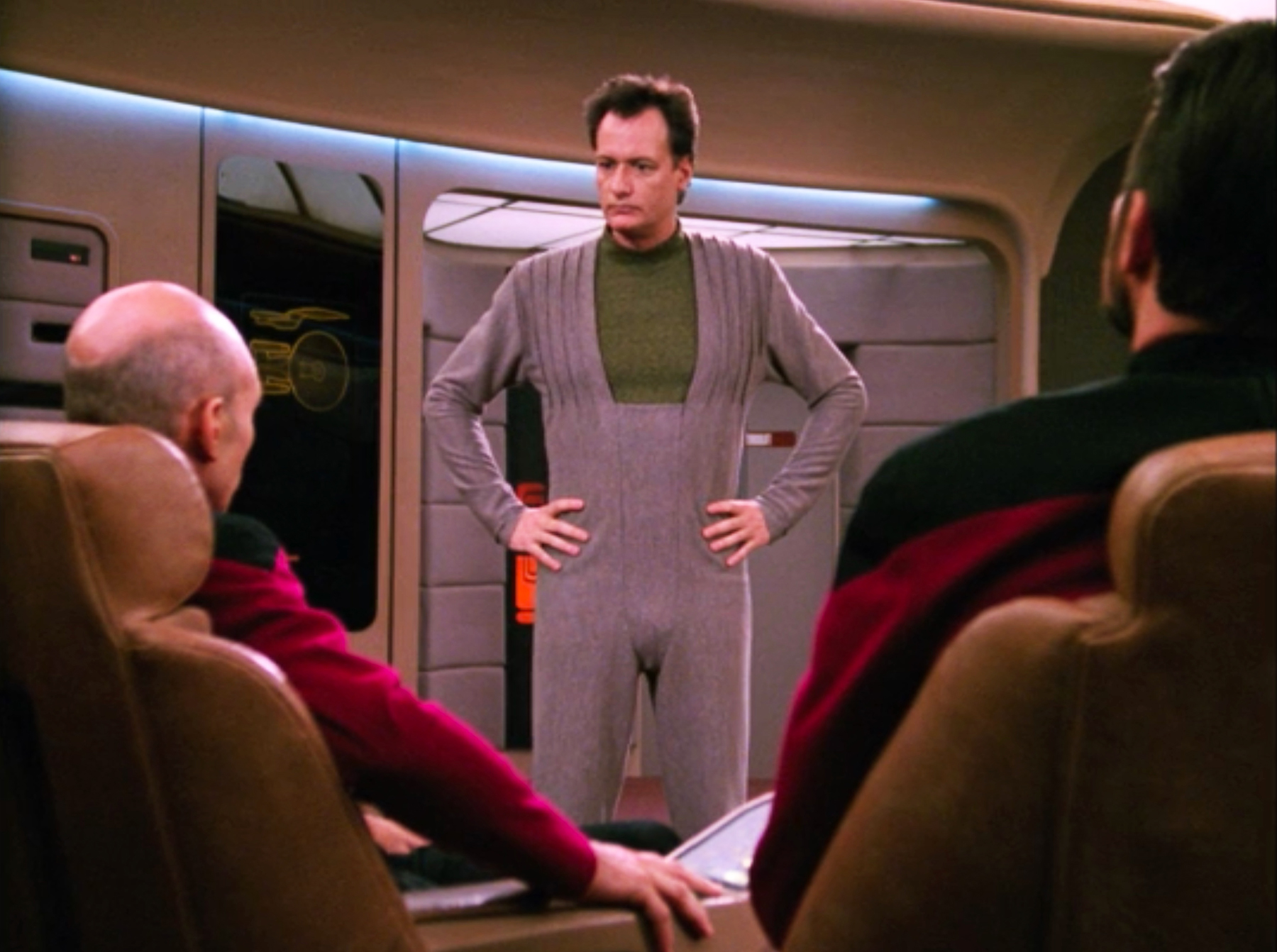
Space onesies. Mortality apparently means space onesies.
Do they trust their former tormenter? No, dear reader, they do not. Picard is facing a crisis of his own, a moon to an alien world is threatening to crash into its parent planet. Not only does he think that Q is responsible for the natural disaster, he also believes that this is some intricate ruse on Q's part to test them. Side note, only Picard can use the word 'ruse' and get away with it. I can't even type it without feeling like a fraud.

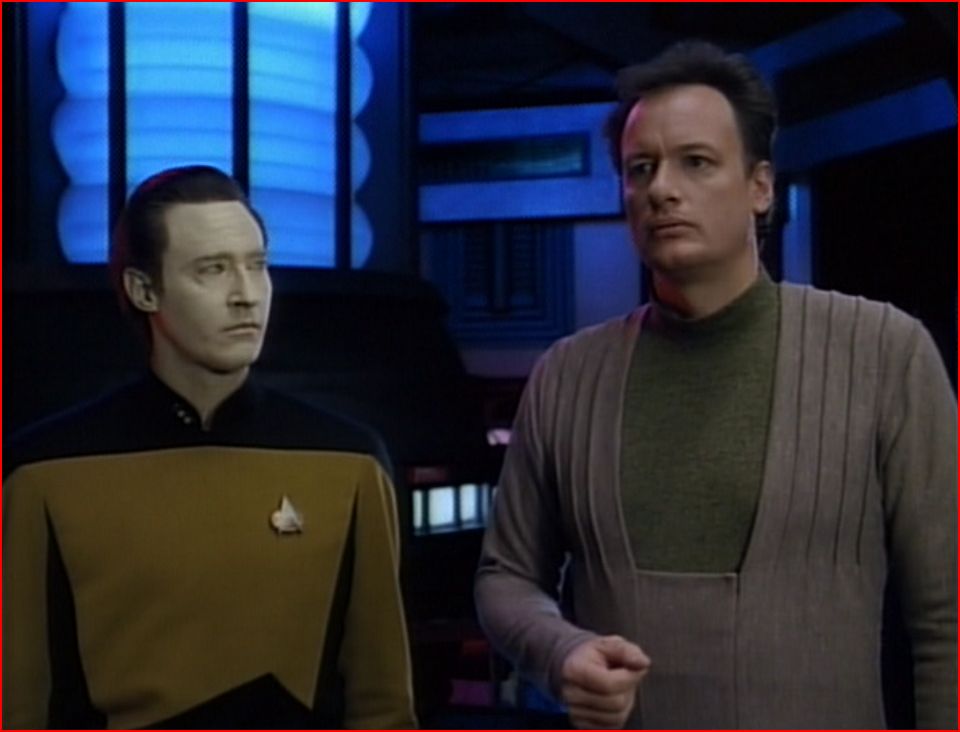
In contrast to the flamboyant DeLancie as the newly mortal Q, he's paired with Spiner's ever-quizzitive and serene Data. And while in normal circumstances it would be so completely on the nose it would be painful -- having a being who is revolted by having humanity thrust upon him, and the being for whom humanity is a goal forever out of reach -- I forgive it here because the interplay between Q and Data is just that damned entertaining. While Q learns the hardships of his newfound biological needs -- like sleeping, gross, and hunger, double-gross! -- Data is there to remind him of the gift of, if not humanity, than at least perspective. Q has spent countless millennia toying with lesser species. Now that he's vulnerable, he at least has some idea of what it means to face his mortality.

To prove his worth to Picard, Q is assigned to help Geordie and Data figure out how to stop the alien moon from crashing, which may literally be the most boring thing any Star Trek crew has ever faced ever. Even the people on the planet can't seem to muster any sense of urgency faced with the eradication of their populous. Seriously, why are these people so damned calm? The aliens appear slightly tense, but otherwise, they're just doing their jobs. Pushing the space buttons and what not. I, on the other hand, would be freaking the freak out if the moon were going to crash into the planet. And not just a little bit. I'm talking full-on, last-days-on-Earth-shenanigans-that-would-only-come-to-pass-if-society-rules-were-out-the-windows-dogs-and-cats-living-together-mass-hysteria-level fun. I would not take the end of the world well is all I'm saying.

"No, it's fine. Our planet is going to be destroyed, and we're relatively okay with that." — Doomed Aliens
In the midst of this, the most boring challenge ever in the history of space, Q is attacked by one of the species that he formally tormented. Picard makes the choice to protect Q, against all logic, because it's the right thing to do. Does Picard like having to risk his ship to protect this former god-like being? No, dear reader, he does not. But Q is now a member of his crew, and it's the right thing. There's a bemoaning hesitation on the Captain's part, but it soon passes. He's risking his ship and his crew over one person. Would he do the same for a nameless gold shirt serving on the lower decks of Engineering? I would have to say, probably. Which is why Picard is the best man suited for the chair of the Enterprise D.

Q eventually realizes that he must sacrifice himself to save the Enterprise. With that, another member of the continuum appears (LA Law's Corbin Bernsen, randomly, of all people), confirms that Q has learned his lesson, and restores Q to his former power. Q snaps his fingers and resets the moon, and all's right with the alien world below.

"Remember me? No? Maybe as the dad from Psyche? Still no? Understandable." -- Other Q
Now, if this episode totally sucked, unequivocally and inexorably, if the entire episode had lacked the wonderful exploration of humanity between Q and Data, the ending would have still have earned it a spot on the list of Top 100 Episodes of Trek of all time. Because when Q is absolved of his crimes and has his powers are restored, he celebrates is a manner fitting of a next generation trickster god. With a battle cry of "Mon Capitan!" Q presents a full-on mariachi band on the bridge. Picard and Riker are given celebratory cigars, and Data is given a glimpse at humanity in the form of uncontrollable laughter.

The best part of this is that it happened.  
Throughout the episode we're treated to the sarcastic outsider's view of the Enterprise and the world of the Federation, with Q holding up the funhouse mirror to the absurdity of what it means to be human.

Therefore, Data's laughter at the end is wholly, wholly deserved.

--

Up next, the crew of Voyager examines the morality of war with Memorial.

Friday, December 19, 2014

#90, The Booby Trap, The Next Generation, Season 3, Episode 7

Before being promoted to Chief Engineer, Geordi Laforge had an interesting career aboard the Enterprise. And by interesting, I mean I'm not sure they really knew what to do with him in the first season. He was the helmsman, sometimes. A command officer, other times. His defining characteristic was the visor that gave him sight. As the season progressed we got to learn more about him. Like, he's Data's friend... and other things? I guess? He had a crush on Tasha Yar? At the same time, the ship's engineering section was also going through an identity crisis. Every episode, it seemed like there was someone new as Chief Engineering, then never to be seen again. Like a drummer in Spinal Tap.

In season two, they promoted him from Conn Officer to Chief of Engineering. But there was no real indication that Geordi was qualified to hold the position of Chief Engineer. He was smart, and capable — even taking command of the Enterprise during a crisis that left the rest of the command crew trapped on a planet in 'The Arsenal of Freedom' — but qualified for Chief Engineer? Experienced enough to take responsibility for the most advanced ship in Starfleet? If you say so, Enterprise HR Director. Because, from the established episodes before the promotion, Data or Wesley seem far more qualified for the position.

So, Geordi suddenly became an expert on all things warp drive, put on the gold uniform and said some absolutely ridiculous technobabble throughout the rest of his tenure aboard the Enterprise. Seriously, kudos to Lavar Burton for getting some of these words out, let alone make them not sound ludicrous. Now in season three, we see the crew settling into their roles and their personalities continue to be explored. Now, there's one other thing we know about Geordi...

First and last date with Lt. Friendzone. 
The episode opens establishing that Geordi is not a ladies man. He's on a date on the holodeck with a woman who, frankly, never should have accepted the date in the first place. When a young man offers to take you on a moonlit caribbean beach, complete with drinks in coconut shells, and a violinist, and you're not into him, say no. Don't wait, presumably hours into the date, to let him down awkwardly. It's not good for anyone. It's painful (and a bit ham-fisted), but immediately puts Geordi in a position of sympathy.

Meanwhile, Data and Wesley are playing a game of chessposition, a game that combines the excitement of chess with the necessary evil of exposition. The Enterprise has found an ancient battle site, between two ancient alien races. Picard is super-excited to discover one of these ancient vessels in tact. Now, it's time to beam over and poke alien stuff. Because nothing ever goes wrong when you beam over to a thousand-year-old ship full of dead aliens.

In chessposition, no one wins. 
As they examine the derelict, the away team accidentally trigger a trap that bombards the Enterprise with radiation and drains any power output. They can't get away, and should they lose power to their shields, everyone on the enterprise would die of radiation poisoning. Having re-watched the episode (twice for this review), I'm not entirely sure I understand how the trap works, was supposed to work, how it affects the systems of the Enterprise, or how the trap was triggered in the first place. The gist is, the more power they use, the more powerful the effect. And if they don't get out, they're all going to die.

Geordi works with a holodeck character to figure out the problem. And things start to get a little weird.

What this episode really had me wondering was, just how smart and powerful is the Enterprise computer? It makes choices about how to interpret Geordi's commands. Has seemingly infinite storage and information. When asked, it extrapolates a personality for a holodeck character based on a real person from symposium records and personal journals and complains of a potential 9.37% margin of error in personality responses in seconds. In seconds. In essence, it makes a holographic life form, as if it's no big deal to make a digital copy of a personality and have it react like a living, breathing human being. In seconds.

This computer interpretation of engineer Dr. Leah Brahms is so real, that Geordi starts to have a relationship with this digital avatar.  It can flirt, offer massages, brag about its cooking skills, and self-aware enough to know that it's a hologram. It's essentially the same concept the computer used to create a holographic Dr. Moriarty, except the basis of this artificial intelligence isn't a fictional villain, but one of the engineers who designed the engines for Galaxy class starships. Do they make out? Not quite, (at least not shown), but they do part on a genuine kiss before Geordi turns her off.

"Silly, you're supposed to do the opposite of that." — Dr. Leah Brahms 
Geordi and his new holodeck lady friend (who looks eerily like the woman who rejected him earlier in the episode, but isn't) spend the entire episode arguing and come up with a plan to turn control of the ship over to the  computer, which no one is really having any part of. Not Riker, not Picard, and not even Geordi. When Geordi comes up with another plan, one that puts the risk in the hands of human beings rather than the computer. With a single burst from the engines before the boobytrap can use that power against them, they should be able to escape. Geordi offers to take the helm and solidify his rightful position as the episode's hero.

Except...

Except Picard (or possibly Stewart) decides he needs to be hero and takes the helm instead. He has to be the one who leads the Enterpise crew to safety. When things go south in Geordi's plan, Picard pulls a maneuver that neither Geordi, Data, nor anyone else with a basic understanding of physics sees coming. Using the gravitational pull of a nearby asteroid, Picard slowly slingshots them out of range of the booby trap. There's a fantastic moment when Data congratulates Picard on his cleverness, and he does so with both surprise and not a small amount of patronization.

The episode ends with a bit of a mixed message. Goerdi says goodbye to the Dr. Brahms hologram with a speech about how it's great to have technology, but we can't entirely rely on it. It can't replace the human factor. Then, in complete contrast to that, he gives her the aforementioned goodbye kiss. Through out the first act, Geordi longs for a connection with another person. He comes across as a little desperate. Then, that need is then fulfilled with a computer's interpretation of a person.

There's a great callback episode to this one, where Geordi meets the Real Dr. Brahms, and she discovers the holodeck program, and the awkwardness ensues. It's portrayed as an invasion. A violation of her as a person. And Geordi has to reconcile his emotional connection to an interpretation of a person, with the actual person.


Next up, we're putting James T. Kirk up for a court martial in the appropriately named Court Martial.

I'm sure it'll turn out fine.

Wednesday, November 12, 2014

#93 Future's End, Voyager, Season 3, Episodes 8 & 9

This is where I take a beat to remind everyone reading that this is not my list of the Top 100 Trek Episodes of All Time. This exercise for me is a chance (an excuse, really) to examine a brand I love and revisit some great moments of science fiction television. So, not my list. I say this because I would have never...

Neh-vher...

...Put the two-part  'Future's End' on any list of anything other than Top 100 things I don't ever need to see again. The Voyager crew travels back in the past to the 1990s to stop a catastrophe in the 29th century and... Because... Ed Begley, Jr.? There's a time paradox and a ship from Voyager's future and the crew dresses all 90s and... Ugh...

Trek is known for its comedic episodes. And this one, well, falls flat. There's a lot of forced attempts at humor in this episode. Neelix watches tabloid tv! Voyager is an UFO on the news! Ed Begley, Jr. is a villain! Janeway wears a pantsuit with giant, giant shoulder pads! The crazy homeless guy who claims to be from the future is actually from the future! Tuvok wears a hat!

"This hat hides both my alien heritage and my dignity." — Tuvok
We even lose some of the time-travel-fish-out-of-water shenanigans because Tom Paris is supposedly an expert on 20th century. And, for all that seems to be be going on with the future time ship, stealing technology from the future, trying to stop the paradox, Tom's romance with an astrophysicist...

Hold up.

Is that...?

Holy crap, that's Sarah Silverman. Mind... blown...

Okay, I digress. For all that's going on, they're seemingly spread too little episode over too much time. It's so thin, that they throw in some survivalists/government conspiracists at the end of the second episode to hold Chakotay and B'Elanna hostage seemingly to just run out the clock and provide a modicum of action. Hacker Begley, Jr.'s main threat to Voyager is taking over their computer so there was a lot of evil typing while grinning maniacally.

Silverman's character, Rain Robinson, is an astrophysicist working for Ed Begley's Harry Starling and is not having any of Tuvok's and Tom's shenanigans. She sees right through their attempts to be 90s. She calls out their odd behavior and isn't fooled by Tuvok's hat covering his ears. She's surrounded by spacemen, aliens, holograms, starships and takes it all in stride. She's written smart and it's refreshing to have someone call bullshit on the things going on around her. If there's one thing that works in this episode, it's one of the icons of the alternative comedy movement playing it straight. A feat of cosmic irony, which I calculate as making zero-point-zero sense.

Silverman makes zero filthy jokes in these episodes. What's wrong with the universe?  

According to rumor, Silverman was considered to be made a series regular, joining the crew. And one can't help but wonder what direction the show might have taken if she had been part of the retooling of Voyager and not Jeri Ryan's Seven of Nine, Tertiary Adjunct of Unimatrix Zero-One. Fewer formfitting silver catsuits, probably, but we'll never know for sure.

Speaking of casting against type, Ed Begley, Jr. plays a billionaire mogul driven to steal technological advancements from the future at any cost so he can sell them for even more billions! He's selfish, destructive, and sociopathic, and carries about as much weight as a substitute chemistry teacher. If I've noticed anything in episodes that I've not really connected with is a villain who's non-threatening or miscast (I'm looking at you Kivas Fajo).

And in complete trekkie nitpickery, there's not one single mention of the Eugenics War that was supposed to be happening on earth at the time of this episode. Not even an obligatory 'historical records must have been off by a few decades' or 'the timeline's been altered.' Come on, Trek! 

Now, it's time to say something nice. These episodes provides the show with an excuse to let the Doctor out of sickbay with a piece of technobabble from the 29th century. Something that the show will play with throughout the remainder of the series. The Doctor, as always, is fun.

Trek in all of its iterations has its ups and downs. What surprises me is how well this episode is rated.   The reviews are generally positive, citing both Begley and the time travel bits as clever. I'm here to offer the counter argument, I guess. This one was just not for me.

Sorry, Sarah.

--

Next up, it's back to Deep Space Nine with the Magnificent Ferengi.

Saturday, November 1, 2014

#95, The Most Toys, The Next Generation, Season 3, Episode 22

Here's the first entry for The Next Generation on the list, with 'The Most Toys.' I'm not unbiased here. The Next Generation is my Trek.

What's Klingon for 'Boo-yah!'? 

I think of Season Three of TNG as the season where the show found its legs. When it got it's space-crap together. When they ridded themselves of the zipper onesie, moved past left-over Phase II scripts, and started to get out of the shadow of The Original Series. There were hints of greatness throughout the first two seasons. Notably, 'Measure of a Man,' (later in the countdown), 'Matter of Honor' (which holds a special place in my heart because it may be the first episode of Trek I ever saw), 'Elementary My Dear Data,' 'Q Who?' and 'The Emissary.' But Season Three is, in my mind, when The Next Generation started to click.

Then, I re-watched 'The Most Toys.' On the whole, it's not a bad episode, but suffers from the production design. The sets, makeup, and costumes for the alien baddie Kivas Fajo and his crew have not aged very well. And in instances, look downright silly.

"Why, whatever are you saying?' — Kivas Fajo

However, if my gushing over seeing Brent Spiner as Dr. Soong in the three-part Khan-fest on Enterprise wasn't enough of an indicator, Data is one of my favorite characters in all of Trekdom. And there's a whole lotta Data in this episode. And the interchanges between Data and his captor are well-written.

An insanely wealthy, and amoral monster who is obsessed with unique artifacts throughout the galaxy. He's a collector who's private museum includes the Mona Lisa, a bird-thing that's thought to be extinct, a Joe Dimagio baseball card (complete with gum), and now, the universe's only known sentient android. He went through this ridiculously complicated scheme to kidnap Data, convince his crewmates that he perished in a shuttle accident, and put Data in his personal museum of one-of-a-kind object d'arts.

Meanwhile on the ol' 1701-D, as they with Data's passing, the rest of the crew start to realize that something was wrong with the accident and they hunt for the truth behind what happened to Data.

Data and Fajo go back and forth about the morality of keeping a sentient being as property. About passive resistance. About his personhood. About his rights as a living being, even if he is an artificial one. It would make a nice companion episode to 'Measure of a Man.' Spiner let's Data play in the quiet moments when he's alone with the other Exhibits. Playing with the alien bird-thing or trying to imitate Mona Lisa's smile.

Sentient Android, mint in box. 
Here's the thing I observed about Kivas Fajo. He's written as a stone-cold sociopath. His actions are taken without any consideration of anyone but self. He's insanely wealthy, and keeps his servants in line with the threat of torture and death. He kills on a whim and is single-minded in his mission to subjugate Data and bend the android to his will. Sit in the chair, android. Do as your told. Entertain me and my guests. This is your life until I tire of you and then put you in storage. I extrapolated that last part. Once he's stopped, in the Enterprise's brig for  he even promises to one day own Data again, as if the whole incident was a mere inconvenience to his obsession of possession. On the page, Fajo could be terrifying.

But he's not. The way he's played is effeminate, flighty, and flamboyant. He comes across as a spoiled brat rather than a threat. It's distracting from the weightier conversation of Data's newfound status as a slave in this man's private collection and the lengths to which Data must go to regain his freedom. And it's kind of disappointing, because there's a lot of good dialog here, undercut by a directorial choice. Data comes within milliseconds of vaporizing Fajo with an illegal disruptor as the only way out to not only free himself, but Fajo's other servants as well.

Throughout the episode, Data attempts passive resistance, trying to adhere to his Starfleet training and ideas. But when faced with the choice between slavery and freedom at the price of violence, he makes the latter choice. The only thing the stops him from that act a chance teleporter from the Enterprise that beams him to the safety of the ship. Data goes back to his duty, with only him knowing how close he came to killing someone.

It's a moment his crewmates never see — a super-intelligent machine who's made the decision that his survival is necessitated by the logical choice to override his programmed ethics and kill.

And it's a great moment, in an otherwise uneven episode.

--

Next up, #94 in the Top 100 Episodes of Trek of All Time. An accident leaves Troi in charge and it's a 'Disaster.' Season 5, Episode 5 of the Next Generation.

Troi-centric episodes are usually a warning sign, but I remember this one being not bad. We'll see.