Showing posts with label Picard. Show all posts

Sunday, June 28, 2015

78. Remember Me


'I know what I'm saying is crazy. You have to believe me, Jean-Luc; this is my 'very-serious' face." — Dr. Crusher

 Remember Me, The Next Generation, Season 4, Episode 5

I kind of feel like the Top 100 List is punishing me. Last episode, I plowed through 'I, Mudd' with great difficulty. This time, we get an episode of TNG that just didn't work for me. It's not terrible, but for me it falls in the category, of 'why is this in the list, again?' It's a Beverly-Crusher-centric episode, and that's not always a good thing. In 'Remember Me,' Dr. Crusher is trapped in a reality that's collapsing in on her, eliminating everything and everyone around her.

It starts off with a strange occurrence. Dr. Crusher starts to notice that members of the crew go missing. First, it's just an old friend of Dr. Crusher, seemingly wiped from existence. All record of his presence on the Enterprise is gone. Everyone's memory has been altered and Dr. Crusher has trouble convincing everyone that something is wrong. Others start to go missing, until the Enterprise is staffed with a skeleton crew. And Dr. Crusher fights to convince everyone that what they're experiencing is incorrect. That she's not crazy. That something is very, very wrong on the Enterprise-D.  

Space-Calgon is a very dangerous, and should not be tampered with. 
Let's talk about about Dr. Beverly Crusher. Chief Medical Officer of the Enterprise. Commander in rank. Former head of Starfleet Medical. Widow. Mother. Friend and potential love interest of Jean-Luc Picard. She's supposed to be a strong female character, but more often than not she's relegated to exposition and caretaker. Which means, more often than not, Dr. Crusher doesn't have that much to do other than wave her tricorder and speak nonsense. Unlike McCoy in the Original Series, she's not integral to the show, as demonstrated by her replacement, Dr. Pulaski, in season two. Pulaski, though her service aboard the Enterprise was brief, shook things up, constantly challenged the status quo, and showed more character development in one season than Crusher did in six.

Earlier in the series, Crusher had a will-they-won't-they thing happening with Picard, but other than that, she didn't have that well-developed of a character. She didn't really have a hook, so to speak, like the other doctors in the series. McCoy was the country doctor. Bashir was naive, inexperienced and a bit arrogant. Voyager's EMH was an artificial intelligence looking to expand his existence beyond his original programming. Phlox was an alien outsider and constant optimist. Crusher was Wesley's mom, and not much else going on. Everything about her was seemingly defined by someone else. I can't really put that on the actor, Gates McFadden. She does the best she can with the cards she's dealt.

For Dr. Crusher to carry the episode, she needed to have been a more substantial as a character, and, sadly, she's not. And we're midway through in the series, and she's still defined by her relationships with her captain and her son. We need a reason to care for her more than she's part of the ensemble.

Then there's a shift in this episode when it changes focus from Dr. Crusher to her son Wesley. In that moment, it changes from being about character to being about technobabble. And that's pretty much when 'Remember Me' loses me.

'Wait a minute! Geordie look at this! According to my calculations —which I can totally do in my head — if we can reconfigure the antimatter in the warp-matrix, and re-route auxiliary power to the starboard nacelle, we can bypass main power, and re-channel it through the main defector dish. Then once we use inverted tachyons to generate a stable graviton field, we should be able to have just enough power to do a site-to-site transport and get everyone into the final act of this episode and get my mom back. Also, EPS conduits, and jefferies tubes, or something. I can do this by speaking excitedly and pushing about three buttons on this panel. It probably won't blow up the ship at all." — Wesley Crusher
Wesley is super-duper-special with warp technology and science stuff, or so they tell us. When, it's revealed that Dr. Crusher was caught in an accident from Wesley's warp experiment, my reaction was a hearty 'whatever.' Her passing thoughts at the time of the accident create a reality around her that starts to fall apart as time goes on. I bet she's glad wasn't thinking of giant, killer, mutant spiders when the accident happened. I bet it would have made a much more exciting episode, but what the heck do I know.

The last act is chockfull of warp-speak and metaphysical pseudoscience about thought affecting reality. We even get callback to Season One with an alien who proclaimed Wesley's super-specialness. The problem is that the purpose of Wesley's experiment is vague, and the accidental disappearance of Dr. Crusher is never explained in a way that really connects.* The solution to the mystery presented feels like a cheat. Because it's not one that the audience can solve by piecing together the clues presented, the resolution felt to me like a big, fat 'uh-if-you-say-so.'

When reunited, Wesley falls asleep mid-hug.
Over the course of the series, Dr. Crusher does branch out a bit. When Wil Wheaton left the show, and Dr. Crusher was without Wesley to worry about, we learn that she's interested in command, a playwright and director, a capable leader, and one hell of a tap dancer. Dr. Crusher moves from being a protective mother and eventually evolves into the stalwart moral compass of the Enterprise.

But in this instance, she's still just Wesley's mom.

--

Next up, another doctor steps into the holosuite role of a suave, sixties, super-spy in 'Our Man Bashir.' 

* Okay, it tracks logically, I guess — if you want to get technical about the technobabble — but it comes from a place of plot not emotion, and therefore no one really cares. 

Wednesday, June 24, 2015

80. The Wounded

The Wounded, The Next Generation, Season 4, Episode 12

'The Wounded' marks the first appearance of the Cardassians, a race that would become a huge part of the Trek mythology. I think back on how far the Klingons have come since their first appearance in 'Errand of Mercy' and look at the depiction of the Cardassians from their introduction to their final appearance, and am surprised how fully formed they were from 'The Wounded.' Aside from the aesthetics of their uniforms, they're pretty much the same here as they are when Ben Sisko takes command of Deep Space Nine a few years later. It doesn't hurt that Marc Alaimo is playing the lead Cardassian here, as he would go on to play one of the most prominent villains in Trek's history.*

Though this was the first and last appearance of these bitchin' Cardassian helmet-things.

The Cardassians are presented as an empire with enough military might to threaten Starfleet. A smaller empire than the Klingons and Romulans, perhaps, but they're the best and worst of those two races. As smart as Romulans, as merciless as Klingons, but without the honor that keeps the latter in check. They are reptilian in appearance, calculating, cruel, and brutal. They will enslave an entire planet and justify their actions because they need to preserve their Empire. In short, they are everything the Federation to are not. But the Federation isn't what it used to be.

With their fleet decimated by the Borg attack, what we have is a Federation about to enter into a conflict they may not win. The war with the Cardassians had raged long enough for Picard to tell a war story from his time aboard his previous command, the Stargazer.**

Picard is ordered to keep the peace at all costs, and has to make some hard choices. He has to hunt down one of Starfleet's own, as Captain Ben Maxwell has gone rogue and attacked Cardassian targets. This could lead the Federation back into war with a ruthless enemy. As a show of good faith, Picard takes on a Cardassian delegation, who are constantly trying to get Picard to compromise Maxwell and let them blow him and his ship to smithereens.

If nothing else, this episode has a lot of sitting and talking. 
To do that, he enlists the help of one of his crew who served with Maxwell during the war, Miles Edward O'Brien. And it turns out this petty officer is far more interesting than a guy that pushes buttons in the transporter room. O'Brien was Maxwell's tactical officer during the Cardassian War, which make this 'simple enlisted man' more complex than he'd been so far. He turns our to be clever, and resourceful.

As O'Brien is not an officer, so I can only infer that his time as a Tactical Officer aboard the Rutledge was a war-time field-commission. It also makes his position on the Enterprise a bit strange. Transporter Chief seems like a demotion from Tactical. Perhaps O'Brien sought the honor of serving on the flagship. Perhaps he needed an assignment that was less intense than Tactical, even if that assignment was on a ship in constant danger. Miles is not shy about his feelings about the Cardassians. He's not a fan. He's seen the horrors of war, and he holds the Cardassians responsible for the man he had to become to survive it. We also see the consequences of families aboard the Enterprise as O'Brien tries to process his experiences with his new wife, Keiko.

But Miles knows Maxwell, and he uses every trick up his sleeve to help Picard bring a peaceful end to Maxwell's one-man war against the Cardassians. As Picard and crew attempt to figure it out, the Cardassian representative, Gul Macet, is constantly angling for the means to end Maxwell. Assuring Picard that the only way to attain peace is through Maxwell's end.

And to do that? Endless, endless meetings. 
Maxwell is presented as a contemporary of Picard's, perhaps his equal. Maxwell is smart, determined, and pulls off some tactical maneuvers that sets him up as a formidable opponent. He commands the USS Rutledge, a ship as advanced as the Enterprise. More importantly, Maxwell is a believer. He's a man on a self-appointed mission to expose the Cardassians as the duplicitous snakes they are. He suspects that the Cardassians are using the ceasefire as an excuse to rebuild their navy for a new assault. Maxwell blows up a science station because he believes the Cardassians are using it to spy on the Federation. He assaults a Cardassian civilian freighter because he thinks the Cardassians are secretly using them to resupply their war efforts.

Picard has to stop Maxwell, and there appears to be no easy way out of it. What makes Picard's job that much harder is that Maxwell is right. Maxwell is a man who has suffered loss. Perhaps he's one a mission to avenge the death of his wife during the war. Perhaps he's attempting suicide via death-by-cop. Perhaps he is doing exactly what he says he is, exposing the Cardassians. The truth turns out to be a mix of all of these things, and it makes Maxwell a fascinating antagonist.

Picard has to choose between doing what's right, and serving the greater good and keeping the peace. He can't even entertain Maxwell's suggestions to investigate the Cardassians supply ships because if Picard has proof, he'll have no option but to drag the Federation back into a costly war.  It's a hard choice, and arguable if he made the right one.

--

Next up, it's Kirk vs. Robots and dudes with handlebar mustaches I, Mudd.


*Note, I haaaaate Marc Alaimo's Gul Dukat with a fiery passion, but not in the way that the creators of Deep Space Nine intended. For more on why he's terrible, please check out my review of #88 on the countdown.

**If I have complaints about the episode they're mostly inconsequential. The timeline suggests that the Federation and the Cardassians have been at war up until a year ago, but it's never mentioned in the first two seasons. As Picard tells his Stargazer story, it implies the war has been going on for quite quite a while. Other than the forehead makeup, the Cardassians themselves look terrible, and went through a much needed uniform upgrade before their next appearance. 

Friday, June 12, 2015

#82, Conundrum, The Next Generation, Season Five, Episode 14

"Wait. What's happening? I have zero idea." — Jean-Luc Picard
I'm of two minds of this episode.

On the one hand, hot damn, 'Conundrum' is just great. I mentioned in the previous post about taking the familiar and putting them in an unfamiliar surrounding, and in this episode we get an inversion of that motif. We take the familiar setting and put new characters in it. Well, not really new, per se. We still have Worf, Riker, Picard and Data, but their memories have been erased. They have no idea who they are, or what their purpose was. Just a bunch of people on a giant space ship, wearing snazzy uniforms, and wondering whiskey tango foxtrot is going on.

Too often we've seen mystery set up on Star Trek where we the viewing audience is a step or twelve ahead of the crew (for example, 'Parallels'), but here, we're just as clueless as the crew themselves. As the crew realizes none of them know who they are, there's an unfamiliar face on the bridge of the Enterprise. Commander MacDuff, the ship's First Officer. Whuuuuuuuuuut? And it's on like Ferengi Kong.  We know that something is horribly wrong, but the characters do not. MacDuff is a metaphorical bomb and we're just waiting to for him to go off. As he manipulates the crew, thwarting their attempts to get to truth, we're just waiting for the payoff.

The clues are well paced as the crew pieces together what's going on, with bread crumbs of information doled out in tiny chunks. The Enterprise is supposedly on a secret mission to take out an enemy base to end a bloody war. The enemy has a new secret weapon, which explains the memory loss. The Enterprise burns through the enemy lines, they grossly overpower their supposed mortal enemy.

There are some great character moments as the crew figure out who they are. What we have here are the characters stripped down to their cores. Riker is pure swagger. Ro is impulsive, looking to make her own rules. Deanna states the obvious. Beverly is there, I guess. Data tries to figure out who and what he is. Worf is pure warrior. Picard is wisdom incarnate. The Captain has some great verbal explorations of the moral dilemma of his mission. When they encounter their enemy, they discover  they're no match to them, he doubts the moral certainty of the conflict.

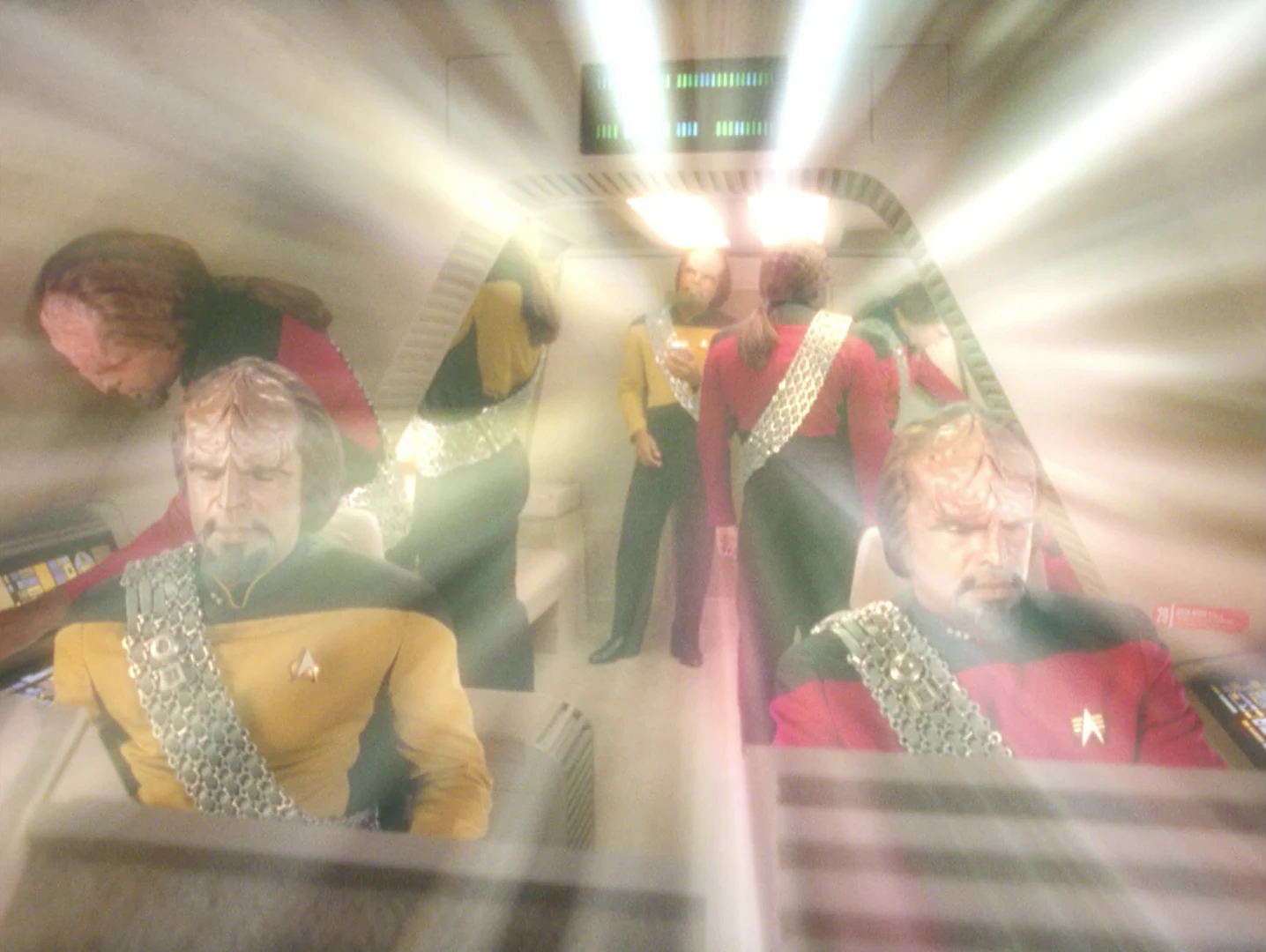
The episode is not without fun. Data and Geordie wonder if Data is unique or part of a ship's standard equipment, which is a fascinating concept. Ro and Riker put aside their usual animosity and replace it with amorousness.* And Worf thinks he's captain for a good chunk of the first act and no one bothers to stop him.

When everyone realizes that no one has their memories, Worf decides he's captain, because why not. With no one with any information to contradict him, he takes charge. His instincts tell him that they've been attacked and he starts ordering the rest of the crew to get the ship battle-ready. Picard shows patience and diplomacy as the young Klingon takes over his ship, and immediately slides into the role of the experienced advisor. It's great to see the contrast between the characters. Worf's single-mindedness and Picard's big picture view. It's the difference between inexperience and experience.  Worf's mea culpa to Picard is great when he discovers that he's the junior-most bridge officer.

"One day, I'll be Captain of my own ship, I swear. Computer, activate crowdfunding." — 'Captain' Worf. 
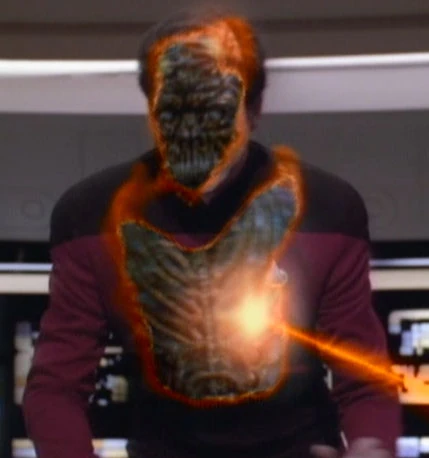
As they make it to their destination, the mystery is revealed, the MacDuff has been manipulating the Enterprise into destroying the base of his species' enemies, ending their war using the Enterprise's vastly superior firepower. Picard can't reconcile what he's been ordered to do and decides to talk to their 'enemy' rather than blow the shit out of their space station. When MacDuff forces his the issue, the crew stops him from murdering thousands using the Enterprise as his weapon. MacDuff shows his true colors, and those colors are alien and gross.

Apparently MacDuff belonged to the same species of  aliens as the ones from 'They Live.'
On the other hand, holy crap, the alien plot is just damned nonsensical. If they can take down the crew of the Enterprise in one shot, why not replace all of them with their own people? Why just the one guy? Why put your agent as the first officer and not the captain? The aliens that take over the ship, the Satarrans, are supposedly a hundred years behind the Enterprise in technology, but can reprogram Data and the ship's computer? The structure of the mystery is well done, but the reveal is a huge let down. and the episode begins with Troi beating Data a chess, a thing that no one ever would find plausible. However, I'm willing to give it a lot of latitude because the rest of the episode is so strong.

What's the verdict? In my opinion — and it's the official opinion of this blog — the strengths of 'Conundrum' far outweigh its weaknesses. So, in the end, 'Conundrum' is great. Flawed, but great.

--

Next up, we get two Kirks for the price of one within 'The Enemy Within.'

--

*They get it on, is what I'm saying. 

Thursday, May 28, 2015

#84, Parallels, The Next Generation, Season 7, Episode 11

"Ahead full! Maximum Worf!" — Worf
I'm not going to lie. I was worried about this episode. Worried because when I announced that 'Little Green Men' was on the docket, I also announced how much I liked it. But when I revisited that episode, I realized that it didn't hold up to my memory. Part of this is the nature of comedy. Much of comedy relies on surprise. A set-up followed by misdirection. A classic structure of expectation and reversal. A third phrasing of that thing. A big part of my reaction to that episode was that it just wasn't all that funny. I've always found Trek better at being 'amusing' than 'funny.' 'Little Green Men' was just a little too-not-at-all-that-funny for my tastes.

That being said, I really, really remembered liking 'Parallels' and I was worried it would fall short of my expectations. After watching, I'm pleased to say it's still a great deal of fun, as Worf bounces from parallel reality to parallel reality, drifting further and further from the Enterprise he knows. As he shifts, the changes in his surroundings go from subtle (the cake is a different color!) to drastic (Riker is Captain!). It's one of those episodes that takes our familiar characters and puts them outside their comfort zones. What is at first contributed to a concussion from a bat'leth tournament messing with Worf's memories quickly escalates into him realizing that he's no longer in his home reality. Worf is lost, unsure of where he is or what's happening thanks to some shuttle accident and Geordi's visor, or something. The technobabble and technobabble solution aren't not really the problems here. Worf's motivations as a character are.

Worf rolls with the changes fairly well at first, assuming his memory is suspect thanks to the aforementioned blow to the head. But, history keeps changed around him. And not little things.  Deanna Troi is his suddenly his wife. Picard is dead at the hands of the Borg. Data has blue eyes. Dr. Crusher is no longer the Chief Medical Officer. Their combadges are slightly different. It's madness.

"Come, sit down, embace this new me-filled reality." — Deanna Troi
What I find interesting is that the reality in which Worf finally finds himself is a fairly sweet one. He's gotten a promotion to first officer of the Enterprise and is happily married to Deanna Troi with two supposedly beautiful children (we never see them). It's not until he realizes that in this reality, his son, Alexander, was never born, that Worf's drive to return home kicks in. Sirtis does a great job of handling Deanna's complex emotional roller coaster as she realizes that Worf not only has no memory of their relationship, the man she knew and loved is gone. Replaced with a man from another world. It's a completely weird thing to ask of an actor, but I think it's handled well.

If I have one major complaint about the episode (I have second but it isn't critical, and is super-nerdy) it's that the episode spends a great deal of time establishing what is essentially a non-mystery. The audience is so far ahead of the characters in this episode on what's going on, it's painful to watch the them catch up. They spend way too much time with the setup and explaining to the audience what a parallel reality is. It's a fairly well-known science-fiction trope and I feel we could skip a fair amount of this and get straight to the emotional conflict in the episode. I say a non-mystery because the reveal of what's going on is in the damned title. Doesn't take a warp-engine specialist to put two and two here.

The episode is very character heavy, where a man who is normally sure of himself, questions everything around him. There's not much driving the story forward, past the mystery we already know the answer to. So, the episode lumbers a bit. We have new, shiny things to look at, but it does drag. There are a few red herrings. Cardassians tamper with a space telescope, and aggressive Bajorans strike against intruders to their territory, but neither pay off in a satisfactory way. It's not until the barriers of reality start to break down that we have an actual threat to deal with, and Worf has any kind of decision to make.

My second complaint about the episode is far more nit-picky and about the Son of Mogh himself. In this episode, Worf comes across as the Klingoniest-Klingon-to-ever-Klingon-a-Klingon. And it bugs me. The episode starts off with Worf returning from a bat'leth tournament, which sounded an awful lot like an Olympics where competitors get impaled. Or, I imagine something akin to MMA, but with giant knives. But not only did he compete, he won with Grand Champion standing. I call shenanigans.*

Worf going off to a bat'leth tournament as a spectator I totally buy. He wasn't raised by Klingons and Worf has always struggled to connect to his heritage in a meaningful way. Worf running off to learn what it means to be a Klingon is a reoccurring character theme. But for him to go to this tournament and win, I just don't buy it. Having competed in martial arts tournaments (I have, don't laugh), I can tell you the people that win those trophies on that level are preternaturally gifted, train non-stop or both.

Worf is a capable officer and warrior, but for him to be competitive amongst natively-raised Klingon warriors, living in a society where competition pushes each of them to the extremes is not credible. I get that we need a mcguffin for him to recognize what reality he's in, and what's changed. As a symbol of the changing realities, his grand master trophy changing from 3rd place to 9th to a participatory ribbon certainly works. It just stands out as being a little too Klingoniest-Klingon to me.

As he swapped realities, it would have been great to have seen Worf in a wind up in a place where Klingons ruled the Federation, which may have been a real emotional challenge for Worf. Here we'd have a character who's struggled with connecting with his heritage, and then have to choose to give it up in order to save reality.

While it's fun to subtly change things around Worf, things never drift too far from the Enterprise-D we know and love. The changes aren't really that drastic. Worf pops into a reality where Wesley Crusher is the tactical officer (one once again questions the wisdom of Starfleet HR). And it would have been great to have Dr. Kate Pulaski show up as medical chief in a cameo. I love that there's something meta here. It's like we're looking at the series in alternate timelines. It's almost as if they're embracing the fan rumors/theories that Stewart wasn't going to return for season three after 'Best of Both Worlds.' Or looking at what if Wil Wheaton had stayed on with the series to become Lt. Crusher?

"Ugh. Pressing space buttons is so beneath my preternatural genius." — Tactical Officer, Lt. Wesley Crusher 
The mind, it boggles.

If anything, I wish they'd gone wilder with it. And weirder with it. We get hints of it with a reality where the Borg have conquered the Federation. When Worf's shuttle takes off to seal the anomaly, it's threatened by a panicked and mountain-man-bearded Riker. He's so desperate to do anything to keep from returning to his nightmare that he'd rather face the breakdown of all existence than the Borg. There's a surreal moment, when New-Reality-Riker is forced to kill Mountain-Bearded-Riker, but it's soon passed. If we had gotten to the answer to the mystery sooner, we might have had a chance to explore some of the more extreme tangents in Enterprise reality. As it is, it's a slow start and a rushed ending.


"The Borg are everywhere! There's no shaving cream or hair gel left in our reality! We won't go back!" — Riker

It's still a fun adventure, but I find myself pondering what might have been. I can't decide if that's appropriate or ironic considering the nature of story.

---

Next up, a 'Timeless' adventure with the Voyager crew. So, the Voyager crew and time travel? Again?

We'll see.

---

*I wanted to use the Klingon word for 'shenanigans' here, but, sadly there isn't one. 

Tuesday, February 24, 2015

#87, Deja Q, The Next Generation, Season 3, Episode 13

"As an android, I'm incapable of disliking you, Q, and yet, somehow, I do." — Data
Q's introduction to the series was, frankly, off putting. His first meeting with the Enterprise feels mashed together with another adventure. Two puzzle pieces that never quite connected together smoothly. Which fits, as from my understanding of the history of Encounter at Farpoint, that's very much what happened as Roddenberry and crew were launching the series. Granted, it was a pilot, and chock full of expositiony bullshit that plague many pilots. However, it seems to me that they only had a vague notion of what Q was and what they wanted him to be, but he wasn't there yet. He came to the Enterprise appearing as a 16th Century Explorer complete with thous and thees, a WWII soldier worried about Gerry, then some post-apocalyptic judge in a robe in a weird hat. It didn't help that Encounter was still figuring out literally everything about the series, and Q was as much a mouthpiece for exposition as anything. He was there to help set the status quo, explain where humanity was, and how far they had yet to go. His powers were ill defined, his mannerisms erratic, and the logic behind his encountering with humans is, shall we say, convenient with the needs of the show. Why the Enterprise and not Earth proper? Why use a weird forcefield? Why go through different eras of humanity (and appropriate accents) to communicate with Team Picard when you've reportedly been watching humans for a very long time? Eh, why the fuck not? Let's get on with the show, people, we have a fictional world to establish!

He'd appeared a few more times before this episode, Deja Q. Once to temp Riker with the god-like powers of the Q-continuum. And once to introduce the Borg and teach Picard a lesson in humility (the latter episode is not great, but the things it leads to are). DeLancie seems to relish playing Q, and he plays the smug, arrogant, and self-serving god-like being with a wink and a smile.

In many instances, Q has to stoop to humanity's intellectual level, and he seems exhausted doing it. He's a malicious scientist, poking at a mouse, trying to get the mouse to run through a maze. The mouse never understands why, it just has to run the course until it gets its cheese. Or not. Sometimes the mouse gets the cheese, sometimes, (as in the first Enterprise's first encounter with the Borg) he has to take the mouse out of the maze and reset the experiment. He's a great foil for the series, the Mr. Mxyzptlk to Picard's Superman. Logic and technobabble don't matter when he shows up. He's freaking magic. And the Enterprise crew has to cope with a power they can't understand. The Enterprise is never any real threat to him. Not ever, in the series. Except once. Here, in Deja Q.

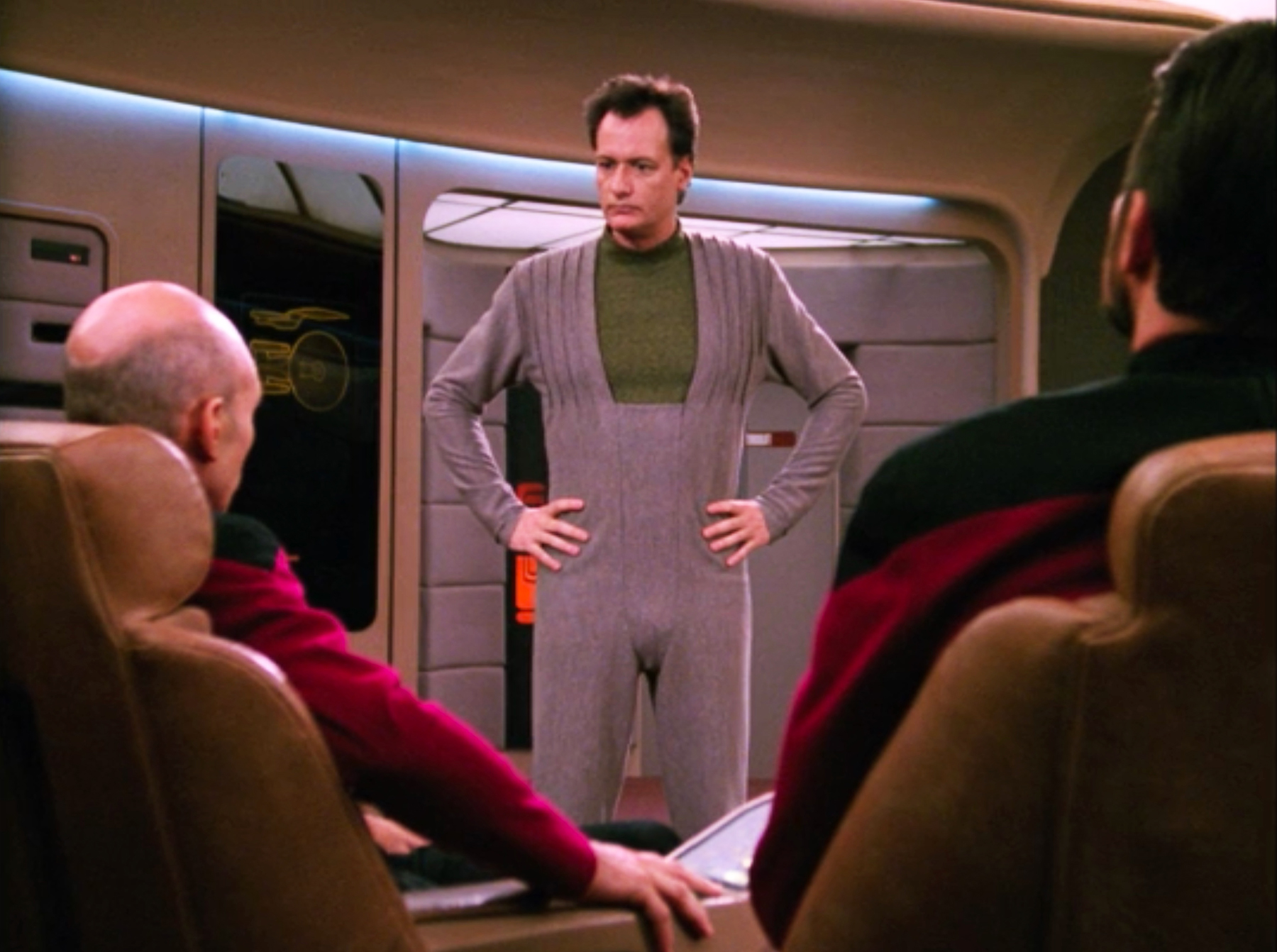
Both figuratively and literally, Q is, for all intents and purposes, the trickster god archetype. And in this, his fourth appearance, they finally figured out that he should just be fun. Because this is a fun episode. Mostly because humans, and being human, are so effing stupid. Q is stripped of his godlike powers, turned human, and abandoned on the Enterprise to spend the rest of his limited existence as a mortal.

Space onesies. Mortality apparently means space onesies.
Do they trust their former tormenter? No, dear reader, they do not. Picard is facing a crisis of his own, a moon to an alien world is threatening to crash into its parent planet. Not only does he think that Q is responsible for the natural disaster, he also believes that this is some intricate ruse on Q's part to test them. Side note, only Picard can use the word 'ruse' and get away with it. I can't even type it without feeling like a fraud.

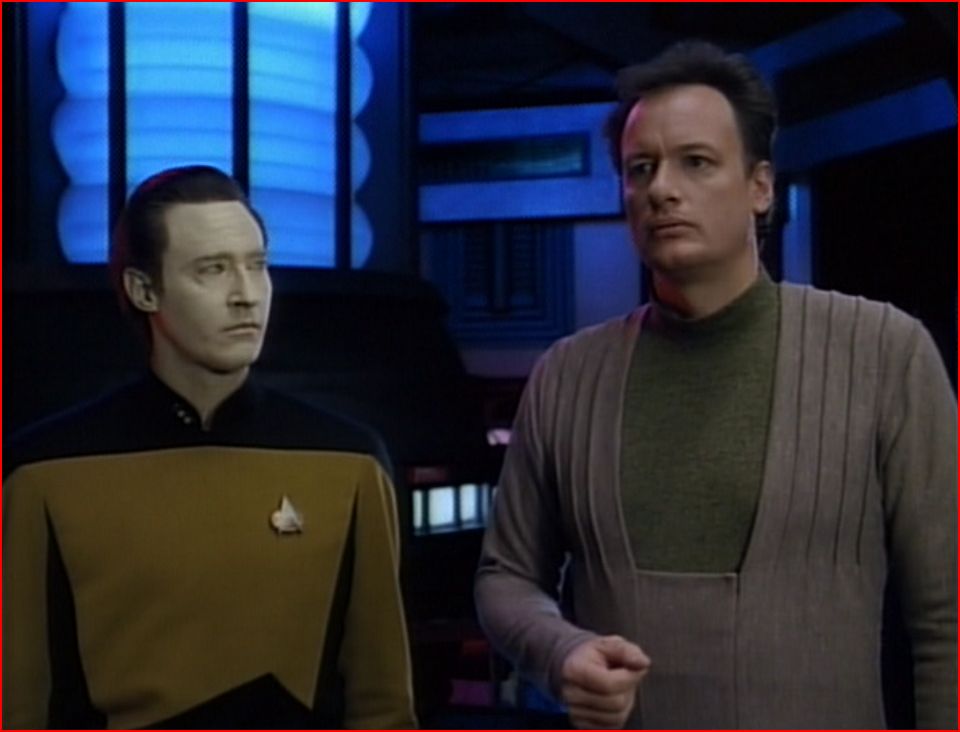
In contrast to the flamboyant DeLancie as the newly mortal Q, he's paired with Spiner's ever-quizzitive and serene Data. And while in normal circumstances it would be so completely on the nose it would be painful -- having a being who is revolted by having humanity thrust upon him, and the being for whom humanity is a goal forever out of reach -- I forgive it here because the interplay between Q and Data is just that damned entertaining. While Q learns the hardships of his newfound biological needs -- like sleeping, gross, and hunger, double-gross! -- Data is there to remind him of the gift of, if not humanity, than at least perspective. Q has spent countless millennia toying with lesser species. Now that he's vulnerable, he at least has some idea of what it means to face his mortality.

To prove his worth to Picard, Q is assigned to help Geordie and Data figure out how to stop the alien moon from crashing, which may literally be the most boring thing any Star Trek crew has ever faced ever. Even the people on the planet can't seem to muster any sense of urgency faced with the eradication of their populous. Seriously, why are these people so damned calm? The aliens appear slightly tense, but otherwise, they're just doing their jobs. Pushing the space buttons and what not. I, on the other hand, would be freaking the freak out if the moon were going to crash into the planet. And not just a little bit. I'm talking full-on, last-days-on-Earth-shenanigans-that-would-only-come-to-pass-if-society-rules-were-out-the-windows-dogs-and-cats-living-together-mass-hysteria-level fun. I would not take the end of the world well is all I'm saying.

"No, it's fine. Our planet is going to be destroyed, and we're relatively okay with that." — Doomed Aliens
In the midst of this, the most boring challenge ever in the history of space, Q is attacked by one of the species that he formally tormented. Picard makes the choice to protect Q, against all logic, because it's the right thing to do. Does Picard like having to risk his ship to protect this former god-like being? No, dear reader, he does not. But Q is now a member of his crew, and it's the right thing. There's a bemoaning hesitation on the Captain's part, but it soon passes. He's risking his ship and his crew over one person. Would he do the same for a nameless gold shirt serving on the lower decks of Engineering? I would have to say, probably. Which is why Picard is the best man suited for the chair of the Enterprise D.

Q eventually realizes that he must sacrifice himself to save the Enterprise. With that, another member of the continuum appears (LA Law's Corbin Bernsen, randomly, of all people), confirms that Q has learned his lesson, and restores Q to his former power. Q snaps his fingers and resets the moon, and all's right with the alien world below.

"Remember me? No? Maybe as the dad from Psyche? Still no? Understandable." -- Other Q
Now, if this episode totally sucked, unequivocally and inexorably, if the entire episode had lacked the wonderful exploration of humanity between Q and Data, the ending would have still have earned it a spot on the list of Top 100 Episodes of Trek of all time. Because when Q is absolved of his crimes and has his powers are restored, he celebrates is a manner fitting of a next generation trickster god. With a battle cry of "Mon Capitan!" Q presents a full-on mariachi band on the bridge. Picard and Riker are given celebratory cigars, and Data is given a glimpse at humanity in the form of uncontrollable laughter.

The best part of this is that it happened.  
Throughout the episode we're treated to the sarcastic outsider's view of the Enterprise and the world of the Federation, with Q holding up the funhouse mirror to the absurdity of what it means to be human.

Therefore, Data's laughter at the end is wholly, wholly deserved.

--

Up next, the crew of Voyager examines the morality of war with Memorial.

Friday, December 19, 2014

#90, The Booby Trap, The Next Generation, Season 3, Episode 7

Before being promoted to Chief Engineer, Geordi Laforge had an interesting career aboard the Enterprise. And by interesting, I mean I'm not sure they really knew what to do with him in the first season. He was the helmsman, sometimes. A command officer, other times. His defining characteristic was the visor that gave him sight. As the season progressed we got to learn more about him. Like, he's Data's friend... and other things? I guess? He had a crush on Tasha Yar? At the same time, the ship's engineering section was also going through an identity crisis. Every episode, it seemed like there was someone new as Chief Engineering, then never to be seen again. Like a drummer in Spinal Tap.

In season two, they promoted him from Conn Officer to Chief of Engineering. But there was no real indication that Geordi was qualified to hold the position of Chief Engineer. He was smart, and capable — even taking command of the Enterprise during a crisis that left the rest of the command crew trapped on a planet in 'The Arsenal of Freedom' — but qualified for Chief Engineer? Experienced enough to take responsibility for the most advanced ship in Starfleet? If you say so, Enterprise HR Director. Because, from the established episodes before the promotion, Data or Wesley seem far more qualified for the position.

So, Geordi suddenly became an expert on all things warp drive, put on the gold uniform and said some absolutely ridiculous technobabble throughout the rest of his tenure aboard the Enterprise. Seriously, kudos to Lavar Burton for getting some of these words out, let alone make them not sound ludicrous. Now in season three, we see the crew settling into their roles and their personalities continue to be explored. Now, there's one other thing we know about Geordi...

First and last date with Lt. Friendzone. 
The episode opens establishing that Geordi is not a ladies man. He's on a date on the holodeck with a woman who, frankly, never should have accepted the date in the first place. When a young man offers to take you on a moonlit caribbean beach, complete with drinks in coconut shells, and a violinist, and you're not into him, say no. Don't wait, presumably hours into the date, to let him down awkwardly. It's not good for anyone. It's painful (and a bit ham-fisted), but immediately puts Geordi in a position of sympathy.

Meanwhile, Data and Wesley are playing a game of chessposition, a game that combines the excitement of chess with the necessary evil of exposition. The Enterprise has found an ancient battle site, between two ancient alien races. Picard is super-excited to discover one of these ancient vessels in tact. Now, it's time to beam over and poke alien stuff. Because nothing ever goes wrong when you beam over to a thousand-year-old ship full of dead aliens.

In chessposition, no one wins. 
As they examine the derelict, the away team accidentally trigger a trap that bombards the Enterprise with radiation and drains any power output. They can't get away, and should they lose power to their shields, everyone on the enterprise would die of radiation poisoning. Having re-watched the episode (twice for this review), I'm not entirely sure I understand how the trap works, was supposed to work, how it affects the systems of the Enterprise, or how the trap was triggered in the first place. The gist is, the more power they use, the more powerful the effect. And if they don't get out, they're all going to die.

Geordi works with a holodeck character to figure out the problem. And things start to get a little weird.

What this episode really had me wondering was, just how smart and powerful is the Enterprise computer? It makes choices about how to interpret Geordi's commands. Has seemingly infinite storage and information. When asked, it extrapolates a personality for a holodeck character based on a real person from symposium records and personal journals and complains of a potential 9.37% margin of error in personality responses in seconds. In seconds. In essence, it makes a holographic life form, as if it's no big deal to make a digital copy of a personality and have it react like a living, breathing human being. In seconds.

This computer interpretation of engineer Dr. Leah Brahms is so real, that Geordi starts to have a relationship with this digital avatar.  It can flirt, offer massages, brag about its cooking skills, and self-aware enough to know that it's a hologram. It's essentially the same concept the computer used to create a holographic Dr. Moriarty, except the basis of this artificial intelligence isn't a fictional villain, but one of the engineers who designed the engines for Galaxy class starships. Do they make out? Not quite, (at least not shown), but they do part on a genuine kiss before Geordi turns her off.

"Silly, you're supposed to do the opposite of that." — Dr. Leah Brahms 
Geordi and his new holodeck lady friend (who looks eerily like the woman who rejected him earlier in the episode, but isn't) spend the entire episode arguing and come up with a plan to turn control of the ship over to the  computer, which no one is really having any part of. Not Riker, not Picard, and not even Geordi. When Geordi comes up with another plan, one that puts the risk in the hands of human beings rather than the computer. With a single burst from the engines before the boobytrap can use that power against them, they should be able to escape. Geordi offers to take the helm and solidify his rightful position as the episode's hero.

Except...

Except Picard (or possibly Stewart) decides he needs to be hero and takes the helm instead. He has to be the one who leads the Enterpise crew to safety. When things go south in Geordi's plan, Picard pulls a maneuver that neither Geordi, Data, nor anyone else with a basic understanding of physics sees coming. Using the gravitational pull of a nearby asteroid, Picard slowly slingshots them out of range of the booby trap. There's a fantastic moment when Data congratulates Picard on his cleverness, and he does so with both surprise and not a small amount of patronization.

The episode ends with a bit of a mixed message. Goerdi says goodbye to the Dr. Brahms hologram with a speech about how it's great to have technology, but we can't entirely rely on it. It can't replace the human factor. Then, in complete contrast to that, he gives her the aforementioned goodbye kiss. Through out the first act, Geordi longs for a connection with another person. He comes across as a little desperate. Then, that need is then fulfilled with a computer's interpretation of a person.

There's a great callback episode to this one, where Geordi meets the Real Dr. Brahms, and she discovers the holodeck program, and the awkwardness ensues. It's portrayed as an invasion. A violation of her as a person. And Geordi has to reconcile his emotional connection to an interpretation of a person, with the actual person.


Next up, we're putting James T. Kirk up for a court martial in the appropriately named Court Martial.

I'm sure it'll turn out fine.

Sunday, November 9, 2014

#94, Disaster, The Next Generation, Season 5, Episode 5

 'Disaster,' the second entry on Top 100 from the Next Generation, is fine example of a bottle episode. When a collision with an interstellar technobabble something or other (a quantum filament) causes an accident that incapacitates the Enterprise, the crew struggles to get back control before the ship explodes.

The Enterprise in 'sleep' mode. 

I should note that this episode was written by future Battlestar Galactica mastermind, Ronald D. Moore. The focus here is entirely character driven, and on putting these characters in unfamiliar territory. Situations counter to their nature. Captain Picard has to lead a group of children. Worf has to guide a woman through childbirth. And, the situation with the potential for the most disaster, Troi is put in command of the Enterprise.

Captain Picard has promised the winners of the Enterprise children's science fair a special tour of the ship. Picard, who in the pilot of the series stated that he's uncomfortable around children, is forced to get in touch with his paternal instincts and lead the children through the disaster. Throughout the episode, Picard has to adjust to leading children, something he admits to having little experience. By the end of the episode, he's bonded with these children. Effectively overcoming his admitted awkwardness with kids. Which means, by the end of the episode Picard is now without any weaknesses whatsoever. Because he is awesome.

When the accident happens, a redshirt bridge commander -- who we've never met before — bites it, and leaves Troi in command. Troi, it turns out, has the rank of Lieutenant Commander. This is not a thing that comes up often. Or, well, ever. Usually her role in the show is to state the obvious or move the plot forward. Here she's got to and she transitions from a position of uncertainty, blindly taking suggestions from O'Brien and Ensign Ro, to making command decisions that saves the lives of everyone on the crew.  But she does so on nothing but blind luck.

With no section of the ship able to communicate with any other part of the ship, their plan to save the Enterprise is dependent on someone alive in engineering able to reactivate the antimatter containment field saving the ship. Ro pushes for Troi to separate the saucer section and save everyone they can. And pushes hard. Troi refuses, wanting to give everyone the best possible chance to survive.

Troi is running entirely on faith, with no evidence that there's anyone else alive on the ship. Why she can't sense them is a convenient oversight in the story. But it's the convenience of her being right that kind of irks me here. There's an infallibility to the crew that cuts out the dramatic tension. And though there was never any real threat of the Enterprise blowing up, the only real consequence is the aforementioned redshirt. Everyone does the right thing in this episode. And every decision is validated with success. Fortunately, Riker and Data's head (see the episode, it'd take too long to explain) make their way to Engineering just in time, and everyone gets a mega-happy ending.

"Where is my happy ending, Counsellor?" — Data

Marina Sirtis does a good job of showing someone completely out of her element finding confidence in their decisions. When she finally takes control she does with as much gravitas as she's able.

And Worf delivers a baby in Ten Forward. Hilarity ensues.

My Favorite Moment in the episode... When Picard meets the winners of the children's science fair, he asks them about their experiments. The youngest of them had the strangest, and most awesome response. The boy said, "I planted radishes in special dirt and they came out all weeeeird." Complete with maniacal grinning and finger steepling. Aaaaannd, what? What the hell kind of mutant soil are they letting kids play with? What the hell kind of kid would want to do that? What the hell, Next Generation? Maybe growing up on a starship warps kids in ways we can't possibly imagine. During the episode, when Picard is trying to boost morale of the kids by assigning they ranks in their small crew, he appoints the kid the Executive Officer in Charge of Radishes.

It's a position that will not turn out well for any radish on board.

--

Next up on the list, Voyager's two-part 'Future's End.' Voyager travels back to the distant past in the 1990s and the villain is Ed Begley, Jr. If that doesn't sound like a recipe for success, then...

Okay, I have no idea how to finish that sentence.