Showing posts with label Sisko. Show all posts

Sunday, July 12, 2015

77. Our Man Bashir

"Bashir, Julian Bashir." — Bashir, Julian Bashir


#77, Our Man Bashir, Deep Space Nine, Season 4, Episode 9

Star Trek likes playing with genres. From horror, to whodunnits, to courtroom dramas, to slapstick, to war films. The show(s) thrives when it tries something new. TOS took on gangster films. TNG took on Sherlock Holmes and the Old West. Voyager took on 1940s serials. Each one is a deconstruction of the genre, and putting a Star-Trek-y twist on it. At least, they're a break from the usual Federation fair.  Even when the results are mixed, they're usually interesting when Trek breaks itself out of its norm and allows the actors and creators to stretch their legs a bit and play. In Our Man Bashir, we take a look at the spy genre from the 60s with the title character taking on a jet-setting-super-agent based on a certain franchise known for gadgets, femme-fatals, double-crosses, and world domination.

Julian Bashir likes to play James Bond, a registered trademark of MGM, and we get to go along for the ride. The episode examines the tropes of the Bond films and plays with them. 'Our Man Bashir' is far more interested in character than plot. It's more interested in fun than logic. The technobabble surrounding the transporter accident that trapped the crew in his spy-fantasy isn't important. It's background noise. An excuse to make Sisko a villain of epic proportions. To give O'Brien a falcon-based eyepatch. Kira is a Russian double-agent. Dax is the missing geologist. Worf gets to wear a tux and play cards. It's also an excuse to add genuine stakes to what is essentially Bashir playing a spy-themed adventure game.

Each of the crew trapped in the holodeck are an abstraction of their real personalities and true to their nature, yet there's also an inversion of that. Worf is the bodyguard; the gatekeeper for Dr. Noah, but uses subtlety instead of brute force to subdue Bashir and Garrak. Kira, as the Russian Agent, is the foreigner, but she's seductive and silly instead of her usual serious no-nonsenseness. Dax, as Dr. Honey Bear, is the beautiful scientist, yet unsure of her own sexuality and identity. O'Brien's Falcon is the no-nonsense fixit man, but uses violence to get what he wants. And Sisko is the charismatic leader who likes to give epic, epic speeches, yet cast in the role of the villain. The contrasts are played intentionally over the top, and the results are fun to watch.

"Don't let the glasses and the up hairdo fool you. I'm crazy sexy." — Dr. Honey Bear

Also in that abstraction, we look at Julian, and who he wants to be. His alter-ego allows him to play the hero. From his first appearance, Julian has had this desire to be a hero. He's a romantic, coming to Deep Space Nine to be a pioneer on the edge of Federation space. He's super-intelligent, and too smart for his own good. Throughout his holosuit adventures with Miles, they're constantly playing heroes. World War 2 pilots, viking warriors, soldiers art the Alamo. He's constantly playing out his heroic fantasies. Here he goes against a madman with global ambitions.

Dr. Noah's plan is simple. Activate volcanos around the world with lasers to flood the earth somehow and start civilation anew with a few hand-chosen scientists, artists and mercenaries to build a new human race on Mt. Everest. Did I say simple? Because I meant bugfuck crazy, but not necessarily any crazier than any other Bond villain's plan.  Does Avery Brooks as Dr. Noah enjoy cutting loose and giving a devious villain monolog? You bet he does, folks. Every word he utters is forced out with an excited breath, as if he can't wait to say the next line in his diabolical speech.

Because of the circumstances of the transporter accident that left the physical patters of the crew trapped in the holosuite, if he ends the game, they die. If he leaves the game they die. If a character with a crew member's pattern gets killed, their pattern gets erased.

We get the impression that Julian has played this adventure multiple times. Garrak, who joins Bashir on the adventure, mentions that he's been in the holosuite non-stop since the program arrived. Bashir knows the characters, the plot. Even the outcome. He tells Garrak that the game is rigged so that either Anastasia (Kira) or Dr. Bear (Dax) will die, and he will hook up with the other one. Garrak mentions that Dr. Bashir has been playing for hours, so I can only extrapolate that he's played through several times, trying different techniques to get to the finale. He glides through the steps of the game with ease, careful to change his play through only to make sure everyone lives.
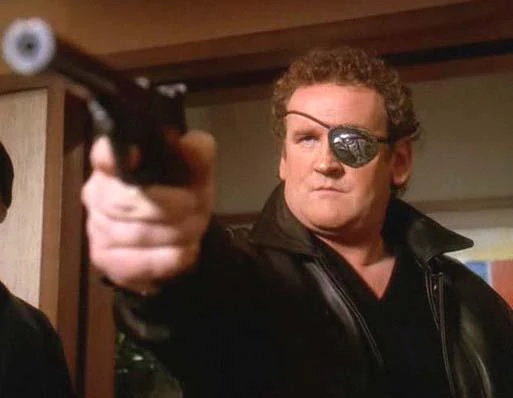
O'Brien get to be a meaney. Get it? Puns are a requirement in Bond-parodies.
Garrak is an interesting companion on Bashir's adventure. We're reminded that Garrak has been the very thing that Bashir wants to be, an intelligence agent. Except Garrak is the real deal. He's infiltrated strongholds. Stolen information from the enemy. Tortured prisoners. Killed without remorse for his country. And he's constantly pointing out the inaccuracy and the lunacy of how espionage is portrayed in Bashir's fantasy. Bashir knows it's silly, and not realistic, he just doesn't care. This is his way to blow off steam and the turn the drama of the Dominion War off for a moment and enjoy himself.

And while Garrak provides kind of anti-Jimminy-Cricket advice to Bashir on how real spies in the real world work, Bashir knows how this fantasy-world works and what's expected of him. The Bond films (and spy television shows) of the era are very much of their time, over-the-top male fantasies with high-tech gadgets and women with both revealing clothing and loose morals. They've evolved into bombastic action films throwing realism out the window in favor of bravado, machismo, and sensationalism.*

More often than not, Star Trek is better at being clever, than funny. And this episode is both a clever look at the spy-genre and ends with a clever twist on it. In order to extend the game long enough for the crew to be rescued — beamed from the holosuite to the Defiant —he presses the big, red doomsday button. He saves the day by letting Dr. Noah destroy the world.

Which is not a thing they taught Garrak about being a spy.

--

Next up, Scotty is accused of murder in 'A Wolf in the Fold.'

*While I loved the Bond films as a kid, they have not aged well. But that's a discussion for another blog.

Thursday, May 21, 2015

#85, Little Green Men, Deep Space Nine, Season 4, Episode 7

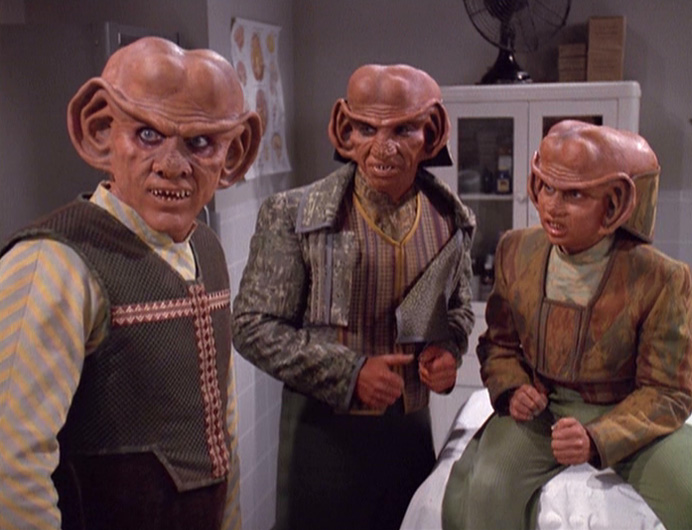
Now's where we hit the cold hard reality of memory versus actuality. I had very fond memories of 'Little Green Men,' where Quark, Rom, and Nog accidentally travel back in time and crash in Roswell, New Mexico, in 1947. Taken to Area 51, they make contact with the primitive natives. The premise is strong, and we get to see our favorite Ferengi try to hustle forties-era humans out of their planet. It's... well... It's not good. At least, not as good as I thought it was going to be.

I'd remembered it being much, much funnier. As I rewatched it, much of the humor in the episode falls more than a little flat. The jokes were expected and could be seen coming a quadrant away. Nostalgia is a dangerous thing. It convinces us that things in the past were good, when, in fact, there's a good chance they were not. I will never look upon the original Battlestar Galactica, A-Team, Dukes of Hazard, the Transformers, or Big Trouble In Little China because there's a zero-percent chance they hold up. This, however, this episode I was really looking forward to. And I was really disappointed.

Quote-hu-mor-unquote.
Maybe it's that Quark and crew are truly at their best when they're ancillary to the story. Maybe it's that this is the second Ferengi-centered comedic episode in the countdown, and much of the goodwill that I felt for Shimmerman's Quark and his compatriots has already been spent on my review of the Magnificent Ferengi. Maybe it's because that episode had Iggy Pop and this one did not. Maybe it's that nothing could possible equate to "Roswell that Ends Well" from Futurama. Both episodes had similar time-travel-to-Roswell-shenanigans, but Futurama did it a bazillion times better.

"Shut up and take my latinum!" — Fry
Maybe it's that funny is really, really hard.

Really.

So, rather than bash on the episode for not being what I remembered it to be (which in all fairness is probably more on me than it), let's accentuate the positive, shall we? Let's talk about how we got Quark from the pilot to this episode and why that's kind of cool. For all the type of bumpy foreheaded peoples in the Star Trek universe, there are few aliens that are really explored in depth. There are only a handful that break out of the monoculture formula. And through the characters of Quark, Rom and Nog, we get to explore a few different aspects of the Ferengi. The three started out as pretty much the same character, and over the course of the series we saw each of them grow into more than their sniveling, greedy, funny-looking species of origin.

'Look who's calling us funny looking. Stupid hu-mon.' — Quark

Quark here, represents the idealized Ferengi. Opportunity, profit, and thrill. Ferengi love negotiating. And here Quark throws caution to the wind, at the mercy (and gunpoint) of a military base, he sets out to conquer their planet, with no weapons, no plan, nothing really to offer. And he does this because he thinks he can. He goes for it with a bravado and fearlessness that's kind of awesome. He seeks challenge in the only way he knows how. In Ferengi society this is referred to as having the 'lobes,' but let's call it for what it is. Giant, giant brass. But throughout the series, Quark is constantly being called out by other Ferengi for not being ruthless enough. Living amongst aliens for so long, he's had to adapt to cultures outside his own, and finally finds a balance between his Ferengi ideals and those of the Federation. That is, until he unceremoniously throws away years of character development in the series finale, but we'll jump off that bridge when we come to it.

Rom, his idiot-savant brother, is far more interested in making things than money. This makes him an outcast. Because he sees more to life than the acquisition of things, he's considered an 'idiot' by his brother. He's clearly not; he's just not wired in the same way that other Ferengi are. Early in the series, Rom was always nipping at Quark's heels. Always scheming to get the bar from Quark. Not because he really wants it, but because he's lost. He's terrible at business. Terrible at negotiation. Terrible at scheming. Terrible at all the things Ferengi are supposed to be. As the character developed, Rom stops being Quark's incompetent shadow, and starts to become his own man. He marries an alien. He gets a menial job on the station, not because it will make him wealthy, but because he loves it. He follows his passions, regardless of what his kin will think of him. Rom went from being a horribly cartoonish background character to an actual person.

Nog starts the series out as Diet Quark. A ne'er-do-well, no-good-nik and a bad influence on Jake Sisko who's sole function seemed to be to create conflict between Jake and his father. He was mean-spirited, willfully ignorant, a liar, and a tiny jerk. School was dumb. Girls were to be opinionless property. Latinum was all that mattered. He was, in essence, the ideal Ferengi in training. As Nog changed, he became more than a foil for the Siskos and came to represent the future of his species. In this episode, he's off to Starfleet Academy. He sees Starfleet was a way for him to better himself. To see something greater. Not because of profit, but because, like his father, he wanted more from life than the acquisition of things. I mean, he still wants profit, don't get me wrong. But perhaps joining a society that has, in effect, no money, may not have been the ideal way to go about doing it. Nog has ambition, but not in the way that his people usually quantified it, making him a new breed of Ferengi.

These characters have changed over the years, and of all the explorations that Trek has done, it's of character that's the most challenging in interesting. The Ferengi are, after all, odd-looking creatures who may appear homogenous, but are far more complex than just their surface appearance might suggest.

Just like the rest of us.

--

Next up, Worf goes reality skipping in TNG's 'Parallels.'

I like to think, somewhere in the infinite number of parallel realities, Michael Dorn is about to write a review of my performance as Lt. Commander Worf.


Friday, January 16, 2015

#88, 'Favor the Bold' & 'Sacrifice of Angels,' Deep Space Nine, Season Six, Episodes 5 & 6

I seem to remember the retaking of Deep Space Nine in Favor the Bold and Sacrifice of Angels as being a big moment in the mythology of the show. When Sisko takes back Deep Space Nine from the enemy. We're deep into a war with the Dominion, and the Federation is losing. Losing territory and ships to a vastly superior opposing force, they're outgunned, outnumbered, and falling into a pattern of attack and retreat.

Lives have been lost. Morale is low. And Sisko has decided it's time for some let's-blow-the-shit-out-of-something-big action. A go-for-broke plan that will strike the heart of the Dominion and provide the Federation with a much needed victory. They have to force a victory, or lose the war. He puts together a task force to take back his former command, Deep Space Nine.

Sone where in this armada, I like to think Picard is making it so.

As I re-watched these, I came to realize that this two-episode arc represent the best and the worst of what Deep Space Nine was. As if they are a microcosm of the series as a whole. The episodes are wildly uneven, oscillating between good and bad almost from scene to scene. Deep Space Nine is a show I like (a lot), but I have to admit that there are some elements that just never clicked for me.

On the one hand, we have Avery Brooks, who, once again, rocks it like a boss. Sisko's a man with his back against the wall, making the hard decisions. He's passionate. Earnest. Bold. And takes zero shit from zero people, aliens, or cosmic beings from another reality.

The Dominion are (with exceptions noted below) the perfect villains for the series. I'd described them in a previous post as a totalitarian anti-Federation. They're everything the Federation isn't. They seek conquest, not exploration. Jeffery Combs' Weyoun is fantastic. The show takes chances, swinging for the fences. When they decided to make the major through line of the show the Dominion War, they went for it. Throughout the series, Deep Space Nine has presented space combat on a scale not seen since the Battle of Endor, and it did it on television. Repeatedly. Certainly not on a scale seen in any other iteration of Trek.

We have great character moments. Miles and Julian bonding. Quark setting aside his self-interest for the greater good. Even Rom shines in a rare instance of not being completely annoying. Also, Worf son of Mogh. 'Nuff said.

And then, on the other end of the spectrum (for the record, the bad one), we have the prophets calling Ben "The Sisko." We have the character known only as Female Changeling, who apparently cannot have a line without saying the words 'solids' or 'great link.' We have Odo's, ugh, love affair with Major Kira, which has always felt forced and awkward. We have the logic problems of both the Bajoran gods and the Dominion changeling rules. And, then, we have Gul Dukat.

Gul Du-fucking-kat.

I swear I got eye strain from rolling them too much every time Gul Dukat was on the screen. I loathe him, but not in the way I'm meant to. He's smarmy, arrogant, self-agrandizing, and speaks with with an almost operatic rhythm — where every sentence builds in volume and intensity and is then followed by a soft coda. Once I identified this, it drove me absolutely mad. Dukat is, perhaps, the Star Trek villain with the most screen time of any other. In fairness, I didn't do any kind of quantitative analysis on that, I'm just going by memory. But holy crap is there a lot of Dukat on this show.

"Was it something I said?" -- Gul Dukat. "Pretty much everything you've ever said, ever, yes." — Me

Over the course of the series, he's been portrayed as a cold-blooded mass murderer, a misunderstood tyrant, a crazy person, a patriot, revolutionary, a cult leader, a messiah, and a vessel to evil gods. And every time he's on the screen, I'm just checking my watch until he's done being terrible. He grates me. He's mustache-twirly terrible. He stands out as cartoonishly broad and over-the-top in a show with alien forehead makeup and spaceships going kler-splode. That says something. He strives to have the gravitas to be Sisko's equal, and the failure at that is palpable. But, they keep using him. And his use keeps giving me eye strain. Ow.

However, the worst part of this particular Niner adventure is that it ends with the most blatant (and literal) deus ex machina you could possibly imagine. Sisko's bold plan has failed. The Federation strike force is unable to break the Dominion lines, except for one line ship, the Defiant. The minefield that has kept the Dominion re-enforcements at bay is taken down. Sisko and the crew of the Defiant sail into the worm hole to face off against two-thousand-plus Jem'Hadar warships alone. Their sailing into their deaths in a hollow sacrifice. They don't even say anythig like, 'we're going to technobabble the warp core and collapse the wormhole so that the Jam'Hadar can't get through and save the alpha quadrant with our noble sacrifice!' Instead, they lock phasers, and calmly accept their own deaths at the hands of alien weapony. Then, the Bajoran Prophets pull Sisko out of his reality and into their temporal dream state.

The interaction with the Bajoran Prophets is just painful. They seem to interrupt the action for the sake of interrupting. Call Sisko "the Sisko" for no apparent reason other than to just annoy me. They ramble about a 'game,' which I infer to mean the writers aren't sure what to do with these alien beings in the long term. They are dismissive of Sisko's needs until he makes an old-fashioned empassioned speech. Sisko begs them for a miracle, and they provide it. The Dominion fleet vanishes from Existence, and the Defiant returns to Deep Space Nine. Sisko and crew return the triumpant heroes to the Station, and the war goes on.

For both good and ill.

---

Next up, it's a trip to the continuum with Déjà Q.