Showing posts with label Top 100. Show all posts

Friday, April 22, 2016

75. The Raven

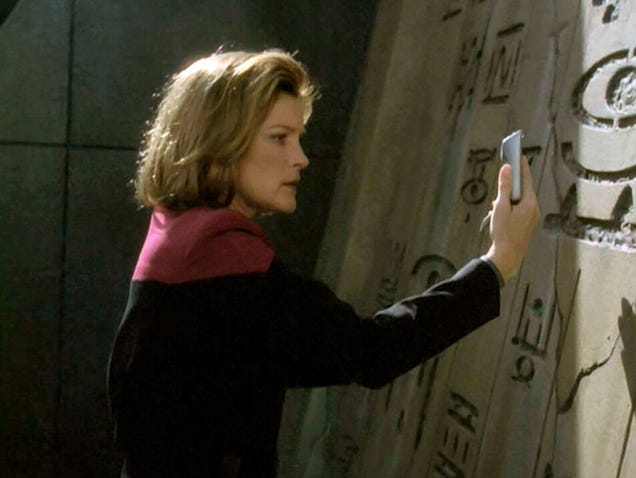
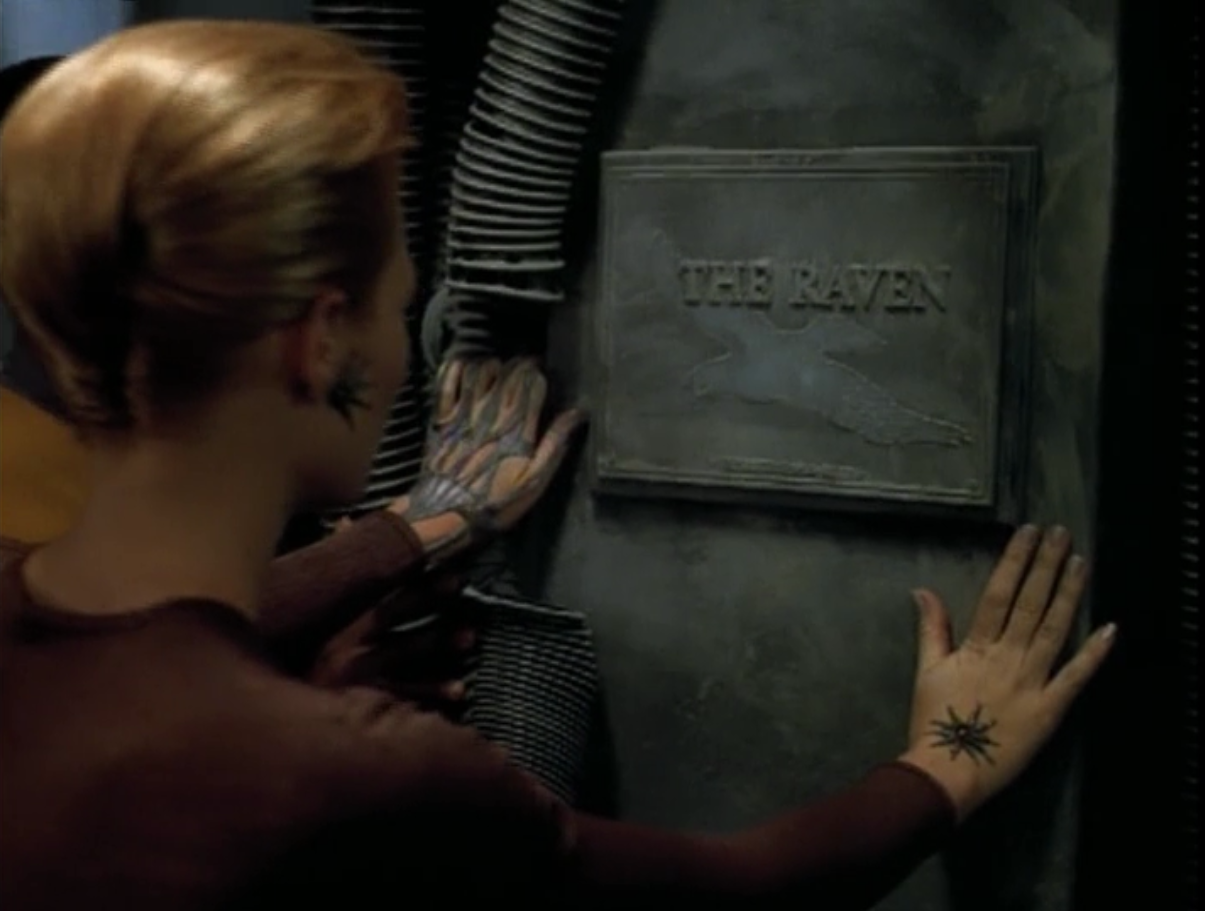
Seven, don't panic, but there's a Borg spider on your hand. Seriously, don't panic. 

75. The Raven, Voyager, Season 4, Episode 6

As you may have noticed, I've strayed from my initial mission statement of reviewing the Top 100 Star Trek Episodes of All Time, as compiled by io9. There is a very good reason for that. I took a job in Japan and one of the many, many differences between the United States and Japan is that Japanese Netflix doesn't have any of the series. In fact, the only two pieces of Trek available to me are Abram's Star Trek and Star Trek Into Darkness. While, I'll get to reviewing those films later, because I cannot stand the vacuum of Trek in my life right now, I wanted to get back on track, with at least this review that I started before I began my journey to the Land of the Rising Sun.

And now, without further ado, let's set course for the Delta Quadrant.

It's a common belief that Seven of Nine, Tertiary Adjunct of Unimatrix Zero One, 'saved' Voyager. I'm not sure that's consistent with fact. I would say that that's more to the presence of the Borg than that particular character. And though the first episode in which she appeared had relatively high ratings, it was the part two of a cliffhanger that found Voyager in the clutches of the Borg. I understand the ratings for the show went back to normal, yet Seven of Nine, Tertiary Adjunct of Unimatrix Zero One, remained pretty much the focal point of the show from the moment she arrived until the series finale.

"Excuse me, my ocular implants are up here." — Seven of Nine, Tertiary Adjunct of Unimatrix Zero One


Up until she arrived, the show had steered away from cheesecake. The show had three prominent female characters and none of them were overly sexualized. Janeway was, for all intents and purposes, Picard with better hair. B'Elanna was portrayed as a smart, strong, if sometimes cartoonishly angry character. And while there was a certain manic-pixie-dreamgirl quality to Kes, she was never really presented as a sex symbol. But Seven of Nine, Tertiary Adjunct of Unimatrix Zero One, was front and center with her silver catsuit, Borg enhancements, and characters inexplicably falling for her despite her being a flat out horrible person. Seriously, Harry, Chakotay and the Doctor all fell hard for her despite her having nothing but contempt for pretty much anyone and everything that wasn't Borg.

I guess that I was supposed to find Seven of Nine sexy. I didn't. This is not because Jeri Ryan did not have a pleasing shape that was squeezed into a skintight catsuit. She did and it was. It was because the character was a terrible person. Arrogant. Rude. Entitled. Mean-spirited. Intentionally unlikable. She was interesting, but horribly unlikable.

Worst of all, her presence changed one of the greatest villains in all of Trek history into being a non-threat. Through her, the Borg became familiar. And that familiarity bred contempt. I'll dig into this a bit deeper when we get to episodes like, I, Borg or Best of Both Worlds, but the Borg were legitimately scary. They were partially scary in that their appearances were scarce. The were a shadow threat that loomed over the Next Generation crew. The creators of the show were wise to keep their appearances few and far between. That is, they were scary until Voyager defeated them left and right using their own technology as an intergalactic cure-all for seemingly every situation. I'd love to see how many episodes were resolved by modifying Borg nanoprobes, because there were a lot. The Borg went from being the embodiment of the loss of self through technology to an irksome nuisance.

While she may be an interesting character, Seven of Nine, Tertiary Adjunct of Unimatrix Zero One,  pretty much guaranteed that any chance Voyager ever had from getting out of TNG's shadow was nil. They essentially assimilated the Borg into their cast. Don't get me wrong, I do like Voyager, and there are some great episodes on this list yet to explore. But Seven of Nine, Tertiary Adjunct to Unimatrix Zero One's addition to the cast was a fundamental shift in the show's dynamic, and I'd argue not for the better.  She became the show's new toy. Janeway was constantly trying to explore her humanity, and teach her about the importance of her free will outside the Borg Collective. I'll skip over the painful, painful irony of Janeway denying Seven's choice to rejoin the Collective because she's trying to get the former Borg to understand the concept of freewill. Over the next few seasons, their mentor-student relationship became tiresome and repetitive.

With the Raven, we get a little bit more about her backstory, and how as a child she was assimilated and raised by the Borg. A mysterious signal triggers something in her brain and she is driven to rejoin the Collective. As she traces the source of the signal what we find is the wreckage of her parent's ship, The Raven. This is where Anaka Hansen was filled with robot parts and had everything she was carved away and turned into a microscopic cog in the infinite machine that is the Borg Collective.

We're even robbed of the connection between Janeway and Seven in the resolution. And in the end, it's Tuvok, not Janeway, that shares the moment of her repressed memories of her assimilation being unleashed. Seven has a breakdown, and it reveals that Ryan's acting chops are far more suited to standing still and hating people while looking good doing it than trying to show a genuine emotion. She's clearly pushing herself as a performer, but the scene is awkward and forcing too much down our throats in terms of emotional connection to the character.

From her facial expression, I'm pretty sure Ryan can smell the clunkiness of this scene. 
This is supposed to make her sympathetic, but I felt it was too rushed. Like we're checking off a box with Seven's origin, rather than getting to a place where her origin mattered. I would have much preferred to see her explored a bit more and see a bit of her PTSD creep in over the course of a season before we rush to her origin story. This was just a few episodes after her debut, and if Janeway and crew had a better chance to care about her, her drive to rejoin the Borg would have had more weight. This would also have given the audience to better understand Janeway's drive to maintain Seven's humanity. If she cared about her as a person rather than as an intellectual and ethical exercise in preserving one's individuality. 'Assimilated as a child' is all we really needed to know about her backstory, and while this episode fills in the gaps to her tale, it doesn't have the emotional resonance that I would have expected from one of my favorite Trek and TV writers and personal heroes, Bryan Fuller.

As she evolves and develops her human side, there are great moments with Seven of Nine throughout Voyager. This is just felt too much too soon.

--

Next up, we take a trip to a museum dedicated to the most ruthless villain in Trek History, Katherine Janeway, with 'Living Witness.'

Monday, August 3, 2015

76. A Wolf In the Fold

Subtlety, thy name is Star Trek

76. 'A Wolf in the Fold,' The Original Series, Season 2, Episode 14

I had almost no memory of 'A Wolf In The Fold' when I started watching it. This episode doesn't hit my list of my personal favorites from the Original series and it hasn't risen up though the ranks of pop culture consciousness in the way that, say, one with the Gorn or the Tholian Web have. So, I was able to come into this episode with relatively fresh eyes. And what we see here is the TOS taking a stab at psychological thriller with a scifi twist. Pun intended.

On an alien pleasure planet, Argelia, where Scotty is accused of murdering women. He's literally caught red-handed with a dead body in one hand and a bloody knife in the other. He has no memory of the crime, and professes his innocence. We have here a haunting coming from the mind of the man who wrote Psycho, Robert Bloch. If that is a pedigree for exploring psychological horror, I don't know what is.

As Scotty maintains his innocence despite ridiculous evidence to the contrary, the true murderer reveals itself to be an energy being that hops from host-to-host killing women and feeding off their fear to sustain itself. Scotty was just its latest vessel on the planet at it hacked it's way through the populous. It revealed itself to be an entity that has traveled from system to system, and took credit for countless murders, and had even visited earth in the past, and that's pretty much where this passable mystery to just third-act nonsense.

You see, I've been doing my best to review the Original Series for what it is, but that's not always easy. This episode had great potential. It had a great setup, flamboyant guest stars, an interesting (and edgy for the time) alien culture that mixed hedonism with mysticism. My issue here isn't with any of the usual low-hanging-fruit complaints about the series — the stylized acting, or the limitations of the budget, or the undercurrent of blatant sexism that permeates the 60s — but the inclusion of Jack the Ripper.

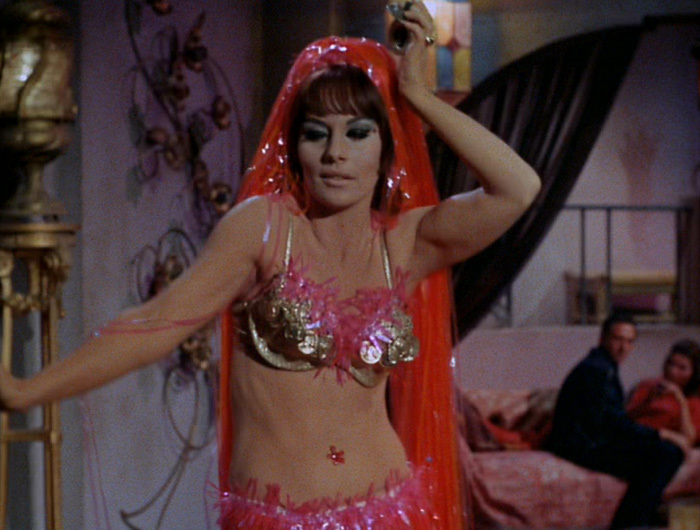
Seriously, every Argelian looked as if they stepped right out of a victorian-era magician's poster.
When the alien entity reveals itself as Jack the Ripper, it lost me. It's weirdly out of place, and seems only to exist to give the audience some kind of context for the entity. But it misses the mark. It's forced. And when the entity leaves its host and takes control of the Enterprise, it goes from weird to worse. A being that lives on terror and fear takes over one of the greatest military weapons ever built by human hands. But what should be terrifying comes across as silly. McCoy gets the crew so doped up to keep them from feeling fear and feeding the entity they sway and giggle at their stations. At that point, I'm just waiting it for 'A Wolf in the Fold' to end.

This is supposed to be about Scotty, but it's not. For an episode focused on the chief engineer, all we really learn about the character is that he can creepily leer at women, and doesn't really give a fig about local customs. We learn that Kirk is fiercely loyal to his crew. We learn that Spock has some weird opinions on the emotions of women. We learn that McCoy has a metric f-ton of drugs aboard the Enterprise, and is not afraid to use them.

"Hey, man, an alien murder thing has, like, control of the ship? Like, groovy, man." — Sulu
Now, I feel like I've just been bashing the Original Series in my last few reviews on this list* and I want to acknowledge that that's not really my intent. They just haven't connected with me.  I have great respect of the Original Series, its creators, its vision, its legacy, and the fictional world it created. The character dynamics of Kirk, Spock and McCoy are among the strongest, and smartest in the history of not just television, but all of storytelling.

But for this adventure, what's the message here? Trust each other? Kirk's always right? Scotty objectifies women? I'm not sure. For me, 'A Wolf in the Fold' lacks a strong central theme that elevates other classic episodes above the limitations of the show.

There are adventures of The Original Crew I love with all my heart. This just wasn't one of them.

--

Next up, Seven of Nine, Tertiary Adjunct of Unimatrix Zero One, faces her past in 'The Raven.'

*A reminder, that this isn't my list, but io9's Top 100 Episodes of Star Trek of All Time.

Sunday, June 7, 2015

#83, Timeless, Voyager, Season 5, Episode 6


An episode so time-travely they borrow Doctor Who's time vortex. 
In this episode of Voyager we get a glimpse of an alternate future, where an aged Harry Kim and Chakotay travel fifteen years back in time to undo a mistake that cost the crew of Voyager their lives. They're gruffer and grayer than we know them. They've turned their backs on the Federation, committed treason, stolen a ship and a piece of rare Borg tech, and are racing against the clock to send a message back in time to save their crew. Also, they have Captain Geordi LaForge, commanding the Galaxy Class starship Challenger, on their tail.

Harry and Chakotay have a confederate in this. Chakotay's girlfriend, Tessa, who's perfectly willing to die to help Chakotay. She faces death at the hands of the Challenger's torpedoes with a kind of blasé attitude that makes on wonder what kind of effed up relationship she has with Chakotay. Throughout Trek in it's many incarnations, there's this kind of detached calm when things are blowing up around people. Seriously, next time you watch an episode look for the 'I'm-just-doing-my-job' attitude that comes from extras and guest-stars in the show. It's kind of eerie. Tessa goes about her business as if changing time and exploding are perfectly normal.

The best moment in 'Timeless' comes at the beginning, when Voyager crashes into a planet and gets engulfed by a glacier. For a show (and series) where a lot of space action happens off screen to save money (i.e. holding on Tom Paris, for example, when he announces, "The enemy is exploding. It's spectacular! I wish you could see this!"), it's nice to see a big moment in the show. The crash looks great, and the special effects hold up well lo these many years later. The image of Chakotay and Harry, decked out in space parkas finding the englaciered Voyager is well done, and immediately sets up a the mystery. And like every mystery in the post-Seven-of-Nine era of Voyager, it's solved by Borg-technobabble. Considering how effing magic the Borg's technology is, it's astounding they haven't conquered the galaxy yet. More on that later when we get to more Borgy Voyager adventures later in this countdown.

'Let it go. Let it go.' — Elsa Janeway

Also, it's nice to see that Geordi gets a promotion to Captain in the future. It's always a treat for me when the series cross over with one another, even if it's for a glorified cameo. Although, for whatever reason, it looks like Geordi is commanding his ship from his ready room. I'm going to guess that reason is budgetary. It's a nice reminder that Voyager, despite it's premise of being lost thousands of lightyears away from home is still part of the larger fabric of Trek mythology. I've never been a fan of the extended universe for Trek. I've read a few of the novels — don't judge, I went through massive withdrawals when TNG went of the air — and find them lacking. None of the video games have ever caught my attention. So, it's fun to get to see where the next generation Enterprise crew land in the future, and fill in some of the gaps between the end of the series and 'All Good Things.' It carries massive good will to Voyager for me, and fills in the connective tissue of the universe.

"Though you might be tempted, don't read Star Trek novels." — Captain LaForge of the U.S.S. Reading Rainbow

Now, if there's one thing that Voyager, as a show, can do, it's ignore the crap out of temporal paradoxes. I'd love to see a quantitative analysis if the show, breaking down the number of episodes that deal with mucking with time as a concept. We've seen two in this list alone just from Voyager. A quick look at the list, and we've got another 15 or so that deal with time travel, or alternate timelines in some capacity, not counting any Temporal Cold War shenanigans from Enterprise. And in this episode, logic gets shoved right out an airlock as Harry and Chakotay race against the clock to save Voyager in the past. When they succeed in sending their message back in time, they erase the timeline that enabled them to save Voyager. Janeway even shrugs off the paradox with an "Eh, fuck it. Time paradoxes. What you gonna do?" I'm paraphrasing the captain, of course, but that's the gist of how 'Timeless' ends.

Then, we have a message from elder Harry Kim from an alternate future addressing his former self, and letting him know what his hubris might have cost the crew. Time logic problems aside, I wish the moment had had more gravitas. Part of the problem with putting our heroes outside their norm is that we don't get to see these new incarnations of the crew fully fleshed out. As elder Harry Kim, actor Garret Wang growls his way through the episode and I never got the sense that he was playing the truth of his situation. There are hints of PTSD and survivor's guilt, but the episode also has to shove in space battles and slip-stream-drive-technobabble, too. This truncates the character moments, and making me wish we had more time with this reality.

If there's a reoccurring theme in the episodes that I've seen on this list, it seems to be taking our characters out of their normal roles and throwing them in a situation, environment or timeline they find wholly out of the norm for a crew of a starship/space station. We've seen it in 'Parallels,' 'Little Green Men,' 'Bride of Chaotica,' 'The Killing Game,' and 'Future's End.' I'm making an observation, here, not a judgement, but that's almost a third of the episodes on the list so far. I can see the appeal from a creative standpoint. It shakes things up both for the audience and the writers and performers.  I'm going to keep an eye on this trend as the countdown continues, but for now, I'm just going to welcome 'Timeless' to that list.

--

Next up, the crew of the Enterprise-D face a 'Conundrum.'

Saturday, May 9, 2015

#86, Memorial, Voyager, Season 6, Episdoe 14

It's been too long since I journeyed — trekked if you will — back to the Delta Quadrant. I realize now that it's been a while since my last trek-realted post, and for that, I apologize, dear readers. But life gets in the way. Work took a weird turn. I directed a web series due out next month, Assassin Nine and have been busy in post. Designed a card game. Had to vent about Batman V Superman: Dawn if Justice. Which brings me to 'Memorial,' and my general dereliction of duty. But now, I'm back to it, with the latest in the Top 100 episodes of Trek according to io9 fan poll.

I had watched 'Memorial' weeks ago when I first set down to write this entry, and, well, nothing stuck. This is the second time I've watched a Voyager episode in this countdown and came away going, "Yeah, okay, fine, whatever, that happened." So, for a second time, I had to wonder if there's something in this episode that I missed. And as it gnawed at me -- what's the deal with this episode, why have fans dubbed it worthy to be on this list -- I think the point of the episode is that sometimes there is no clear answer. Voyager takes on a heavy, complex topic, but because this is a space-adventure show, it comes at it a bit sideways.

"Ugh, get on with it, already. Seriously." — Tom Paris

Tom, Harry, Chakotay and Neelix are returning from a weeks-long mission aboard the Delta Flyer. When they return to the ship they start having vivid and violent dreams about an armed, alien conflict, where they were participants. These visions go from being dreams to waking nightmares where the characters can't tell the dream from reality. Tom has a breakdown in his quarters. Neelix takes his goddaughter hostage in the mess hall. And the whatever-it-is starts to spread throughout the crew. Nightmares and visions of a way no one had fought. Even Janeway starts to feel the effects of the dreams.

As they follow the mystery and backtrack the Flyer's path, they discover an alien beacon, showing a massacre from their history with the events beamed directly into passerby's brains. They find an alien obelisk on a planet, a memorial to the event that happened centuries ago. Anyone in range relives the firefight, so that it's never forgotten.

The show tries to dive into the moral complexity of war. Showing a military police action forcibly removing colonists from their homes, and things get out of hand. The colonists fight back and someone opens fire and violent higgledy-piggeldy ensues. Other than the commander of the military rigidly following orders (which those types are wont to do) and being a dick about it, there's no clear right or wrong here. It's just people caught in the middle of a difficult situation that has spiraled out of control.

Through the characters, they explore PTSD, with Tom, Neelix, and Chakotay playing the roles of soldiers retuning from duty and trying to re-assimilate back to normal life. Tom comes home to his wife, who greets hm with beer, popcorn and television (literally). They fight. Harry returns to work, and finds tasks that should have been routine, horrifying. Neelix has a complete psychotic break and takes the aforementioned hostage, forever changing his relationship with his goddaughter, Naomi. All of this is pretty heavy stuff coming from a show with space lasers, a woman in a silver catsuit, and a Neelix.

"Don't worry, Naomi! I'll protect you from the nothing!" — Neelix

Let's talk about Nelix. Much of my initial reaction to Nelix as a character was responding to his aesthetic. He, like Quark on DS9, is the alien outsider, an excuse to exposit on the state of humanity in the 24th century. Like Quark, his appearance is over-the-top, clownish among the predominantly black uniforms of the rest of the crew. Initially, I didn't care for him. His make-up and faux-hawk hair were on the side of the ridiculous. But past his leopard-goldfish-bulldog appearance, I do like the character. He's charming, optimistic, and brings a bit of color both metaphorically and physically to the show. Ethan Phillips has to do a hell of a job acting through that makeup job, and when he emotes, it can come across as silly. Not here, though. Here, his pain and fear come off as real as a man in a leopard-goldfish-bulldog mask can.

As the crew finds the obelisk, they spend a hot second wondering whether to turn it off. To prevent others from suffering the same fate as the crew. Their decision to leave it be, at first feels like a cop out. Janeway passing the moral buck because it's not her decision to make. But, it's not. And her leaving the memorial be is the right thing to do, so that the pain and loss of the massacre won't be forgotten. The episode is a bit ham-fisted, but sometimes Star Trek is what it is, a space-adventure show.

'Tricorder is reading high-doses of heavy-handed dialog. The OTN readings are off the charts." — Janeway

Star Trek likes to ask the tough questions. Memorial shows that those tough questions don't always have answers.

--

Next up, we're off the Roswell, New Mexico, for one of my favorite episodes of Deep Space Nine, 'Little Green Men.'


Friday, January 16, 2015

#88, 'Favor the Bold' & 'Sacrifice of Angels,' Deep Space Nine, Season Six, Episodes 5 & 6

I seem to remember the retaking of Deep Space Nine in Favor the Bold and Sacrifice of Angels as being a big moment in the mythology of the show. When Sisko takes back Deep Space Nine from the enemy. We're deep into a war with the Dominion, and the Federation is losing. Losing territory and ships to a vastly superior opposing force, they're outgunned, outnumbered, and falling into a pattern of attack and retreat.

Lives have been lost. Morale is low. And Sisko has decided it's time for some let's-blow-the-shit-out-of-something-big action. A go-for-broke plan that will strike the heart of the Dominion and provide the Federation with a much needed victory. They have to force a victory, or lose the war. He puts together a task force to take back his former command, Deep Space Nine.

Sone where in this armada, I like to think Picard is making it so.

As I re-watched these, I came to realize that this two-episode arc represent the best and the worst of what Deep Space Nine was. As if they are a microcosm of the series as a whole. The episodes are wildly uneven, oscillating between good and bad almost from scene to scene. Deep Space Nine is a show I like (a lot), but I have to admit that there are some elements that just never clicked for me.

On the one hand, we have Avery Brooks, who, once again, rocks it like a boss. Sisko's a man with his back against the wall, making the hard decisions. He's passionate. Earnest. Bold. And takes zero shit from zero people, aliens, or cosmic beings from another reality.

The Dominion are (with exceptions noted below) the perfect villains for the series. I'd described them in a previous post as a totalitarian anti-Federation. They're everything the Federation isn't. They seek conquest, not exploration. Jeffery Combs' Weyoun is fantastic. The show takes chances, swinging for the fences. When they decided to make the major through line of the show the Dominion War, they went for it. Throughout the series, Deep Space Nine has presented space combat on a scale not seen since the Battle of Endor, and it did it on television. Repeatedly. Certainly not on a scale seen in any other iteration of Trek.

We have great character moments. Miles and Julian bonding. Quark setting aside his self-interest for the greater good. Even Rom shines in a rare instance of not being completely annoying. Also, Worf son of Mogh. 'Nuff said.

And then, on the other end of the spectrum (for the record, the bad one), we have the prophets calling Ben "The Sisko." We have the character known only as Female Changeling, who apparently cannot have a line without saying the words 'solids' or 'great link.' We have Odo's, ugh, love affair with Major Kira, which has always felt forced and awkward. We have the logic problems of both the Bajoran gods and the Dominion changeling rules. And, then, we have Gul Dukat.

Gul Du-fucking-kat.

I swear I got eye strain from rolling them too much every time Gul Dukat was on the screen. I loathe him, but not in the way I'm meant to. He's smarmy, arrogant, self-agrandizing, and speaks with with an almost operatic rhythm — where every sentence builds in volume and intensity and is then followed by a soft coda. Once I identified this, it drove me absolutely mad. Dukat is, perhaps, the Star Trek villain with the most screen time of any other. In fairness, I didn't do any kind of quantitative analysis on that, I'm just going by memory. But holy crap is there a lot of Dukat on this show.

"Was it something I said?" -- Gul Dukat. "Pretty much everything you've ever said, ever, yes." — Me

Over the course of the series, he's been portrayed as a cold-blooded mass murderer, a misunderstood tyrant, a crazy person, a patriot, revolutionary, a cult leader, a messiah, and a vessel to evil gods. And every time he's on the screen, I'm just checking my watch until he's done being terrible. He grates me. He's mustache-twirly terrible. He stands out as cartoonishly broad and over-the-top in a show with alien forehead makeup and spaceships going kler-splode. That says something. He strives to have the gravitas to be Sisko's equal, and the failure at that is palpable. But, they keep using him. And his use keeps giving me eye strain. Ow.

However, the worst part of this particular Niner adventure is that it ends with the most blatant (and literal) deus ex machina you could possibly imagine. Sisko's bold plan has failed. The Federation strike force is unable to break the Dominion lines, except for one line ship, the Defiant. The minefield that has kept the Dominion re-enforcements at bay is taken down. Sisko and the crew of the Defiant sail into the worm hole to face off against two-thousand-plus Jem'Hadar warships alone. Their sailing into their deaths in a hollow sacrifice. They don't even say anythig like, 'we're going to technobabble the warp core and collapse the wormhole so that the Jam'Hadar can't get through and save the alpha quadrant with our noble sacrifice!' Instead, they lock phasers, and calmly accept their own deaths at the hands of alien weapony. Then, the Bajoran Prophets pull Sisko out of his reality and into their temporal dream state.

The interaction with the Bajoran Prophets is just painful. They seem to interrupt the action for the sake of interrupting. Call Sisko "the Sisko" for no apparent reason other than to just annoy me. They ramble about a 'game,' which I infer to mean the writers aren't sure what to do with these alien beings in the long term. They are dismissive of Sisko's needs until he makes an old-fashioned empassioned speech. Sisko begs them for a miracle, and they provide it. The Dominion fleet vanishes from Existence, and the Defiant returns to Deep Space Nine. Sisko and crew return the triumpant heroes to the Station, and the war goes on.

For both good and ill.

---

Next up, it's a trip to the continuum with Déjà Q.

Monday, November 24, 2014

#92, The Magnificent Ferengi, Deep Space Nine, Season 6, Episode 10

"Look, brother! Hu-mons!" — Rom

Quark lives his life by a different set of values than the rest of the DS9 regulars. His vision is clear, earn latinum by any means necessary (provided that it's not in conflict with self preservation, of course). He's constantly evaluating risk and reward for his schemes, and gets as much thrill out of the execution plans as the profit itself. He's smart. He's proud. He's a brilliant negotiator and knows the Rules of Acquisition by heart.

In the opening of this episode, he's just pulled off one of the aforementioned brilliant negotiations — piecing together bits of obscure information to learn that a merchant is hoarding precious goods to drive demand up, and uses that information to blackmail the merchant into giving him a large quantity of precious cargo. Space syrup or something. Quark's trying to celebrate by laying out his scheme in detail for anyone who will listen. But nobody's is listening. Bashir and Dax just got back from a secret behind-enemy-lines mission against the Dominion and Quark's tale of cunning and profit is overshadowed by more, shall we say, conventional acts of heroism.

In the eyes of the his people, what's he's just done is masterful. Epic. Heroic. Quark knows he's a bad ass, even if the rest of Deep Space Nine don't see it. His ego is bruised, unsure why his heroic act isn't viewed in the same light as the Starfleet covert mission. Remember when I said Quark was proud? Yeah, this starts to eat at him.

"Why won't any one take me seriously? Is is the suit made from pimp curtains? It's probably that." – Quark

Why can't the Ferengi get any respect from the Federation types? Why are they dismissed? Isn't the Ferengi Alliance an empire on par with the Klingons, the Romulans, or the Federation? So, when Quark learns that his mother has been kidnapped by the Dominion, he decides that instead of hiring alien mercenaries to pull off the rescue it should be a Ferengi-only tactical mission. Quark believes that Ferengi are every bit as formidable as the aforementioned Klingons, Romulans, and Federation. And why should be not believe that? The Ferengi are smart, cunning, ruthless, and driven with vast resources and powerful warships.

Hilarity ensues.

No, seriously, this is a fun episode. Quark puts together a rag-tag team of Ferengi warriors and his team is a mix of old and new Ferengi faces. Rom is the first to join. Nog is eager to use his Starfleet training to coordinate the military effort. There's a guy who likes explosions. Quark's cousin, I think. And their former foil, Brunt played by the great Jeffery Combs.

Together, they make an ineffectual commando team in training, so Quark relies on what the Ferengi do best. Negotiation. They decide to exchange a captured Dominion Vorta, for Quark's mother and things get complicated when they accidentally shoot their prisoner before they can make the exchange.

What's interesting here is the episode mirrors the fate for the Ferengi in the mythology of Trek.  They were supposed to be the nemesis of the Next Generation. The new Klingons. Perhaps it was their production design or their early portrayals, but as the Next Generation progressed, the Ferengi went from credible threat to cartoonish foils. And that's kind of what happens in this episode. Quark sets out to put together a team of Ferengi commandos, but it degenerates into playing for laughs as the traits of greed, self-interest and backstabbing set in.

There's a lot of things that may have been funnier on the page than in execution, but it's an amusing episode. Quark's role is as a foil and to provide an outsider's perspective on the Federation. This episode provides some much-needed comic relief in an otherwise dark time for Deep Space Nine crew. Quark, Nog and Rom are fine as flavor, but when the entire episode is Ferengi-focused like this one, it can be a bit much. It's entertaining, but not my favorite Quark-centered adventure. That's coming up later in the countdown in "Little Green Men."

Also, Iggy Pop is in this episode as a street-walking Vorta with a heart full of napalm.

The runaway son of a nuclear warp bomb.
And his performance is fantastic. So, I can't really complain about that.

--

Next up, the Voyager crew are hunted for sport by alien-Nazis in the two-part "The Killing Game."

Sunday, November 9, 2014

#94, Disaster, The Next Generation, Season 5, Episode 5

 'Disaster,' the second entry on Top 100 from the Next Generation, is fine example of a bottle episode. When a collision with an interstellar technobabble something or other (a quantum filament) causes an accident that incapacitates the Enterprise, the crew struggles to get back control before the ship explodes.

The Enterprise in 'sleep' mode. 

I should note that this episode was written by future Battlestar Galactica mastermind, Ronald D. Moore. The focus here is entirely character driven, and on putting these characters in unfamiliar territory. Situations counter to their nature. Captain Picard has to lead a group of children. Worf has to guide a woman through childbirth. And, the situation with the potential for the most disaster, Troi is put in command of the Enterprise.

Captain Picard has promised the winners of the Enterprise children's science fair a special tour of the ship. Picard, who in the pilot of the series stated that he's uncomfortable around children, is forced to get in touch with his paternal instincts and lead the children through the disaster. Throughout the episode, Picard has to adjust to leading children, something he admits to having little experience. By the end of the episode, he's bonded with these children. Effectively overcoming his admitted awkwardness with kids. Which means, by the end of the episode Picard is now without any weaknesses whatsoever. Because he is awesome.

When the accident happens, a redshirt bridge commander -- who we've never met before — bites it, and leaves Troi in command. Troi, it turns out, has the rank of Lieutenant Commander. This is not a thing that comes up often. Or, well, ever. Usually her role in the show is to state the obvious or move the plot forward. Here she's got to and she transitions from a position of uncertainty, blindly taking suggestions from O'Brien and Ensign Ro, to making command decisions that saves the lives of everyone on the crew.  But she does so on nothing but blind luck.

With no section of the ship able to communicate with any other part of the ship, their plan to save the Enterprise is dependent on someone alive in engineering able to reactivate the antimatter containment field saving the ship. Ro pushes for Troi to separate the saucer section and save everyone they can. And pushes hard. Troi refuses, wanting to give everyone the best possible chance to survive.

Troi is running entirely on faith, with no evidence that there's anyone else alive on the ship. Why she can't sense them is a convenient oversight in the story. But it's the convenience of her being right that kind of irks me here. There's an infallibility to the crew that cuts out the dramatic tension. And though there was never any real threat of the Enterprise blowing up, the only real consequence is the aforementioned redshirt. Everyone does the right thing in this episode. And every decision is validated with success. Fortunately, Riker and Data's head (see the episode, it'd take too long to explain) make their way to Engineering just in time, and everyone gets a mega-happy ending.

"Where is my happy ending, Counsellor?" — Data

Marina Sirtis does a good job of showing someone completely out of her element finding confidence in their decisions. When she finally takes control she does with as much gravitas as she's able.

And Worf delivers a baby in Ten Forward. Hilarity ensues.

My Favorite Moment in the episode... When Picard meets the winners of the children's science fair, he asks them about their experiments. The youngest of them had the strangest, and most awesome response. The boy said, "I planted radishes in special dirt and they came out all weeeeird." Complete with maniacal grinning and finger steepling. Aaaaannd, what? What the hell kind of mutant soil are they letting kids play with? What the hell kind of kid would want to do that? What the hell, Next Generation? Maybe growing up on a starship warps kids in ways we can't possibly imagine. During the episode, when Picard is trying to boost morale of the kids by assigning they ranks in their small crew, he appoints the kid the Executive Officer in Charge of Radishes.

It's a position that will not turn out well for any radish on board.

--

Next up on the list, Voyager's two-part 'Future's End.' Voyager travels back to the distant past in the 1990s and the villain is Ed Begley, Jr. If that doesn't sound like a recipe for success, then...

Okay, I have no idea how to finish that sentence. 

Saturday, November 1, 2014

#95, The Most Toys, The Next Generation, Season 3, Episode 22

Here's the first entry for The Next Generation on the list, with 'The Most Toys.' I'm not unbiased here. The Next Generation is my Trek.

What's Klingon for 'Boo-yah!'? 

I think of Season Three of TNG as the season where the show found its legs. When it got it's space-crap together. When they ridded themselves of the zipper onesie, moved past left-over Phase II scripts, and started to get out of the shadow of The Original Series. There were hints of greatness throughout the first two seasons. Notably, 'Measure of a Man,' (later in the countdown), 'Matter of Honor' (which holds a special place in my heart because it may be the first episode of Trek I ever saw), 'Elementary My Dear Data,' 'Q Who?' and 'The Emissary.' But Season Three is, in my mind, when The Next Generation started to click.

Then, I re-watched 'The Most Toys.' On the whole, it's not a bad episode, but suffers from the production design. The sets, makeup, and costumes for the alien baddie Kivas Fajo and his crew have not aged very well. And in instances, look downright silly.

"Why, whatever are you saying?' — Kivas Fajo

However, if my gushing over seeing Brent Spiner as Dr. Soong in the three-part Khan-fest on Enterprise wasn't enough of an indicator, Data is one of my favorite characters in all of Trekdom. And there's a whole lotta Data in this episode. And the interchanges between Data and his captor are well-written.

An insanely wealthy, and amoral monster who is obsessed with unique artifacts throughout the galaxy. He's a collector who's private museum includes the Mona Lisa, a bird-thing that's thought to be extinct, a Joe Dimagio baseball card (complete with gum), and now, the universe's only known sentient android. He went through this ridiculously complicated scheme to kidnap Data, convince his crewmates that he perished in a shuttle accident, and put Data in his personal museum of one-of-a-kind object d'arts.

Meanwhile on the ol' 1701-D, as they with Data's passing, the rest of the crew start to realize that something was wrong with the accident and they hunt for the truth behind what happened to Data.

Data and Fajo go back and forth about the morality of keeping a sentient being as property. About passive resistance. About his personhood. About his rights as a living being, even if he is an artificial one. It would make a nice companion episode to 'Measure of a Man.' Spiner let's Data play in the quiet moments when he's alone with the other Exhibits. Playing with the alien bird-thing or trying to imitate Mona Lisa's smile.

Sentient Android, mint in box. 
Here's the thing I observed about Kivas Fajo. He's written as a stone-cold sociopath. His actions are taken without any consideration of anyone but self. He's insanely wealthy, and keeps his servants in line with the threat of torture and death. He kills on a whim and is single-minded in his mission to subjugate Data and bend the android to his will. Sit in the chair, android. Do as your told. Entertain me and my guests. This is your life until I tire of you and then put you in storage. I extrapolated that last part. Once he's stopped, in the Enterprise's brig for  he even promises to one day own Data again, as if the whole incident was a mere inconvenience to his obsession of possession. On the page, Fajo could be terrifying.

But he's not. The way he's played is effeminate, flighty, and flamboyant. He comes across as a spoiled brat rather than a threat. It's distracting from the weightier conversation of Data's newfound status as a slave in this man's private collection and the lengths to which Data must go to regain his freedom. And it's kind of disappointing, because there's a lot of good dialog here, undercut by a directorial choice. Data comes within milliseconds of vaporizing Fajo with an illegal disruptor as the only way out to not only free himself, but Fajo's other servants as well.

Throughout the episode, Data attempts passive resistance, trying to adhere to his Starfleet training and ideas. But when faced with the choice between slavery and freedom at the price of violence, he makes the latter choice. The only thing the stops him from that act a chance teleporter from the Enterprise that beams him to the safety of the ship. Data goes back to his duty, with only him knowing how close he came to killing someone.

It's a moment his crewmates never see — a super-intelligent machine who's made the decision that his survival is necessitated by the logical choice to override his programmed ethics and kill.

And it's a great moment, in an otherwise uneven episode.

--

Next up, #94 in the Top 100 Episodes of Trek of All Time. An accident leaves Troi in charge and it's a 'Disaster.' Season 5, Episode 5 of the Next Generation.

Troi-centric episodes are usually a warning sign, but I remember this one being not bad. We'll see.

Thursday, October 23, 2014

#96, Lineage, Voyager, Season 7, Episode 12

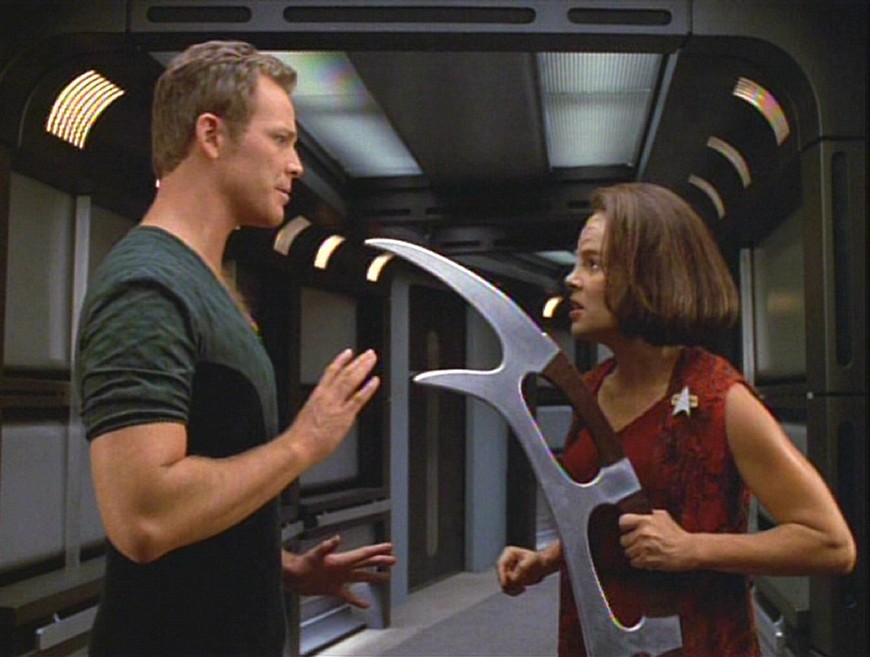
"You don't have to bring a Bat'leth to every argument, you know." — Tom Paris
Our second episode of Voyager in the countdown of the Top 100 Episodes of Trek, and the second one that is Klingon-centric.

Your enjoyment of this episode is entirely dependent on whether or not you like the characters of Tom and B'Elanna. Because pretty much all this episode is, is a character study of those two and their relationship. Particularly B'Elanna, and her self-loathing of her Klingon half.

Your milage may vary, but, I like them enough to find this episode really interesting.

B'Elanna discovers she's pregnant and upon her medical exam, comes to find that there's a complication with the pregnancy. The child has a degenerative spinal disease, passed down from her Klingon side. The Doctor can alter the child's DNA, removing the Klingon genomes causing the disease. And once she realizes that she can remove any trace of her Klingoness from her child, B'Elanna goes to a dark, dark place.

For someone who has always struggled with their mixed heritage, everything B'Elanna went through as a child — her being ostracized for her alien half, her feeling guilt for her father leaving her and her mother — she projects onto her unborn child. Her solution is extreme, to the have the Doctor rewrite the child's entire gene sequence and remove any trace of Klingon. When she learns that doing so would potentially change her daughter's personality, and entire being, B'Elanna pushes anyway. And when the Doctor refuses, B'Elanna goes so far as to reprogram the Doctor to comply (the implications of which is terrifying).

In addition predicting cellphones with the communicator, Trek also predicted the selfie? 
What they're talking about in this is the ethics of genetically modifying a child in the womb before birth. How far can you change someone before they stop being themselves? How far is too far? Where is that line? Who decides where that line is? What say does the father have? The questions proposed is not a subtle one. And, let's be clear, the episode is heavy-handed for sure. But they're tough questions. B'Elanna's diving into dangerous waters, tampering with the DNA of her child with unknown consequences, changing the fundamental personality of one of her shipmates to get what she wants.

The episode demands more of Dawson and McNeill as actors than perhaps any other Voyager episode. Are they up to the task? I'm going to say, mostly. Dawson's B'Elanna usually doesn't have more to do than growl in frustration and stomp around engineering. Granted, she does occasionally smile. But here... she pushes herself as a performer to make B'Elanna's plight sympathetic, and not just, well, crazy. McNeill has to set aside his imitation-Kirk-swagger to try and convince B'Elanna not only of the beauty of their child, but her own beauty. Their relationship has felt forced at times (I even recall an episode where the impetus for their relationship may have been the alien influence), but here it comes across as honest. Tom does love her. He does believe that B'Elanna is beautiful, not despite of but because of her Klingon side. Because it's who she is, and he loves who she is.

There's some klunkiness as the episode finds other things for the rest of the crew to do. Neelix wants to be the godfather. The Captain weighs in on the fact that she can't really weigh in because it's a family matter, and the other crew. Seven of Nine recognizes the irregularities in the doctor's program. Chakotay exists.

I'm wracking my brain to think of another episode of any Trek that is strictly a character study with no subplot to speak of. You could count the flashbacks of B'Elanna's childhood, but those tie directly to her emotional state in the rest of the story (again, this episode was not subtle). There's no exterior threat. Nothing external making the characters act out of character. No 'B' plot to speak of. Just taking these two characters, putting them in a moral conflict and seeing what happens.

And that's awesome.

--

Next up, the Next Gen with The Most Toys.


Friday, October 17, 2014

#97, Borderland, Cold Station 12, and The Augments, Enterprise, Season 4, Episodes 4-6

Hm.... Data, some genetically augmented humans aboard a Klingon ship? Not entirely sure what's happening...
So, let's cut to it. One of my issues Enterprise as a prequel (as with most prequels) is I always felt one step ahead of the characters on the show. I know what Klingons are, so there's no mystery. I know what Orions, Andorians, Romulans, and Tellarites are, so there's no mystery. Oh, the crew is afraid of transporters? Don't worry, they figure that out. Your ship can only go warp 5, and that's a big deal? They get past that.

As an excuse for setting the series in the past, I never really found the 'temporal cold war' that compelling. I felt like the whole show was boldly going to places that I've seen. And changing the nomenclature to 'fire phase cannons' and 'polarize the hull plating' doesn't fundamentally change the action from 'fire phasers' and 'raise shields.'

It's almost as if Enterprise's sole purpose was to pay homage to the Trek that came before it, with a painfully self-satisfied nod is that this took place before The Original Series. Enterprise is practically winking at the audience when they reference things like the prime directive, or, the Mirror, Mirror universe, or, when — and I can't believe I'm typing this — they faced the Borg.

They. Faced. The. Borg.

For. The. Grock. Of. God.

But the show is not without its positives. The production design is flat-out great, striking a great balance of futuristic-and-retro. The cast is fairly solid. Phlox's optimism and curious nature is damned charming. It's enjoyable, but seemed far more interested in the exploring the minutia of the Trek universe than looking outside of what's been done.

To that point, these three episodes feel like a crazy mix-tape of the Trek that have come before it. Klingon Birds of Prey, fight scenes, transporter shenanigans, Orion slave girls, genetic super humans, speeches about doing the right thing, firing torpedoes, sacrifice, Brent Spiner, and a whole lot of Wrath of Khan.

I mean, a whoooooooole lot. Like, down to the mullets and the ragged post-apocalyptic clothing.  Seriously, can super-intelligent supermen and superwomen not find clothes that make them look like a homeless hair-metal band? Seriously? Because, it appears that they cannot.

The plot revolves around a bunch is supposedly badass super soldiers, known as Augments, looking to assert their rightful place as supreme rulers of humanity. Freeing their creator, their 'Father,' Dr. Soong from prison, they set out to recover the augments embryos and create an ARMY OF GENETICALLY ENHANCED SUPERMEN! This should have been followed maniacal laughter in the show, but somehow, sadly, it wasn't.

And Brent Spiner is chewing so much scenery, I'm surprised there's any set left. But he's having a great time and it shows. He's the bright spot in these shows. And it's great to see him on screen again in an episode of Trek, even if it is some kind of 'Data's-creator's-grandfather' sort of way.

"Yes, tell me more about me and how great I am."
The first of these episodes has a fair amount of action that takes us from an assault on a Klingon ship, to an Orion slave auction, to Dr. Soong pulling a fast one to get back to his 'children.' There's a lot of talk about enhancing humanity because it's the right thing to do, and/or just because we can. Dr. Soong, though their creator is still a normal human and has a conflict with the leader of the Augments, the one with the mullet and the Khan-complex (oh, hell, that's all of them).

By midway through the second episode in the trilogy, it starts to drag on, and the action looses steam. They spend a serious amount of time trying to get the Augment embryos, and torturing some poor character actor to get them. And they seem to have the same conversation over and over again about the pros and Khans of genetic engineering.

I am completely sorry about that. I sometimes I cannot help myself.

The Augment decides to get the Federation off their backs by inciting a war with the Klingons with a weapon that would eradicate all life on one of their colonies. Coming from someone who is supposed to be super-intelligent, it's a dumb, convoluted plan that requires on a lot of luck and circumstance to pull off.

Archer gets his ass kicked, because he is not a super-human, but never gives up. Soong has a change of heart and helps the Enterprise crew take out his creations. Augments' Bird of Prey goes down in a fireball of torpedoey explosions. In the end, these episodes are an enjoyable, but it's far more interested in patting itself on the back for rewarding the audience for what they already know than taking them somewhere new.

One day, the shadow of Wrath of Khan will pass over Star Trek, but not this day.

--

Next up, more genetically augmented ethics questions from Voyager's seventh season with 'Lineage.'

Yay, ethics!

Tuesday, October 14, 2014

#98 "Paradise" Deep Space Nine, Season 2, Episode 15

Deep Space Nine makes it's first entry in io9's list of Top 100 Episodes of Star Trek, and the result is kinda... well, meh...

The face of homeopathic evil... 

Now, I like DS9, but will admit it took a while for it to find its legs. Like TNG, it's a few seasons before the show figurea out what it is and what makes it different. Not only did it debut immediately in the shadow of Next Gen at the height of its power, it also had Babylon 5 to deal with. Babylon 5, another science fiction show that launched at the same time also set aboard a space station, was, in many ways, god-fucking-awful. Seriously, it was not my thing.

Deep Space Nine takes a lot of flack among Trek fans, and for reasonable reasons. When it debuted, it didn't feel like Trek. The crew was stationary aboard a space station not really boldly going anywhere. There was a lot of politics going on. A major through-line in the show revolved around religion. The further it went along, the more serial and less episodic it became. It was a physically and psychologically darker show. The sets were alien and unfamiliar in design.

But, it was interesting. There was a lot to like. It was told from the point of view of a damaged man finding purpose again. It was the only Trek where the crew didn't get along.  The crew wasn't the paragons of the Federation, best-of-the-best-of-the-best-of-the-Flagship. They were complex. The villains turned out to be a totalitarian anti-Federation driven by their own Manifest Destiny in conquering the Galaxy. If the Enterprise the was the Shining Beacon of the Federation, Deep Space Nine was its shadow.

I like Sisko a lot. And, man, did Avery Brooks know how to chew scenery with a speech like a boss. I like Miles, Dax, and (mostly) Bashir. Hell, I even like Quark. And if the show did nothing else, it solidified Worf as an bonafide legend.

This episode, granted one of the better ones from the first two seasons, still isn't anything to really write home about. Yet, here I am writing about it mostly because my inherent OCD demands I complete the list. Stupid, broken brain.

Now, on to "Paradise."

Uh... It's not bad...

Okay, so Sisko and Chief O'Brien beam down to a planet where colonists have found a simpler life. A technobabble field prevents them from using their advanced technology and have formed a commune led by a woman named, Alixus. As they explore the village, they come to realize that the village is a cult, and Alixus is their undisputed leader. She has decided that the colonists have lost what it means to be human. What it means to work for what they have. What it means to get back in touch with nature. She is a philosopher, and a former scientist who has embraced her fate as someone who has been forced to live a simpler life.

As they explore the village and there are some chinks in the armor. Folk medicines are used instead of modern medical practices. Sisko and O'Brien are dismissive of the concept of the villagers turning their backs on medicine for more homeopathic solutions. They're baffled by the villagers discouraging them from trying to solve their problems through science. People are pushed to the brink of exhaustion. Disobedience is not an option (unless you like being put in a metal box on a hot day). And anyone who questions Alixus, is, well...

"What's in the boooooooox" — Sisko


As O'Brien looks for a means to contact their Runabout, he gets caught. Apparently looking for a way to disable the technobabble field to use technology again is verboten. Sisko, as O'Brien's CO is punished in his stead. And punishment means getting put in the sweatbox. Sisko goes for days without water in the brutal heat. He's let out for a reprieve and is given a choice. And all Sisko has to do is denounce his uniform, his oath to the Federation, and his principles for a glass of water and acceptance of the society.

Sisko crawls back in the box, presumably to die, rather than give Alixus what she wants — subjugation. It's a great moment, and speaks volumes about who Sisko is, and what his ideals mean to him. If there's any reason why this episode is on this list, it's this beat. Because, it's awesome.

Ultimately, I feel like the casting of the Alexis was fairly weak, and never really found her interesting as a threat. Some of the ideas presented are more interesting than the execution. It's heavy-handed in it's science versus anti-science conversation (if you can call it that). There's the notion that this is the Nth time that Star Trek has found a utopia that wasn't. And, I feel like they had a good half-hour spread too thin over 44 minutes.

When Sisko and O'Brien are saved by a rescue party, Alixus is revealed to have orchestrated the crash that marooned the colonists. She's revealed to have purposefully marooned unsuspecting people because her way of life is better, and by hook or by crook, she was going to prove it. And when she's dragged off for her crimes, some of the villagers choose to stay and continue the live the life they've built under her philosophy. It speaks to the power of cult of personality. Which might be another reason why this episode is on this list.

Like I said, not my favorite episode of the series — that would be either 'Far Beyond the Stars' or 'In the Pale Moonlight,' to be reviewed later in the countdown. But like DS9 itself is interesting, there are some interesting questions raised in the episode.

That, at least, is very true to its Trek heritage.

--

Next up on io9's list... oh, crap, it's a three-part Enterprise tale of genetic augmentation...  Borderland, Cold Station 12 and The Augments...

Three episodes? How is that fair, io9?

Stupid, broken, OCD brain.

Crap...

Wednesday, October 8, 2014

#99, "Day of the Dove" or "How I learned to stop worrying and love the Klingons"

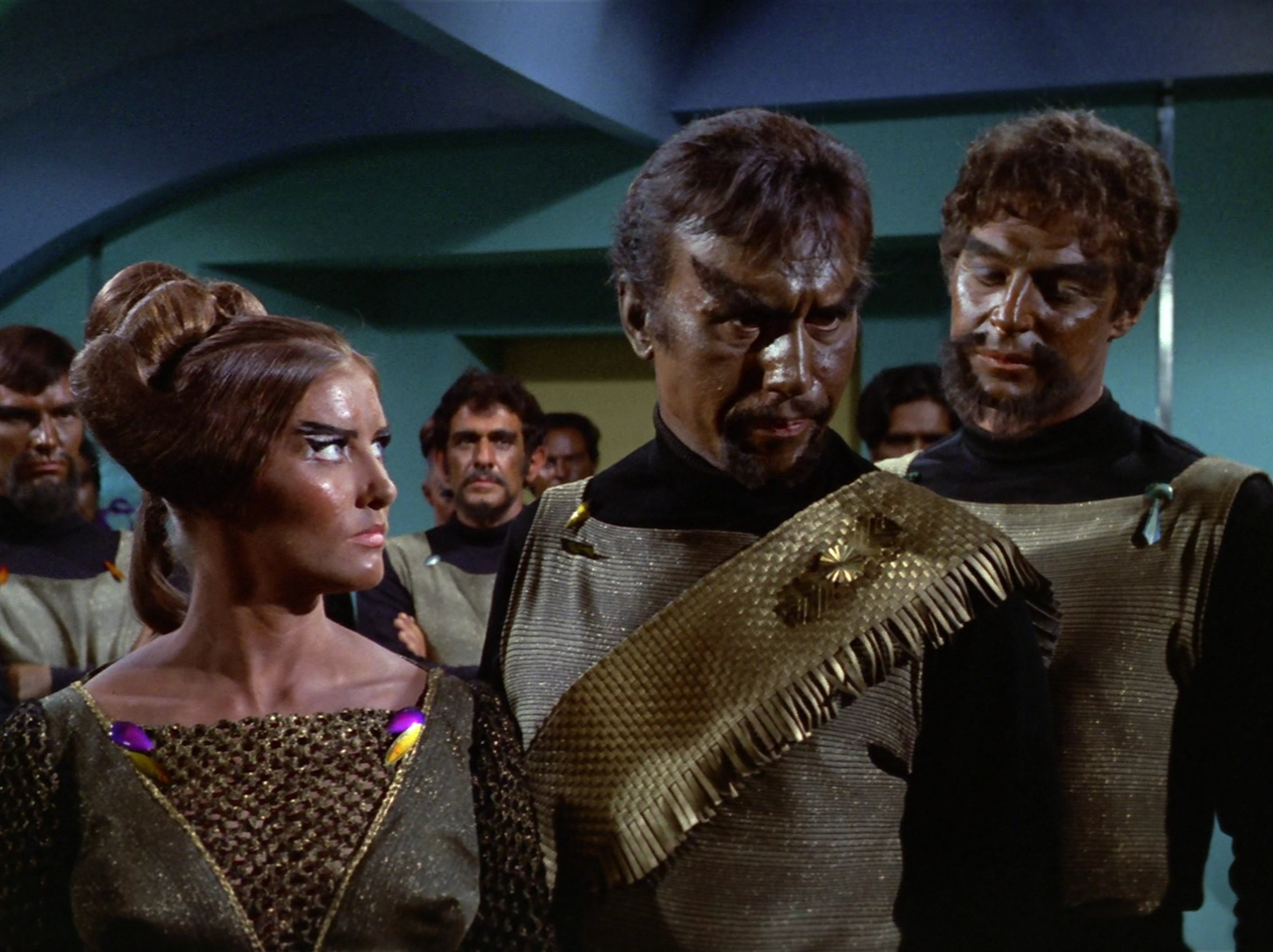
"Don't let the weird makeup, my eyebrows, my shiny shirt and me wearing table runner as a sash fool you. I'm a complete, and utter badass." – Kang

So, here's my dark confession as a Trek fan... don't hate me... I have never really connected with the Original Series. Could be that I grew up in a place where the reruns didn't run. Or that my first exposure to the original cast was the interminably boring The Motion Picture. Or that I freaked out at the parasite scene in Wrath of Khan. Or maybe it was the first actual TV episode of Star Trek I ever saw was a Next Generation episode.

I have trouble looking past the production values. The sets, costumes, models, and effects have, shall we say, not aged well. It's a definitely a product of its time. That's not to say I don't appreciate the show. I've come to love some episodes, (more on them as they come up in the list), and but it's never been my Trek.

Okay, I'll stop now. I think you get where I'm coming from, but...

But...

But here's the thing about 'Day of the Dove." It's badass. It wastes no time in getting to the conflict between Kirk and Klingons. Kirk and party land on a decimated colony with no clue as to what happened to the colonists. Not even a hint that they were ever there. Hundreds dead. Everyone seems on edge as a strange ball of energy hovers just out of sight. Then who decides to show up? The Klingons. Their ship is immediately disabled and begins to drift. The Klingons beam down, give Kirk a swift beatdown, — a beam down, beatdown — and Kang, their leader, steps up with Kirk.

Now, Kang is a bad motherfucker. His battleship has been mysteriously taken down without the Enterprise ever firing a shot. Hundreds of his crew, Klingon warriors all, are dead. He's only got a handful of soldiers left, and he just says to Kirk, "Hey, you know what? Your ship? The one full of perfectly fine, not-dead officers, and a complete arsenal of Photon torpedoes and phaser? It's mine now and you're a prisoner of the Empire. Oh, and our two societies, the Federation and the Empire? We're at war now, because you're a dick." No ship to back that up. No army to get his back. He's got, like, five guys with him. That, my friends, takes space balls. Kang is completely metal.

And that's just the in cold open. "Day of the Dove" does not fuck around. Not at all.

In in the following posturing (both sides claim to have been lure to the planet by a perhaps non-existent distress call) Kirk tells Kang to "Go to the Devil." Which is an odd thing to say, but Kang's reply is nothing short of awesome. "We have no devil, Kirk, but we understand the habits of yours." Then proceeds to tell Kirk how he's going to torture Kirk and his crew to death. Which means Kang has studied his enemies. He's smart. Physically, he looms over Kirk. The episode does a fine job of presenting the Klingon Commander as not only Kirk's equal and darker shadow, but perhaps even his superior.

Then the weirdness starts. Chekov accuses the Klingons of murdering a brother he doesn't have. Later, when a fight aboard the Enterprise breaks out, swords magically appear. And everyone seems to be suuuuuper pissed. And no one can die, apparently. When Kang cuts out life support, it restores itself. Injured crew members are miraculously healed, so they can continue to fight.

In complete contrast to "Bride of Chaotica!," "Day of the Dove" is a dark episode. Mara, wife of Kang and badass in her own right, accuses the Federation of having concentration camps and experimenting on prisoners before they're executed. Chekov tries to, uh, force himself upon Mara before getting punched out by Kirk. Everyone has staight-up murder on their mind. Everyone is completely paranoid. Scotty slips in the f-word under his breath. Even Spock, after being called a half-blood freak confesses, "May I say that I have not thoroughly enjoyed serving with Humans?" Even Spock is on edge!

Wh-what's happening!?

Hey, remember that strange ball of energy? Turns out its an alien or something that feeds on hatred and violence. Not sure, how or why (it's never really explained), but it does. It's go the power to warp reality and manipulate the minds of these lesser beings and feeding off the conflict between the crew and the Klingons. It's goading them to fight, so it can feed on their delicious, delicious anger. It's Kirk who figures out how to defeat the unnamed, super-powerful alien energy being.

See, Kirk's the man.

Despite my above unloading of not being able to connect to the Original Series, I will acknowledge that Kirk is awesome. It's Kirk, not Spock, who proves he's the smartest man in the room by piecing the clues together. It's Kirk, not Spock, who pushes through his emotion to over come the alien influence. It's Kirk, not Spock, who has the answers. It's Kirk who chooses the difficult path of convincing his most hated enemy, that the only course of action is peace. Because the only way to defeat the alien influence is for Kirk to convince Kang to work together in friendship and good tidings to weaken the alien enough to break free.

Fighting is easy. Getting a Klingon warrior hellbent on murdering you to be your pal? Now, that's a challenge. That's why Kirk is captain, and Spock is just the Exposition Officer.

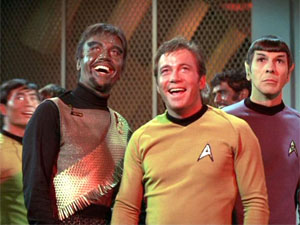
"What's so funny? Also, what's 'funny?'"— Spock

Despite the sets, costumes, models, and effects, this episode is pretty awesome. If "Day of the Dove" had been my introduction to the Original Series instead of The Motion Picture, I might have an entirely different perspective on the first generation crew of the Enterprise.

--

Next up, a trip to Deep Space Nine with "Paradise."

Monday, October 6, 2014

#100, "Bride of Chaotica!" Voyager, Season 5, Episode 12

'End every sentence with an exclamation point!'

I'm glad we're kicking this countdown off with an episode that I love. I mean, I love this episode.

So, you have no idea how much I hope that this was someone's first episode ever of Star Trek. Because I am fascinated by the idea of someone with no context for this show, it's characters, premise, history, or clue of what was going on, trying to parse out what was happening in "Bride of Chaotica!" Because through that lens, this episode is completely batshit. Ridiculously fun, but completely batshit.

Now, we're talking about "Bride of Chaotica!," the twelfth episode from Voyager's fifth season. It's a holodeck-gone-wrong episode. But instead of the fictional characters from the holodeck becoming sentient and running amok, we have aliens made of light from the fifth dimension in an all-out war with... you know what? If you haven't seen it, none of this is going to make any sense whatsoever. So, let's take a step back.

But first, let's assume two things. One, that you've got some familiarity with Trek in general and Voyager in specific.

Tom Paris and Harry Kim are playing a holodeck program modeled after a 1930s scifi serial where Captain Proton defends earth from evil forces of Dr. Chaotica from Planet X. Paris, playing the black-and-white hero, while in the process of fighting the evil doctor bent on nothing short of galactic domination, discovers an anomaly opening a hole to another reality opens up in the holodeck. This causes Voyager to be caught dead in it's tracks and unable to escape. Beings from the anomaly bleed into the program with the intent on making contact with our reality. But because their 'photonic' entities, they mistake the holodeck program for reality. And because Chaotica is eeeeevil, he will settle for nothing short of total domination of the fifth dimension. Chaotica's fake forces start murdering the visitors from the fifth dimension. Murdering them. A program designed to be the cartoonish villain in a pulp serial is straight-up killing these aliens, because in the holodeck, his weapons made of holograms are lethal to the beings made of light. The aliens don't realize that Chaotica is a character in a program, because he, like them, is made of light and energy, and they interpret him as a real person. And from their perspective, a crazy person with a powerful arsenal of death rays, is blasting the bejeezus out of them from behind an impenetrable lightning shield. I'm not going to lie, it's awesome.

In fact, my favorite scene is where Paris, Captain Proton himself, tries to explain the situation to Janeway. They can't stop the program for some technobabble reason, they can't move the ship for some other technobabble reason. And the only way to stop the war and save the new beings is for the crew to embrace the madness of the program, with the Doctor presenting himself as the President of Earth and Captain Janeway taking on the role of Arachnia, Queen of the Spider people, in an attempt to distract Chaotica while Paris and team take down his death ray and save Planet X, Earth, the Aliens and sanity. It's actually much crazier than I'm describing.

And it's kind of wonderful.

It's loopy, goofy, surreal, and, well, it's undeniably fun. It's bombastic and fantastically over the top.  They've dipped into the Captain Proton universe before in a couple episodes as a throw-away gag, but here they embrace the goofiness of the premise and throw caution to the wind.

I've always wanted to like Voyager more than I do, but it's always hit or miss for me. But here, it hits. They're taking a chance on something silly. Something that could have easily been a disaster of epic proportions. And in lesser hands it might have been.

This episode comes to us from Bryan Fuller, who has story credit and shares writing credit with Michael Taylor. Fuller is one of my favorite people working in television. He's a left-of-center storyteller with credits that include the magnificent Wonderfalls, Pushing Daisies, Dead Like Me, the interesting if flawed reboot of the Munsters, Mockingbird Lane, and the utterly, completely badass Hannibal. Seriously, Hannibal is about as far from Bride of Chaotica as you could possibly get and still come from the same brain.

Trek, in all of its television incarnations, has always experimented with different forms of storytelling. Different formats, different framing devices, different perspectives. Sometimes it works, sometimes it doesn't. Trek at it's heart, is about exploring. And here, they're definitely pushing themselves outside their comfort zone. This episode embraces its premise with both arms and never lets go.

For that, I am grateful.

--

Next up, Klingons, Kirk, and Spock in "Day of the Dove." 

Saturday, October 4, 2014

100 Episodes of Fun!

Okay, so, here's a new insomnia project for me. Recently io9 posted a list of the Top 100 Star Trek Episodes of All Time. And though I disagreed with some on the list, ('Darmok' in the top ten, reeeeeeallly?), and a few I had not seen (I'm looking at you Star Trek: The Animated Series), I thought it might be a fun exercise to watch all of these episodes and share some thoughts. Know in advance, that I love Trek a great deal, but it is not sacred to me.

So, if you're willing to come along and play, let's start with #100, from Voyager's 5th season, Episode 12, 'Bride of Chaotica.'