Showing posts with label Scifi. Show all posts

Monday, August 3, 2015

76. A Wolf In the Fold

Subtlety, thy name is Star Trek

76. 'A Wolf in the Fold,' The Original Series, Season 2, Episode 14

I had almost no memory of 'A Wolf In The Fold' when I started watching it. This episode doesn't hit my list of my personal favorites from the Original series and it hasn't risen up though the ranks of pop culture consciousness in the way that, say, one with the Gorn or the Tholian Web have. So, I was able to come into this episode with relatively fresh eyes. And what we see here is the TOS taking a stab at psychological thriller with a scifi twist. Pun intended.

On an alien pleasure planet, Argelia, where Scotty is accused of murdering women. He's literally caught red-handed with a dead body in one hand and a bloody knife in the other. He has no memory of the crime, and professes his innocence. We have here a haunting coming from the mind of the man who wrote Psycho, Robert Bloch. If that is a pedigree for exploring psychological horror, I don't know what is.

As Scotty maintains his innocence despite ridiculous evidence to the contrary, the true murderer reveals itself to be an energy being that hops from host-to-host killing women and feeding off their fear to sustain itself. Scotty was just its latest vessel on the planet at it hacked it's way through the populous. It revealed itself to be an entity that has traveled from system to system, and took credit for countless murders, and had even visited earth in the past, and that's pretty much where this passable mystery to just third-act nonsense.

You see, I've been doing my best to review the Original Series for what it is, but that's not always easy. This episode had great potential. It had a great setup, flamboyant guest stars, an interesting (and edgy for the time) alien culture that mixed hedonism with mysticism. My issue here isn't with any of the usual low-hanging-fruit complaints about the series — the stylized acting, or the limitations of the budget, or the undercurrent of blatant sexism that permeates the 60s — but the inclusion of Jack the Ripper.

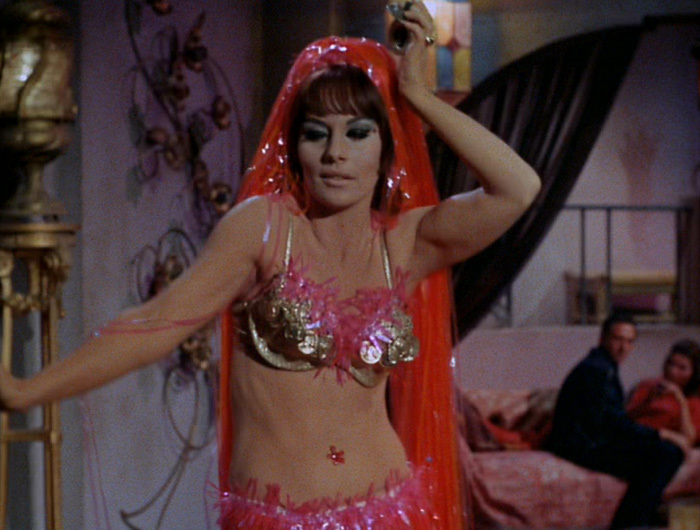
Seriously, every Argelian looked as if they stepped right out of a victorian-era magician's poster.
When the alien entity reveals itself as Jack the Ripper, it lost me. It's weirdly out of place, and seems only to exist to give the audience some kind of context for the entity. But it misses the mark. It's forced. And when the entity leaves its host and takes control of the Enterprise, it goes from weird to worse. A being that lives on terror and fear takes over one of the greatest military weapons ever built by human hands. But what should be terrifying comes across as silly. McCoy gets the crew so doped up to keep them from feeling fear and feeding the entity they sway and giggle at their stations. At that point, I'm just waiting it for 'A Wolf in the Fold' to end.

This is supposed to be about Scotty, but it's not. For an episode focused on the chief engineer, all we really learn about the character is that he can creepily leer at women, and doesn't really give a fig about local customs. We learn that Kirk is fiercely loyal to his crew. We learn that Spock has some weird opinions on the emotions of women. We learn that McCoy has a metric f-ton of drugs aboard the Enterprise, and is not afraid to use them.

"Hey, man, an alien murder thing has, like, control of the ship? Like, groovy, man." — Sulu
Now, I feel like I've just been bashing the Original Series in my last few reviews on this list* and I want to acknowledge that that's not really my intent. They just haven't connected with me.  I have great respect of the Original Series, its creators, its vision, its legacy, and the fictional world it created. The character dynamics of Kirk, Spock and McCoy are among the strongest, and smartest in the history of not just television, but all of storytelling.

But for this adventure, what's the message here? Trust each other? Kirk's always right? Scotty objectifies women? I'm not sure. For me, 'A Wolf in the Fold' lacks a strong central theme that elevates other classic episodes above the limitations of the show.

There are adventures of The Original Crew I love with all my heart. This just wasn't one of them.

--

Next up, Seven of Nine, Tertiary Adjunct of Unimatrix Zero One, faces her past in 'The Raven.'

*A reminder, that this isn't my list, but io9's Top 100 Episodes of Star Trek of All Time.

Sunday, June 28, 2015

78. Remember Me


'I know what I'm saying is crazy. You have to believe me, Jean-Luc; this is my 'very-serious' face." — Dr. Crusher

 Remember Me, The Next Generation, Season 4, Episode 5

I kind of feel like the Top 100 List is punishing me. Last episode, I plowed through 'I, Mudd' with great difficulty. This time, we get an episode of TNG that just didn't work for me. It's not terrible, but for me it falls in the category, of 'why is this in the list, again?' It's a Beverly-Crusher-centric episode, and that's not always a good thing. In 'Remember Me,' Dr. Crusher is trapped in a reality that's collapsing in on her, eliminating everything and everyone around her.

It starts off with a strange occurrence. Dr. Crusher starts to notice that members of the crew go missing. First, it's just an old friend of Dr. Crusher, seemingly wiped from existence. All record of his presence on the Enterprise is gone. Everyone's memory has been altered and Dr. Crusher has trouble convincing everyone that something is wrong. Others start to go missing, until the Enterprise is staffed with a skeleton crew. And Dr. Crusher fights to convince everyone that what they're experiencing is incorrect. That she's not crazy. That something is very, very wrong on the Enterprise-D.  

Space-Calgon is a very dangerous, and should not be tampered with. 
Let's talk about about Dr. Beverly Crusher. Chief Medical Officer of the Enterprise. Commander in rank. Former head of Starfleet Medical. Widow. Mother. Friend and potential love interest of Jean-Luc Picard. She's supposed to be a strong female character, but more often than not she's relegated to exposition and caretaker. Which means, more often than not, Dr. Crusher doesn't have that much to do other than wave her tricorder and speak nonsense. Unlike McCoy in the Original Series, she's not integral to the show, as demonstrated by her replacement, Dr. Pulaski, in season two. Pulaski, though her service aboard the Enterprise was brief, shook things up, constantly challenged the status quo, and showed more character development in one season than Crusher did in six.

Earlier in the series, Crusher had a will-they-won't-they thing happening with Picard, but other than that, she didn't have that well-developed of a character. She didn't really have a hook, so to speak, like the other doctors in the series. McCoy was the country doctor. Bashir was naive, inexperienced and a bit arrogant. Voyager's EMH was an artificial intelligence looking to expand his existence beyond his original programming. Phlox was an alien outsider and constant optimist. Crusher was Wesley's mom, and not much else going on. Everything about her was seemingly defined by someone else. I can't really put that on the actor, Gates McFadden. She does the best she can with the cards she's dealt.

For Dr. Crusher to carry the episode, she needed to have been a more substantial as a character, and, sadly, she's not. And we're midway through in the series, and she's still defined by her relationships with her captain and her son. We need a reason to care for her more than she's part of the ensemble.

Then there's a shift in this episode when it changes focus from Dr. Crusher to her son Wesley. In that moment, it changes from being about character to being about technobabble. And that's pretty much when 'Remember Me' loses me.

'Wait a minute! Geordie look at this! According to my calculations —which I can totally do in my head — if we can reconfigure the antimatter in the warp-matrix, and re-route auxiliary power to the starboard nacelle, we can bypass main power, and re-channel it through the main defector dish. Then once we use inverted tachyons to generate a stable graviton field, we should be able to have just enough power to do a site-to-site transport and get everyone into the final act of this episode and get my mom back. Also, EPS conduits, and jefferies tubes, or something. I can do this by speaking excitedly and pushing about three buttons on this panel. It probably won't blow up the ship at all." — Wesley Crusher
Wesley is super-duper-special with warp technology and science stuff, or so they tell us. When, it's revealed that Dr. Crusher was caught in an accident from Wesley's warp experiment, my reaction was a hearty 'whatever.' Her passing thoughts at the time of the accident create a reality around her that starts to fall apart as time goes on. I bet she's glad wasn't thinking of giant, killer, mutant spiders when the accident happened. I bet it would have made a much more exciting episode, but what the heck do I know.

The last act is chockfull of warp-speak and metaphysical pseudoscience about thought affecting reality. We even get callback to Season One with an alien who proclaimed Wesley's super-specialness. The problem is that the purpose of Wesley's experiment is vague, and the accidental disappearance of Dr. Crusher is never explained in a way that really connects.* The solution to the mystery presented feels like a cheat. Because it's not one that the audience can solve by piecing together the clues presented, the resolution felt to me like a big, fat 'uh-if-you-say-so.'

When reunited, Wesley falls asleep mid-hug.
Over the course of the series, Dr. Crusher does branch out a bit. When Wil Wheaton left the show, and Dr. Crusher was without Wesley to worry about, we learn that she's interested in command, a playwright and director, a capable leader, and one hell of a tap dancer. Dr. Crusher moves from being a protective mother and eventually evolves into the stalwart moral compass of the Enterprise.

But in this instance, she's still just Wesley's mom.

--

Next up, another doctor steps into the holosuite role of a suave, sixties, super-spy in 'Our Man Bashir.' 

* Okay, it tracks logically, I guess — if you want to get technical about the technobabble — but it comes from a place of plot not emotion, and therefore no one really cares. 

Tuesday, June 16, 2015

#81, The Enemy Within, Star Trek, The Original Series, Season 1, Episode 5

"I'm not a bad guy, really." — Dark Kirk
I recently got into a Facebook argument with a friend who only acknowledges the greatness of the Original Series, and feels that everything else that follows is terrible. At least, unworthy. He and I vastly disagree on this, obviously. While, I greatly respect The Original Series and the legacy it created, as I've stated before, it's not my Trek. So, if you're a fan of The Original Series (and only The Original Series), I'm going to apologize in advance for the next few reviews of the adventures of Kirk, Spock and McCoy on the Top 100 list. 'The Enemy Within,' 'I, Mudd,' 'A Piece of the Action,' these episodes are not for me. They're everything that I find off-putting about TOS, however...

However...

However, I'm going to do my best to appreciate them for what they are, the era in which they aired, and the spirit in which they're presented. I'm willing to give 'The Enemy Within' a lot of latitude because as Episode 5 of a decades-spanning franchise, the show is still figuring out what it is. Sulu and Scotty get a lot of air-time. There are a couple of firsts here, it's on this episode that Nimoy created the Vulcan nerve pinch (though an episode shot later aired earlier). We get out first look at Kirk's wrap-around captain's tunic. When a bunch of crew are trapped on a freezing planet and the transporter is inoperable, the obvious solution would be to use shuttlecraft, except they hadn't been established in the show yet.

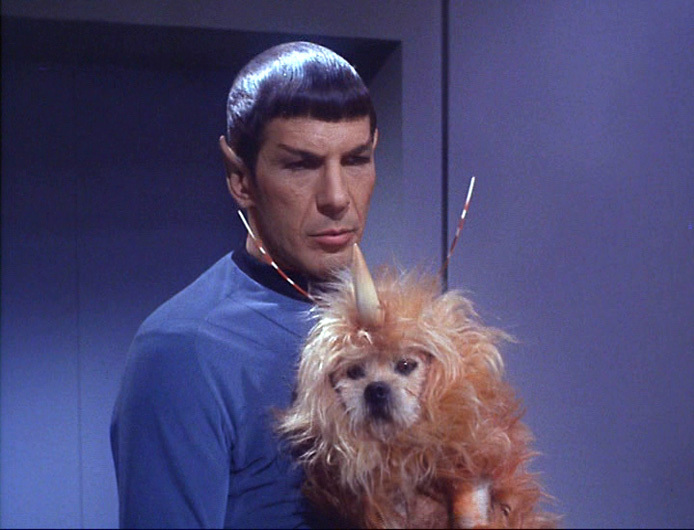
For example, after this episode, they decided against making the Space-Unicorn-Terrier a re-occuring character. 
So, let's try a compliment sandwich, shall we? I'll say something nice, I'll say something less-than-nice, and then I'll say something nice again. Let's see how that works out.

'The Enemy Within' has a fantastic premise and had amazing potential. And the vibe of the episode is far more Twilight Zone that Star Trek. And coming from scifi legend and Twilight Zone alum, Richard Matheson, this is wholly appropriate. The episode is dark, brooding, and explores not just the darker side of Kirk, but the darker side of mankind as a whole. It asks the question of what happens when we strip away our humanity, and looks at what's left. A transporter accident creates two Kirks. One, slowly losing himself in self-doubt and fear, the other, the baser animal nature of humanity. We look at a man split into two extremes, and seeing what happens when a man's psyche is metaphorically and physically thrown off balance.

Matheson keeps the division between the Kirks from being as simplistic as 'Good' and 'Evil.' They go out of their way to point out that these aspects of personality are necessary for the whole. Dark Kirk is primal, driven by desire and self-interest. Kirk-Lite spirals from being the man he once was into a man who's incapable of making a decision.

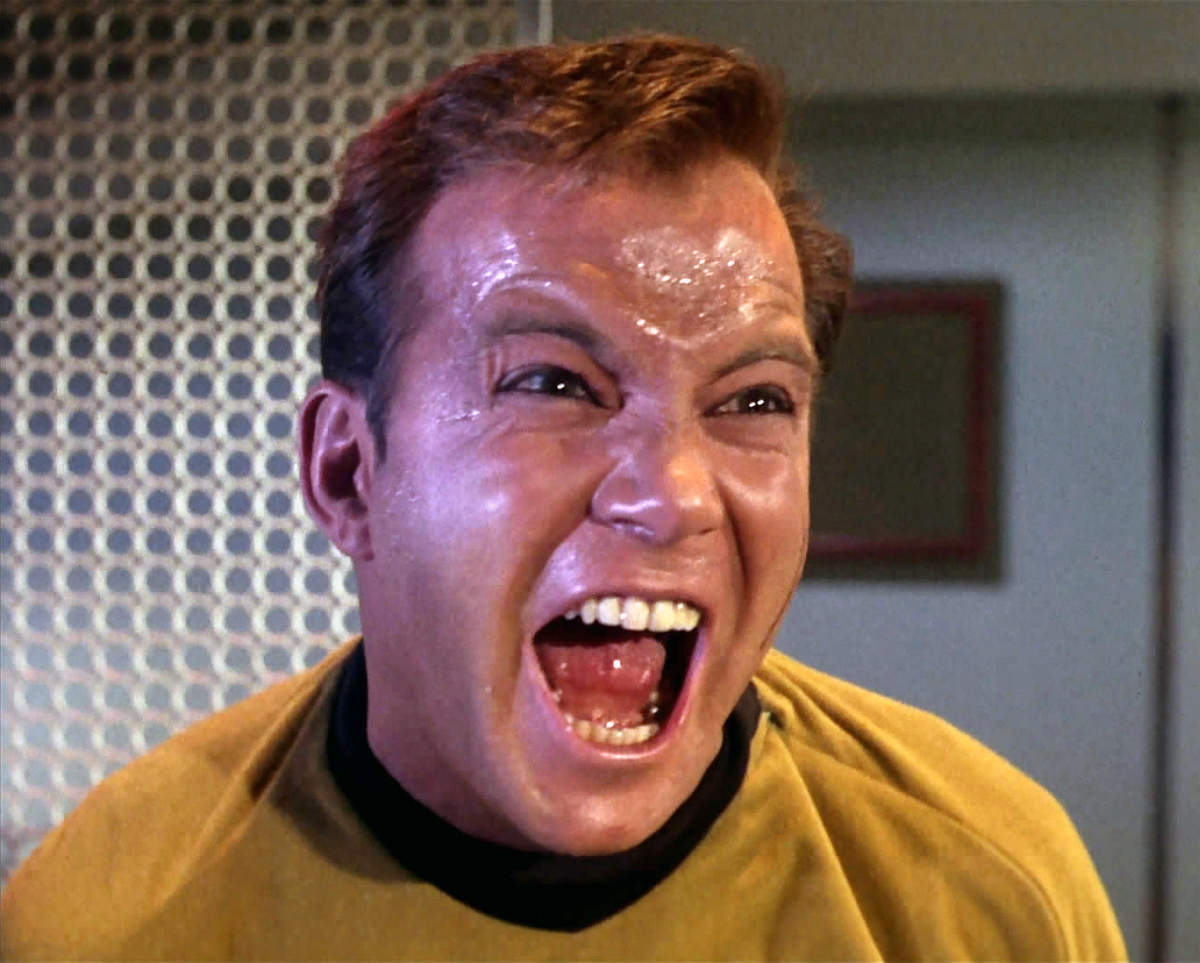
Unfortunaltely, the different aspects of Kirk that are presented, the Compassionate and Indecisive Kirk-Lite and the RAGE, RAGE and OMG-SOMEHOW-YET-EVEN-MORE-RAGE Dark Kirk are played to such extremes the results come across as more comical than poignant. Now, let's call this for what it is, it's a television show trying to communicate a story point. But even so, it's really hard for me to watch Shartner sneer and snarl his way around the Enterprise as Dark Kirk. I don't think I'm going out on a limb in saying that Shatner is not the most well-respected thespian ever to grace the small screen. But in 'The Enemy Within,' his depiction of Dark Kirk as over the top, even for him. The choices of guyliner, general sweatiness of Dark Kirk, over-dramatic music, and the lighting doesn't help the subtlety of the situation, either.

"I'm acting! I am! Acting! I'm ACTING!" - Dark Kirk
Kirk-Lite wanders around the ship, waiting for others to act, and slowly loses his ability to command the Enterprise. Kirk-Lite is far less defined than Dark Kirk. Dark Kirk's first acts are to demand booze and force himself upon Yeoman Rand. Kirk-Lite's actions are more business as usual, but he increasingly becomes incapable of commanding his ship. Where Dark Kirk's actions are clearly aggressive, the aspects of this Kirk's personality are far more vague. I have little doubt that this is unintentional, a deliberate contrast between hard and soft. But we never get a sense of that the traits Kirk-Lite are any kind of benefit. All we get is that Kirk-Lite is incomplete.

"I have no strong opinion. Whatever is fine. What do you think?" — Kirk-Lite
I'm inferring here that the darker nature of humanity is not only necessary, but vital in order to be a whole human being. I'm not sure I'm okay with that. I think I'd be more amenable to the episode if the attributes of compassion and empathy were presented in any kind of positive light. But they're not, really. Compassion here is equated with weakness. I fundamentally disagree with the overall idea that the only way to be whole is to be equal part aggressive asshole. It's quite the mixed message for a show that looks to an idealized society where humanity has evolved to a nigh-utopian state. More than the low-grade production values, more than Spock's sole function as the Exposition Officer, more than the horrible treatment of Rand, this message is this reason that I can't really connect to this episode.

Also, the alien-dog-thing looks just damned ridiculous.

Like all great Star Trek, 'The Enemy Within' asks big questions. I'm just not sure I like the answer they came up with.

--

Next up, Picard does what he does best, negotiating treaties in 'The Wounded.'

Friday, January 16, 2015

#88, 'Favor the Bold' & 'Sacrifice of Angels,' Deep Space Nine, Season Six, Episodes 5 & 6

I seem to remember the retaking of Deep Space Nine in Favor the Bold and Sacrifice of Angels as being a big moment in the mythology of the show. When Sisko takes back Deep Space Nine from the enemy. We're deep into a war with the Dominion, and the Federation is losing. Losing territory and ships to a vastly superior opposing force, they're outgunned, outnumbered, and falling into a pattern of attack and retreat.

Lives have been lost. Morale is low. And Sisko has decided it's time for some let's-blow-the-shit-out-of-something-big action. A go-for-broke plan that will strike the heart of the Dominion and provide the Federation with a much needed victory. They have to force a victory, or lose the war. He puts together a task force to take back his former command, Deep Space Nine.

Sone where in this armada, I like to think Picard is making it so.

As I re-watched these, I came to realize that this two-episode arc represent the best and the worst of what Deep Space Nine was. As if they are a microcosm of the series as a whole. The episodes are wildly uneven, oscillating between good and bad almost from scene to scene. Deep Space Nine is a show I like (a lot), but I have to admit that there are some elements that just never clicked for me.

On the one hand, we have Avery Brooks, who, once again, rocks it like a boss. Sisko's a man with his back against the wall, making the hard decisions. He's passionate. Earnest. Bold. And takes zero shit from zero people, aliens, or cosmic beings from another reality.

The Dominion are (with exceptions noted below) the perfect villains for the series. I'd described them in a previous post as a totalitarian anti-Federation. They're everything the Federation isn't. They seek conquest, not exploration. Jeffery Combs' Weyoun is fantastic. The show takes chances, swinging for the fences. When they decided to make the major through line of the show the Dominion War, they went for it. Throughout the series, Deep Space Nine has presented space combat on a scale not seen since the Battle of Endor, and it did it on television. Repeatedly. Certainly not on a scale seen in any other iteration of Trek.

We have great character moments. Miles and Julian bonding. Quark setting aside his self-interest for the greater good. Even Rom shines in a rare instance of not being completely annoying. Also, Worf son of Mogh. 'Nuff said.

And then, on the other end of the spectrum (for the record, the bad one), we have the prophets calling Ben "The Sisko." We have the character known only as Female Changeling, who apparently cannot have a line without saying the words 'solids' or 'great link.' We have Odo's, ugh, love affair with Major Kira, which has always felt forced and awkward. We have the logic problems of both the Bajoran gods and the Dominion changeling rules. And, then, we have Gul Dukat.

Gul Du-fucking-kat.

I swear I got eye strain from rolling them too much every time Gul Dukat was on the screen. I loathe him, but not in the way I'm meant to. He's smarmy, arrogant, self-agrandizing, and speaks with with an almost operatic rhythm — where every sentence builds in volume and intensity and is then followed by a soft coda. Once I identified this, it drove me absolutely mad. Dukat is, perhaps, the Star Trek villain with the most screen time of any other. In fairness, I didn't do any kind of quantitative analysis on that, I'm just going by memory. But holy crap is there a lot of Dukat on this show.

"Was it something I said?" -- Gul Dukat. "Pretty much everything you've ever said, ever, yes." — Me

Over the course of the series, he's been portrayed as a cold-blooded mass murderer, a misunderstood tyrant, a crazy person, a patriot, revolutionary, a cult leader, a messiah, and a vessel to evil gods. And every time he's on the screen, I'm just checking my watch until he's done being terrible. He grates me. He's mustache-twirly terrible. He stands out as cartoonishly broad and over-the-top in a show with alien forehead makeup and spaceships going kler-splode. That says something. He strives to have the gravitas to be Sisko's equal, and the failure at that is palpable. But, they keep using him. And his use keeps giving me eye strain. Ow.

However, the worst part of this particular Niner adventure is that it ends with the most blatant (and literal) deus ex machina you could possibly imagine. Sisko's bold plan has failed. The Federation strike force is unable to break the Dominion lines, except for one line ship, the Defiant. The minefield that has kept the Dominion re-enforcements at bay is taken down. Sisko and the crew of the Defiant sail into the worm hole to face off against two-thousand-plus Jem'Hadar warships alone. Their sailing into their deaths in a hollow sacrifice. They don't even say anythig like, 'we're going to technobabble the warp core and collapse the wormhole so that the Jam'Hadar can't get through and save the alpha quadrant with our noble sacrifice!' Instead, they lock phasers, and calmly accept their own deaths at the hands of alien weapony. Then, the Bajoran Prophets pull Sisko out of his reality and into their temporal dream state.

The interaction with the Bajoran Prophets is just painful. They seem to interrupt the action for the sake of interrupting. Call Sisko "the Sisko" for no apparent reason other than to just annoy me. They ramble about a 'game,' which I infer to mean the writers aren't sure what to do with these alien beings in the long term. They are dismissive of Sisko's needs until he makes an old-fashioned empassioned speech. Sisko begs them for a miracle, and they provide it. The Dominion fleet vanishes from Existence, and the Defiant returns to Deep Space Nine. Sisko and crew return the triumpant heroes to the Station, and the war goes on.

For both good and ill.

---

Next up, it's a trip to the continuum with Déjà Q.