Showing posts with label Worf. Show all posts

Sunday, July 12, 2015

77. Our Man Bashir

"Bashir, Julian Bashir." — Bashir, Julian Bashir


#77, Our Man Bashir, Deep Space Nine, Season 4, Episode 9

Star Trek likes playing with genres. From horror, to whodunnits, to courtroom dramas, to slapstick, to war films. The show(s) thrives when it tries something new. TOS took on gangster films. TNG took on Sherlock Holmes and the Old West. Voyager took on 1940s serials. Each one is a deconstruction of the genre, and putting a Star-Trek-y twist on it. At least, they're a break from the usual Federation fair.  Even when the results are mixed, they're usually interesting when Trek breaks itself out of its norm and allows the actors and creators to stretch their legs a bit and play. In Our Man Bashir, we take a look at the spy genre from the 60s with the title character taking on a jet-setting-super-agent based on a certain franchise known for gadgets, femme-fatals, double-crosses, and world domination.

Julian Bashir likes to play James Bond, a registered trademark of MGM, and we get to go along for the ride. The episode examines the tropes of the Bond films and plays with them. 'Our Man Bashir' is far more interested in character than plot. It's more interested in fun than logic. The technobabble surrounding the transporter accident that trapped the crew in his spy-fantasy isn't important. It's background noise. An excuse to make Sisko a villain of epic proportions. To give O'Brien a falcon-based eyepatch. Kira is a Russian double-agent. Dax is the missing geologist. Worf gets to wear a tux and play cards. It's also an excuse to add genuine stakes to what is essentially Bashir playing a spy-themed adventure game.

Each of the crew trapped in the holodeck are an abstraction of their real personalities and true to their nature, yet there's also an inversion of that. Worf is the bodyguard; the gatekeeper for Dr. Noah, but uses subtlety instead of brute force to subdue Bashir and Garrak. Kira, as the Russian Agent, is the foreigner, but she's seductive and silly instead of her usual serious no-nonsenseness. Dax, as Dr. Honey Bear, is the beautiful scientist, yet unsure of her own sexuality and identity. O'Brien's Falcon is the no-nonsense fixit man, but uses violence to get what he wants. And Sisko is the charismatic leader who likes to give epic, epic speeches, yet cast in the role of the villain. The contrasts are played intentionally over the top, and the results are fun to watch.

"Don't let the glasses and the up hairdo fool you. I'm crazy sexy." — Dr. Honey Bear

Also in that abstraction, we look at Julian, and who he wants to be. His alter-ego allows him to play the hero. From his first appearance, Julian has had this desire to be a hero. He's a romantic, coming to Deep Space Nine to be a pioneer on the edge of Federation space. He's super-intelligent, and too smart for his own good. Throughout his holosuit adventures with Miles, they're constantly playing heroes. World War 2 pilots, viking warriors, soldiers art the Alamo. He's constantly playing out his heroic fantasies. Here he goes against a madman with global ambitions.

Dr. Noah's plan is simple. Activate volcanos around the world with lasers to flood the earth somehow and start civilation anew with a few hand-chosen scientists, artists and mercenaries to build a new human race on Mt. Everest. Did I say simple? Because I meant bugfuck crazy, but not necessarily any crazier than any other Bond villain's plan.  Does Avery Brooks as Dr. Noah enjoy cutting loose and giving a devious villain monolog? You bet he does, folks. Every word he utters is forced out with an excited breath, as if he can't wait to say the next line in his diabolical speech.

Because of the circumstances of the transporter accident that left the physical patters of the crew trapped in the holosuite, if he ends the game, they die. If he leaves the game they die. If a character with a crew member's pattern gets killed, their pattern gets erased.

We get the impression that Julian has played this adventure multiple times. Garrak, who joins Bashir on the adventure, mentions that he's been in the holosuite non-stop since the program arrived. Bashir knows the characters, the plot. Even the outcome. He tells Garrak that the game is rigged so that either Anastasia (Kira) or Dr. Bear (Dax) will die, and he will hook up with the other one. Garrak mentions that Dr. Bashir has been playing for hours, so I can only extrapolate that he's played through several times, trying different techniques to get to the finale. He glides through the steps of the game with ease, careful to change his play through only to make sure everyone lives.
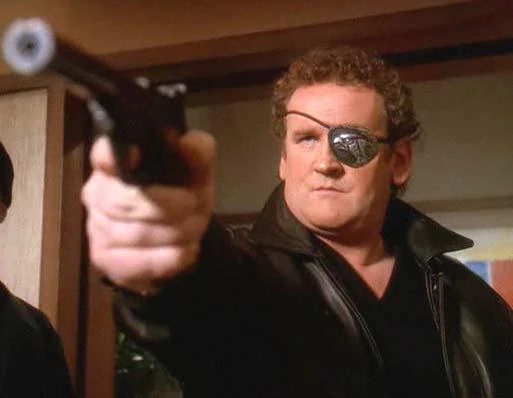
O'Brien get to be a meaney. Get it? Puns are a requirement in Bond-parodies.
Garrak is an interesting companion on Bashir's adventure. We're reminded that Garrak has been the very thing that Bashir wants to be, an intelligence agent. Except Garrak is the real deal. He's infiltrated strongholds. Stolen information from the enemy. Tortured prisoners. Killed without remorse for his country. And he's constantly pointing out the inaccuracy and the lunacy of how espionage is portrayed in Bashir's fantasy. Bashir knows it's silly, and not realistic, he just doesn't care. This is his way to blow off steam and the turn the drama of the Dominion War off for a moment and enjoy himself.

And while Garrak provides kind of anti-Jimminy-Cricket advice to Bashir on how real spies in the real world work, Bashir knows how this fantasy-world works and what's expected of him. The Bond films (and spy television shows) of the era are very much of their time, over-the-top male fantasies with high-tech gadgets and women with both revealing clothing and loose morals. They've evolved into bombastic action films throwing realism out the window in favor of bravado, machismo, and sensationalism.*

More often than not, Star Trek is better at being clever, than funny. And this episode is both a clever look at the spy-genre and ends with a clever twist on it. In order to extend the game long enough for the crew to be rescued — beamed from the holosuite to the Defiant —he presses the big, red doomsday button. He saves the day by letting Dr. Noah destroy the world.

Which is not a thing they taught Garrak about being a spy.

--

Next up, Scotty is accused of murder in 'A Wolf in the Fold.'

*While I loved the Bond films as a kid, they have not aged well. But that's a discussion for another blog.

Wednesday, June 24, 2015

80. The Wounded

The Wounded, The Next Generation, Season 4, Episode 12

'The Wounded' marks the first appearance of the Cardassians, a race that would become a huge part of the Trek mythology. I think back on how far the Klingons have come since their first appearance in 'Errand of Mercy' and look at the depiction of the Cardassians from their introduction to their final appearance, and am surprised how fully formed they were from 'The Wounded.' Aside from the aesthetics of their uniforms, they're pretty much the same here as they are when Ben Sisko takes command of Deep Space Nine a few years later. It doesn't hurt that Marc Alaimo is playing the lead Cardassian here, as he would go on to play one of the most prominent villains in Trek's history.*

Though this was the first and last appearance of these bitchin' Cardassian helmet-things.

The Cardassians are presented as an empire with enough military might to threaten Starfleet. A smaller empire than the Klingons and Romulans, perhaps, but they're the best and worst of those two races. As smart as Romulans, as merciless as Klingons, but without the honor that keeps the latter in check. They are reptilian in appearance, calculating, cruel, and brutal. They will enslave an entire planet and justify their actions because they need to preserve their Empire. In short, they are everything the Federation to are not. But the Federation isn't what it used to be.

With their fleet decimated by the Borg attack, what we have is a Federation about to enter into a conflict they may not win. The war with the Cardassians had raged long enough for Picard to tell a war story from his time aboard his previous command, the Stargazer.**

Picard is ordered to keep the peace at all costs, and has to make some hard choices. He has to hunt down one of Starfleet's own, as Captain Ben Maxwell has gone rogue and attacked Cardassian targets. This could lead the Federation back into war with a ruthless enemy. As a show of good faith, Picard takes on a Cardassian delegation, who are constantly trying to get Picard to compromise Maxwell and let them blow him and his ship to smithereens.

If nothing else, this episode has a lot of sitting and talking. 
To do that, he enlists the help of one of his crew who served with Maxwell during the war, Miles Edward O'Brien. And it turns out this petty officer is far more interesting than a guy that pushes buttons in the transporter room. O'Brien was Maxwell's tactical officer during the Cardassian War, which make this 'simple enlisted man' more complex than he'd been so far. He turns our to be clever, and resourceful.

As O'Brien is not an officer, so I can only infer that his time as a Tactical Officer aboard the Rutledge was a war-time field-commission. It also makes his position on the Enterprise a bit strange. Transporter Chief seems like a demotion from Tactical. Perhaps O'Brien sought the honor of serving on the flagship. Perhaps he needed an assignment that was less intense than Tactical, even if that assignment was on a ship in constant danger. Miles is not shy about his feelings about the Cardassians. He's not a fan. He's seen the horrors of war, and he holds the Cardassians responsible for the man he had to become to survive it. We also see the consequences of families aboard the Enterprise as O'Brien tries to process his experiences with his new wife, Keiko.

But Miles knows Maxwell, and he uses every trick up his sleeve to help Picard bring a peaceful end to Maxwell's one-man war against the Cardassians. As Picard and crew attempt to figure it out, the Cardassian representative, Gul Macet, is constantly angling for the means to end Maxwell. Assuring Picard that the only way to attain peace is through Maxwell's end.

And to do that? Endless, endless meetings. 
Maxwell is presented as a contemporary of Picard's, perhaps his equal. Maxwell is smart, determined, and pulls off some tactical maneuvers that sets him up as a formidable opponent. He commands the USS Rutledge, a ship as advanced as the Enterprise. More importantly, Maxwell is a believer. He's a man on a self-appointed mission to expose the Cardassians as the duplicitous snakes they are. He suspects that the Cardassians are using the ceasefire as an excuse to rebuild their navy for a new assault. Maxwell blows up a science station because he believes the Cardassians are using it to spy on the Federation. He assaults a Cardassian civilian freighter because he thinks the Cardassians are secretly using them to resupply their war efforts.

Picard has to stop Maxwell, and there appears to be no easy way out of it. What makes Picard's job that much harder is that Maxwell is right. Maxwell is a man who has suffered loss. Perhaps he's one a mission to avenge the death of his wife during the war. Perhaps he's attempting suicide via death-by-cop. Perhaps he is doing exactly what he says he is, exposing the Cardassians. The truth turns out to be a mix of all of these things, and it makes Maxwell a fascinating antagonist.

Picard has to choose between doing what's right, and serving the greater good and keeping the peace. He can't even entertain Maxwell's suggestions to investigate the Cardassians supply ships because if Picard has proof, he'll have no option but to drag the Federation back into a costly war.  It's a hard choice, and arguable if he made the right one.

--

Next up, it's Kirk vs. Robots and dudes with handlebar mustaches I, Mudd.


*Note, I haaaaate Marc Alaimo's Gul Dukat with a fiery passion, but not in the way that the creators of Deep Space Nine intended. For more on why he's terrible, please check out my review of #88 on the countdown.

**If I have complaints about the episode they're mostly inconsequential. The timeline suggests that the Federation and the Cardassians have been at war up until a year ago, but it's never mentioned in the first two seasons. As Picard tells his Stargazer story, it implies the war has been going on for quite quite a while. Other than the forehead makeup, the Cardassians themselves look terrible, and went through a much needed uniform upgrade before their next appearance. 

Friday, June 12, 2015

#82, Conundrum, The Next Generation, Season Five, Episode 14

"Wait. What's happening? I have zero idea." — Jean-Luc Picard
I'm of two minds of this episode.

On the one hand, hot damn, 'Conundrum' is just great. I mentioned in the previous post about taking the familiar and putting them in an unfamiliar surrounding, and in this episode we get an inversion of that motif. We take the familiar setting and put new characters in it. Well, not really new, per se. We still have Worf, Riker, Picard and Data, but their memories have been erased. They have no idea who they are, or what their purpose was. Just a bunch of people on a giant space ship, wearing snazzy uniforms, and wondering whiskey tango foxtrot is going on.

Too often we've seen mystery set up on Star Trek where we the viewing audience is a step or twelve ahead of the crew (for example, 'Parallels'), but here, we're just as clueless as the crew themselves. As the crew realizes none of them know who they are, there's an unfamiliar face on the bridge of the Enterprise. Commander MacDuff, the ship's First Officer. Whuuuuuuuuuut? And it's on like Ferengi Kong.  We know that something is horribly wrong, but the characters do not. MacDuff is a metaphorical bomb and we're just waiting to for him to go off. As he manipulates the crew, thwarting their attempts to get to truth, we're just waiting for the payoff.

The clues are well paced as the crew pieces together what's going on, with bread crumbs of information doled out in tiny chunks. The Enterprise is supposedly on a secret mission to take out an enemy base to end a bloody war. The enemy has a new secret weapon, which explains the memory loss. The Enterprise burns through the enemy lines, they grossly overpower their supposed mortal enemy.

There are some great character moments as the crew figure out who they are. What we have here are the characters stripped down to their cores. Riker is pure swagger. Ro is impulsive, looking to make her own rules. Deanna states the obvious. Beverly is there, I guess. Data tries to figure out who and what he is. Worf is pure warrior. Picard is wisdom incarnate. The Captain has some great verbal explorations of the moral dilemma of his mission. When they encounter their enemy, they discover  they're no match to them, he doubts the moral certainty of the conflict.

The episode is not without fun. Data and Geordie wonder if Data is unique or part of a ship's standard equipment, which is a fascinating concept. Ro and Riker put aside their usual animosity and replace it with amorousness.* And Worf thinks he's captain for a good chunk of the first act and no one bothers to stop him.

When everyone realizes that no one has their memories, Worf decides he's captain, because why not. With no one with any information to contradict him, he takes charge. His instincts tell him that they've been attacked and he starts ordering the rest of the crew to get the ship battle-ready. Picard shows patience and diplomacy as the young Klingon takes over his ship, and immediately slides into the role of the experienced advisor. It's great to see the contrast between the characters. Worf's single-mindedness and Picard's big picture view. It's the difference between inexperience and experience.  Worf's mea culpa to Picard is great when he discovers that he's the junior-most bridge officer.

"One day, I'll be Captain of my own ship, I swear. Computer, activate crowdfunding." — 'Captain' Worf. 
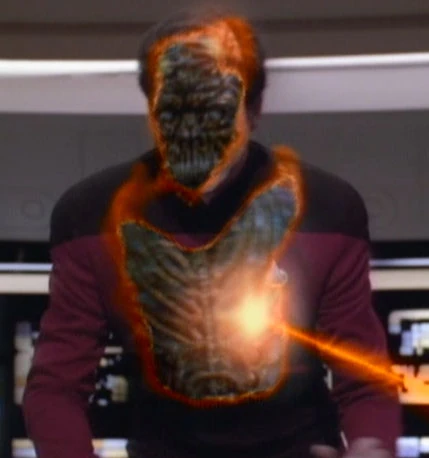
As they make it to their destination, the mystery is revealed, the MacDuff has been manipulating the Enterprise into destroying the base of his species' enemies, ending their war using the Enterprise's vastly superior firepower. Picard can't reconcile what he's been ordered to do and decides to talk to their 'enemy' rather than blow the shit out of their space station. When MacDuff forces his the issue, the crew stops him from murdering thousands using the Enterprise as his weapon. MacDuff shows his true colors, and those colors are alien and gross.

Apparently MacDuff belonged to the same species of  aliens as the ones from 'They Live.'
On the other hand, holy crap, the alien plot is just damned nonsensical. If they can take down the crew of the Enterprise in one shot, why not replace all of them with their own people? Why just the one guy? Why put your agent as the first officer and not the captain? The aliens that take over the ship, the Satarrans, are supposedly a hundred years behind the Enterprise in technology, but can reprogram Data and the ship's computer? The structure of the mystery is well done, but the reveal is a huge let down. and the episode begins with Troi beating Data a chess, a thing that no one ever would find plausible. However, I'm willing to give it a lot of latitude because the rest of the episode is so strong.

What's the verdict? In my opinion — and it's the official opinion of this blog — the strengths of 'Conundrum' far outweigh its weaknesses. So, in the end, 'Conundrum' is great. Flawed, but great.

--

Next up, we get two Kirks for the price of one within 'The Enemy Within.'

--

*They get it on, is what I'm saying. 

Thursday, May 28, 2015

#84, Parallels, The Next Generation, Season 7, Episode 11

"Ahead full! Maximum Worf!" — Worf
I'm not going to lie. I was worried about this episode. Worried because when I announced that 'Little Green Men' was on the docket, I also announced how much I liked it. But when I revisited that episode, I realized that it didn't hold up to my memory. Part of this is the nature of comedy. Much of comedy relies on surprise. A set-up followed by misdirection. A classic structure of expectation and reversal. A third phrasing of that thing. A big part of my reaction to that episode was that it just wasn't all that funny. I've always found Trek better at being 'amusing' than 'funny.' 'Little Green Men' was just a little too-not-at-all-that-funny for my tastes.

That being said, I really, really remembered liking 'Parallels' and I was worried it would fall short of my expectations. After watching, I'm pleased to say it's still a great deal of fun, as Worf bounces from parallel reality to parallel reality, drifting further and further from the Enterprise he knows. As he shifts, the changes in his surroundings go from subtle (the cake is a different color!) to drastic (Riker is Captain!). It's one of those episodes that takes our familiar characters and puts them outside their comfort zones. What is at first contributed to a concussion from a bat'leth tournament messing with Worf's memories quickly escalates into him realizing that he's no longer in his home reality. Worf is lost, unsure of where he is or what's happening thanks to some shuttle accident and Geordi's visor, or something. The technobabble and technobabble solution aren't not really the problems here. Worf's motivations as a character are.

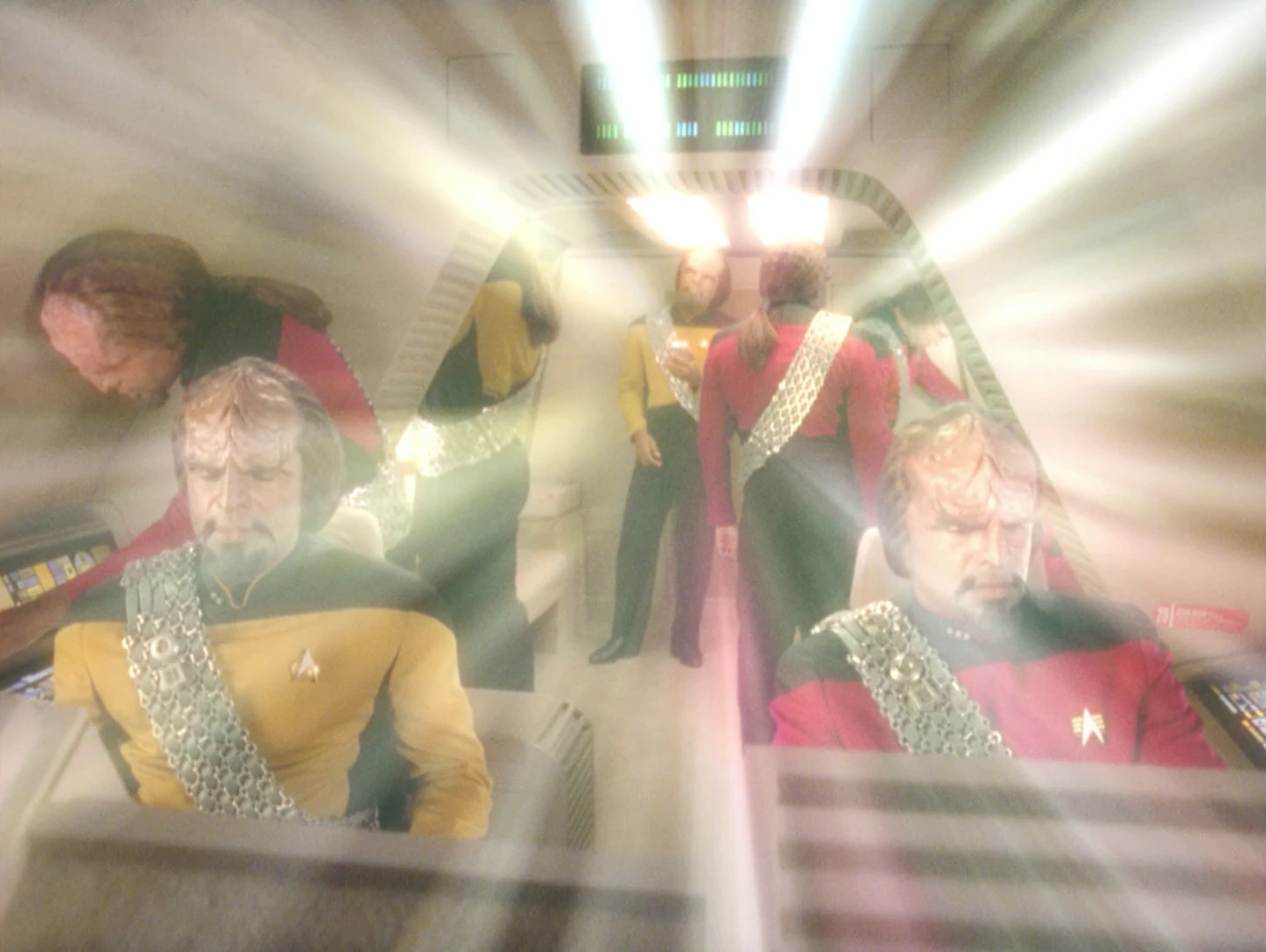
Worf rolls with the changes fairly well at first, assuming his memory is suspect thanks to the aforementioned blow to the head. But, history keeps changed around him. And not little things.  Deanna Troi is his suddenly his wife. Picard is dead at the hands of the Borg. Data has blue eyes. Dr. Crusher is no longer the Chief Medical Officer. Their combadges are slightly different. It's madness.

"Come, sit down, embace this new me-filled reality." — Deanna Troi
What I find interesting is that the reality in which Worf finally finds himself is a fairly sweet one. He's gotten a promotion to first officer of the Enterprise and is happily married to Deanna Troi with two supposedly beautiful children (we never see them). It's not until he realizes that in this reality, his son, Alexander, was never born, that Worf's drive to return home kicks in. Sirtis does a great job of handling Deanna's complex emotional roller coaster as she realizes that Worf not only has no memory of their relationship, the man she knew and loved is gone. Replaced with a man from another world. It's a completely weird thing to ask of an actor, but I think it's handled well.

If I have one major complaint about the episode (I have second but it isn't critical, and is super-nerdy) it's that the episode spends a great deal of time establishing what is essentially a non-mystery. The audience is so far ahead of the characters in this episode on what's going on, it's painful to watch the them catch up. They spend way too much time with the setup and explaining to the audience what a parallel reality is. It's a fairly well-known science-fiction trope and I feel we could skip a fair amount of this and get straight to the emotional conflict in the episode. I say a non-mystery because the reveal of what's going on is in the damned title. Doesn't take a warp-engine specialist to put two and two here.

The episode is very character heavy, where a man who is normally sure of himself, questions everything around him. There's not much driving the story forward, past the mystery we already know the answer to. So, the episode lumbers a bit. We have new, shiny things to look at, but it does drag. There are a few red herrings. Cardassians tamper with a space telescope, and aggressive Bajorans strike against intruders to their territory, but neither pay off in a satisfactory way. It's not until the barriers of reality start to break down that we have an actual threat to deal with, and Worf has any kind of decision to make.

My second complaint about the episode is far more nit-picky and about the Son of Mogh himself. In this episode, Worf comes across as the Klingoniest-Klingon-to-ever-Klingon-a-Klingon. And it bugs me. The episode starts off with Worf returning from a bat'leth tournament, which sounded an awful lot like an Olympics where competitors get impaled. Or, I imagine something akin to MMA, but with giant knives. But not only did he compete, he won with Grand Champion standing. I call shenanigans.*

Worf going off to a bat'leth tournament as a spectator I totally buy. He wasn't raised by Klingons and Worf has always struggled to connect to his heritage in a meaningful way. Worf running off to learn what it means to be a Klingon is a reoccurring character theme. But for him to go to this tournament and win, I just don't buy it. Having competed in martial arts tournaments (I have, don't laugh), I can tell you the people that win those trophies on that level are preternaturally gifted, train non-stop or both.

Worf is a capable officer and warrior, but for him to be competitive amongst natively-raised Klingon warriors, living in a society where competition pushes each of them to the extremes is not credible. I get that we need a mcguffin for him to recognize what reality he's in, and what's changed. As a symbol of the changing realities, his grand master trophy changing from 3rd place to 9th to a participatory ribbon certainly works. It just stands out as being a little too Klingoniest-Klingon to me.

As he swapped realities, it would have been great to have seen Worf in a wind up in a place where Klingons ruled the Federation, which may have been a real emotional challenge for Worf. Here we'd have a character who's struggled with connecting with his heritage, and then have to choose to give it up in order to save reality.

While it's fun to subtly change things around Worf, things never drift too far from the Enterprise-D we know and love. The changes aren't really that drastic. Worf pops into a reality where Wesley Crusher is the tactical officer (one once again questions the wisdom of Starfleet HR). And it would have been great to have Dr. Kate Pulaski show up as medical chief in a cameo. I love that there's something meta here. It's like we're looking at the series in alternate timelines. It's almost as if they're embracing the fan rumors/theories that Stewart wasn't going to return for season three after 'Best of Both Worlds.' Or looking at what if Wil Wheaton had stayed on with the series to become Lt. Crusher?

"Ugh. Pressing space buttons is so beneath my preternatural genius." — Tactical Officer, Lt. Wesley Crusher 
The mind, it boggles.

If anything, I wish they'd gone wilder with it. And weirder with it. We get hints of it with a reality where the Borg have conquered the Federation. When Worf's shuttle takes off to seal the anomaly, it's threatened by a panicked and mountain-man-bearded Riker. He's so desperate to do anything to keep from returning to his nightmare that he'd rather face the breakdown of all existence than the Borg. There's a surreal moment, when New-Reality-Riker is forced to kill Mountain-Bearded-Riker, but it's soon passed. If we had gotten to the answer to the mystery sooner, we might have had a chance to explore some of the more extreme tangents in Enterprise reality. As it is, it's a slow start and a rushed ending.


"The Borg are everywhere! There's no shaving cream or hair gel left in our reality! We won't go back!" — Riker

It's still a fun adventure, but I find myself pondering what might have been. I can't decide if that's appropriate or ironic considering the nature of story.

---

Next up, a 'Timeless' adventure with the Voyager crew. So, the Voyager crew and time travel? Again?

We'll see.

---

*I wanted to use the Klingon word for 'shenanigans' here, but, sadly there isn't one. 

Sunday, November 9, 2014

#94, Disaster, The Next Generation, Season 5, Episode 5

 'Disaster,' the second entry on Top 100 from the Next Generation, is fine example of a bottle episode. When a collision with an interstellar technobabble something or other (a quantum filament) causes an accident that incapacitates the Enterprise, the crew struggles to get back control before the ship explodes.

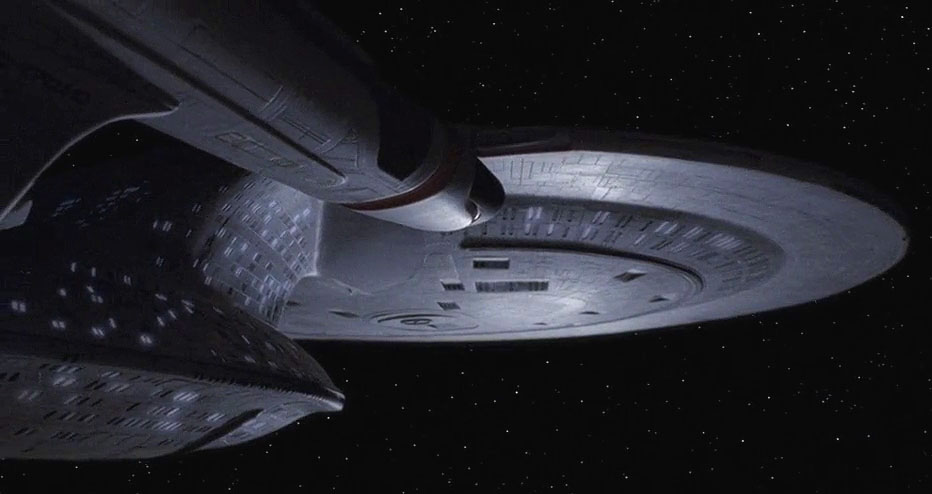
The Enterprise in 'sleep' mode. 

I should note that this episode was written by future Battlestar Galactica mastermind, Ronald D. Moore. The focus here is entirely character driven, and on putting these characters in unfamiliar territory. Situations counter to their nature. Captain Picard has to lead a group of children. Worf has to guide a woman through childbirth. And, the situation with the potential for the most disaster, Troi is put in command of the Enterprise.

Captain Picard has promised the winners of the Enterprise children's science fair a special tour of the ship. Picard, who in the pilot of the series stated that he's uncomfortable around children, is forced to get in touch with his paternal instincts and lead the children through the disaster. Throughout the episode, Picard has to adjust to leading children, something he admits to having little experience. By the end of the episode, he's bonded with these children. Effectively overcoming his admitted awkwardness with kids. Which means, by the end of the episode Picard is now without any weaknesses whatsoever. Because he is awesome.

When the accident happens, a redshirt bridge commander -- who we've never met before — bites it, and leaves Troi in command. Troi, it turns out, has the rank of Lieutenant Commander. This is not a thing that comes up often. Or, well, ever. Usually her role in the show is to state the obvious or move the plot forward. Here she's got to and she transitions from a position of uncertainty, blindly taking suggestions from O'Brien and Ensign Ro, to making command decisions that saves the lives of everyone on the crew.  But she does so on nothing but blind luck.

With no section of the ship able to communicate with any other part of the ship, their plan to save the Enterprise is dependent on someone alive in engineering able to reactivate the antimatter containment field saving the ship. Ro pushes for Troi to separate the saucer section and save everyone they can. And pushes hard. Troi refuses, wanting to give everyone the best possible chance to survive.

Troi is running entirely on faith, with no evidence that there's anyone else alive on the ship. Why she can't sense them is a convenient oversight in the story. But it's the convenience of her being right that kind of irks me here. There's an infallibility to the crew that cuts out the dramatic tension. And though there was never any real threat of the Enterprise blowing up, the only real consequence is the aforementioned redshirt. Everyone does the right thing in this episode. And every decision is validated with success. Fortunately, Riker and Data's head (see the episode, it'd take too long to explain) make their way to Engineering just in time, and everyone gets a mega-happy ending.

"Where is my happy ending, Counsellor?" — Data

Marina Sirtis does a good job of showing someone completely out of her element finding confidence in their decisions. When she finally takes control she does with as much gravitas as she's able.

And Worf delivers a baby in Ten Forward. Hilarity ensues.

My Favorite Moment in the episode... When Picard meets the winners of the children's science fair, he asks them about their experiments. The youngest of them had the strangest, and most awesome response. The boy said, "I planted radishes in special dirt and they came out all weeeeird." Complete with maniacal grinning and finger steepling. Aaaaannd, what? What the hell kind of mutant soil are they letting kids play with? What the hell kind of kid would want to do that? What the hell, Next Generation? Maybe growing up on a starship warps kids in ways we can't possibly imagine. During the episode, when Picard is trying to boost morale of the kids by assigning they ranks in their small crew, he appoints the kid the Executive Officer in Charge of Radishes.

It's a position that will not turn out well for any radish on board.

--

Next up on the list, Voyager's two-part 'Future's End.' Voyager travels back to the distant past in the 1990s and the villain is Ed Begley, Jr. If that doesn't sound like a recipe for success, then...

Okay, I have no idea how to finish that sentence.