Showing posts with label Borg. Show all posts

Friday, April 22, 2016

75. The Raven

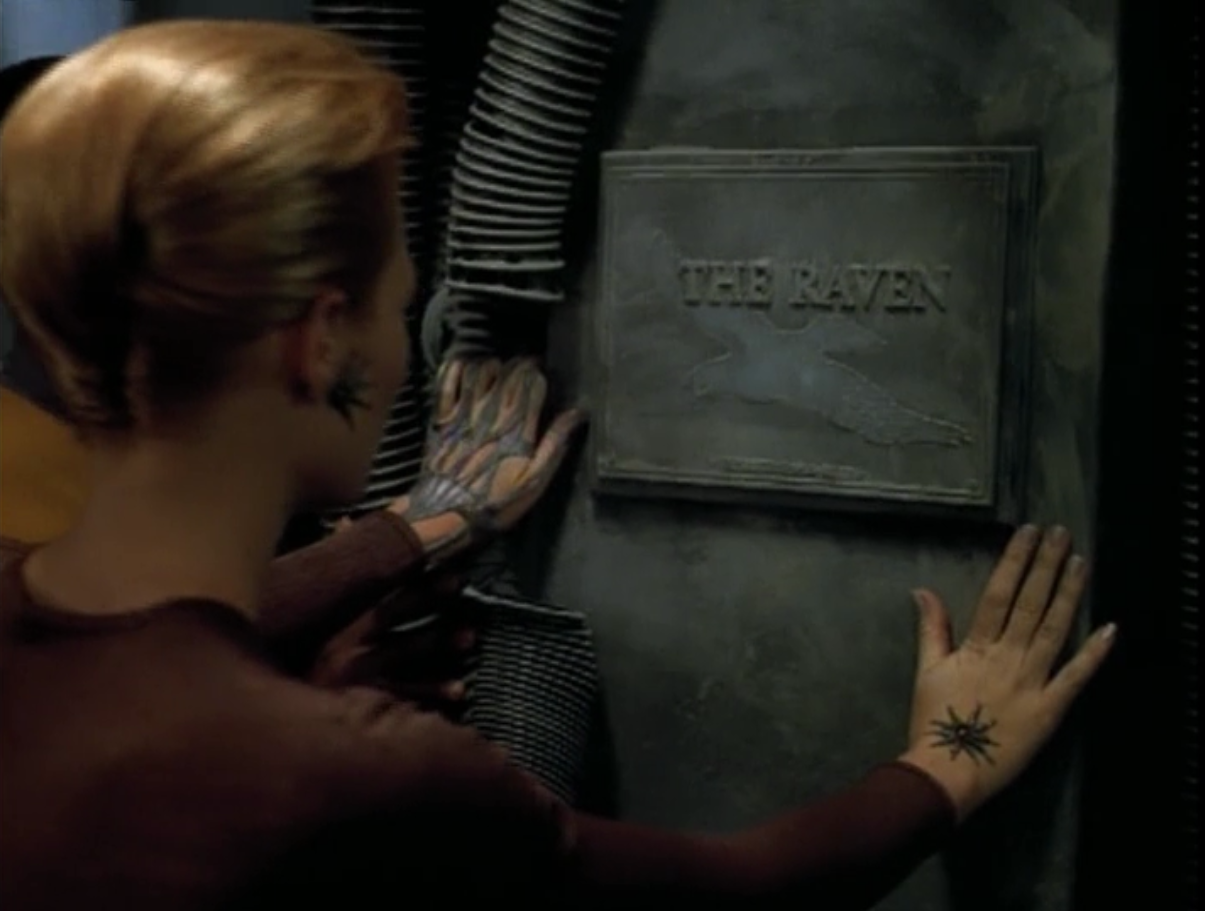
Seven, don't panic, but there's a Borg spider on your hand. Seriously, don't panic. 

75. The Raven, Voyager, Season 4, Episode 6

As you may have noticed, I've strayed from my initial mission statement of reviewing the Top 100 Star Trek Episodes of All Time, as compiled by io9. There is a very good reason for that. I took a job in Japan and one of the many, many differences between the United States and Japan is that Japanese Netflix doesn't have any of the series. In fact, the only two pieces of Trek available to me are Abram's Star Trek and Star Trek Into Darkness. While, I'll get to reviewing those films later, because I cannot stand the vacuum of Trek in my life right now, I wanted to get back on track, with at least this review that I started before I began my journey to the Land of the Rising Sun.

And now, without further ado, let's set course for the Delta Quadrant.

It's a common belief that Seven of Nine, Tertiary Adjunct of Unimatrix Zero One, 'saved' Voyager. I'm not sure that's consistent with fact. I would say that that's more to the presence of the Borg than that particular character. And though the first episode in which she appeared had relatively high ratings, it was the part two of a cliffhanger that found Voyager in the clutches of the Borg. I understand the ratings for the show went back to normal, yet Seven of Nine, Tertiary Adjunct of Unimatrix Zero One, remained pretty much the focal point of the show from the moment she arrived until the series finale.

"Excuse me, my ocular implants are up here." — Seven of Nine, Tertiary Adjunct of Unimatrix Zero One


Up until she arrived, the show had steered away from cheesecake. The show had three prominent female characters and none of them were overly sexualized. Janeway was, for all intents and purposes, Picard with better hair. B'Elanna was portrayed as a smart, strong, if sometimes cartoonishly angry character. And while there was a certain manic-pixie-dreamgirl quality to Kes, she was never really presented as a sex symbol. But Seven of Nine, Tertiary Adjunct of Unimatrix Zero One, was front and center with her silver catsuit, Borg enhancements, and characters inexplicably falling for her despite her being a flat out horrible person. Seriously, Harry, Chakotay and the Doctor all fell hard for her despite her having nothing but contempt for pretty much anyone and everything that wasn't Borg.

I guess that I was supposed to find Seven of Nine sexy. I didn't. This is not because Jeri Ryan did not have a pleasing shape that was squeezed into a skintight catsuit. She did and it was. It was because the character was a terrible person. Arrogant. Rude. Entitled. Mean-spirited. Intentionally unlikable. She was interesting, but horribly unlikable.

Worst of all, her presence changed one of the greatest villains in all of Trek history into being a non-threat. Through her, the Borg became familiar. And that familiarity bred contempt. I'll dig into this a bit deeper when we get to episodes like, I, Borg or Best of Both Worlds, but the Borg were legitimately scary. They were partially scary in that their appearances were scarce. The were a shadow threat that loomed over the Next Generation crew. The creators of the show were wise to keep their appearances few and far between. That is, they were scary until Voyager defeated them left and right using their own technology as an intergalactic cure-all for seemingly every situation. I'd love to see how many episodes were resolved by modifying Borg nanoprobes, because there were a lot. The Borg went from being the embodiment of the loss of self through technology to an irksome nuisance.

While she may be an interesting character, Seven of Nine, Tertiary Adjunct of Unimatrix Zero One,  pretty much guaranteed that any chance Voyager ever had from getting out of TNG's shadow was nil. They essentially assimilated the Borg into their cast. Don't get me wrong, I do like Voyager, and there are some great episodes on this list yet to explore. But Seven of Nine, Tertiary Adjunct to Unimatrix Zero One's addition to the cast was a fundamental shift in the show's dynamic, and I'd argue not for the better.  She became the show's new toy. Janeway was constantly trying to explore her humanity, and teach her about the importance of her free will outside the Borg Collective. I'll skip over the painful, painful irony of Janeway denying Seven's choice to rejoin the Collective because she's trying to get the former Borg to understand the concept of freewill. Over the next few seasons, their mentor-student relationship became tiresome and repetitive.

With the Raven, we get a little bit more about her backstory, and how as a child she was assimilated and raised by the Borg. A mysterious signal triggers something in her brain and she is driven to rejoin the Collective. As she traces the source of the signal what we find is the wreckage of her parent's ship, The Raven. This is where Anaka Hansen was filled with robot parts and had everything she was carved away and turned into a microscopic cog in the infinite machine that is the Borg Collective.

We're even robbed of the connection between Janeway and Seven in the resolution. And in the end, it's Tuvok, not Janeway, that shares the moment of her repressed memories of her assimilation being unleashed. Seven has a breakdown, and it reveals that Ryan's acting chops are far more suited to standing still and hating people while looking good doing it than trying to show a genuine emotion. She's clearly pushing herself as a performer, but the scene is awkward and forcing too much down our throats in terms of emotional connection to the character.

From her facial expression, I'm pretty sure Ryan can smell the clunkiness of this scene. 
This is supposed to make her sympathetic, but I felt it was too rushed. Like we're checking off a box with Seven's origin, rather than getting to a place where her origin mattered. I would have much preferred to see her explored a bit more and see a bit of her PTSD creep in over the course of a season before we rush to her origin story. This was just a few episodes after her debut, and if Janeway and crew had a better chance to care about her, her drive to rejoin the Borg would have had more weight. This would also have given the audience to better understand Janeway's drive to maintain Seven's humanity. If she cared about her as a person rather than as an intellectual and ethical exercise in preserving one's individuality. 'Assimilated as a child' is all we really needed to know about her backstory, and while this episode fills in the gaps to her tale, it doesn't have the emotional resonance that I would have expected from one of my favorite Trek and TV writers and personal heroes, Bryan Fuller.

As she evolves and develops her human side, there are great moments with Seven of Nine throughout Voyager. This is just felt too much too soon.

--

Next up, we take a trip to a museum dedicated to the most ruthless villain in Trek History, Katherine Janeway, with 'Living Witness.'


Sunday, June 7, 2015

#83, Timeless, Voyager, Season 5, Episode 6


An episode so time-travely they borrow Doctor Who's time vortex. 
In this episode of Voyager we get a glimpse of an alternate future, where an aged Harry Kim and Chakotay travel fifteen years back in time to undo a mistake that cost the crew of Voyager their lives. They're gruffer and grayer than we know them. They've turned their backs on the Federation, committed treason, stolen a ship and a piece of rare Borg tech, and are racing against the clock to send a message back in time to save their crew. Also, they have Captain Geordi LaForge, commanding the Galaxy Class starship Challenger, on their tail.

Harry and Chakotay have a confederate in this. Chakotay's girlfriend, Tessa, who's perfectly willing to die to help Chakotay. She faces death at the hands of the Challenger's torpedoes with a kind of blasé attitude that makes on wonder what kind of effed up relationship she has with Chakotay. Throughout Trek in it's many incarnations, there's this kind of detached calm when things are blowing up around people. Seriously, next time you watch an episode look for the 'I'm-just-doing-my-job' attitude that comes from extras and guest-stars in the show. It's kind of eerie. Tessa goes about her business as if changing time and exploding are perfectly normal.

The best moment in 'Timeless' comes at the beginning, when Voyager crashes into a planet and gets engulfed by a glacier. For a show (and series) where a lot of space action happens off screen to save money (i.e. holding on Tom Paris, for example, when he announces, "The enemy is exploding. It's spectacular! I wish you could see this!"), it's nice to see a big moment in the show. The crash looks great, and the special effects hold up well lo these many years later. The image of Chakotay and Harry, decked out in space parkas finding the englaciered Voyager is well done, and immediately sets up a the mystery. And like every mystery in the post-Seven-of-Nine era of Voyager, it's solved by Borg-technobabble. Considering how effing magic the Borg's technology is, it's astounding they haven't conquered the galaxy yet. More on that later when we get to more Borgy Voyager adventures later in this countdown.

'Let it go. Let it go.' — Elsa Janeway

Also, it's nice to see that Geordi gets a promotion to Captain in the future. It's always a treat for me when the series cross over with one another, even if it's for a glorified cameo. Although, for whatever reason, it looks like Geordi is commanding his ship from his ready room. I'm going to guess that reason is budgetary. It's a nice reminder that Voyager, despite it's premise of being lost thousands of lightyears away from home is still part of the larger fabric of Trek mythology. I've never been a fan of the extended universe for Trek. I've read a few of the novels — don't judge, I went through massive withdrawals when TNG went of the air — and find them lacking. None of the video games have ever caught my attention. So, it's fun to get to see where the next generation Enterprise crew land in the future, and fill in some of the gaps between the end of the series and 'All Good Things.' It carries massive good will to Voyager for me, and fills in the connective tissue of the universe.

"Though you might be tempted, don't read Star Trek novels." — Captain LaForge of the U.S.S. Reading Rainbow

Now, if there's one thing that Voyager, as a show, can do, it's ignore the crap out of temporal paradoxes. I'd love to see a quantitative analysis if the show, breaking down the number of episodes that deal with mucking with time as a concept. We've seen two in this list alone just from Voyager. A quick look at the list, and we've got another 15 or so that deal with time travel, or alternate timelines in some capacity, not counting any Temporal Cold War shenanigans from Enterprise. And in this episode, logic gets shoved right out an airlock as Harry and Chakotay race against the clock to save Voyager in the past. When they succeed in sending their message back in time, they erase the timeline that enabled them to save Voyager. Janeway even shrugs off the paradox with an "Eh, fuck it. Time paradoxes. What you gonna do?" I'm paraphrasing the captain, of course, but that's the gist of how 'Timeless' ends.

Then, we have a message from elder Harry Kim from an alternate future addressing his former self, and letting him know what his hubris might have cost the crew. Time logic problems aside, I wish the moment had had more gravitas. Part of the problem with putting our heroes outside their norm is that we don't get to see these new incarnations of the crew fully fleshed out. As elder Harry Kim, actor Garret Wang growls his way through the episode and I never got the sense that he was playing the truth of his situation. There are hints of PTSD and survivor's guilt, but the episode also has to shove in space battles and slip-stream-drive-technobabble, too. This truncates the character moments, and making me wish we had more time with this reality.

If there's a reoccurring theme in the episodes that I've seen on this list, it seems to be taking our characters out of their normal roles and throwing them in a situation, environment or timeline they find wholly out of the norm for a crew of a starship/space station. We've seen it in 'Parallels,' 'Little Green Men,' 'Bride of Chaotica,' 'The Killing Game,' and 'Future's End.' I'm making an observation, here, not a judgement, but that's almost a third of the episodes on the list so far. I can see the appeal from a creative standpoint. It shakes things up both for the audience and the writers and performers.  I'm going to keep an eye on this trend as the countdown continues, but for now, I'm just going to welcome 'Timeless' to that list.

--

Next up, the crew of the Enterprise-D face a 'Conundrum.'

Thursday, May 28, 2015

#84, Parallels, The Next Generation, Season 7, Episode 11

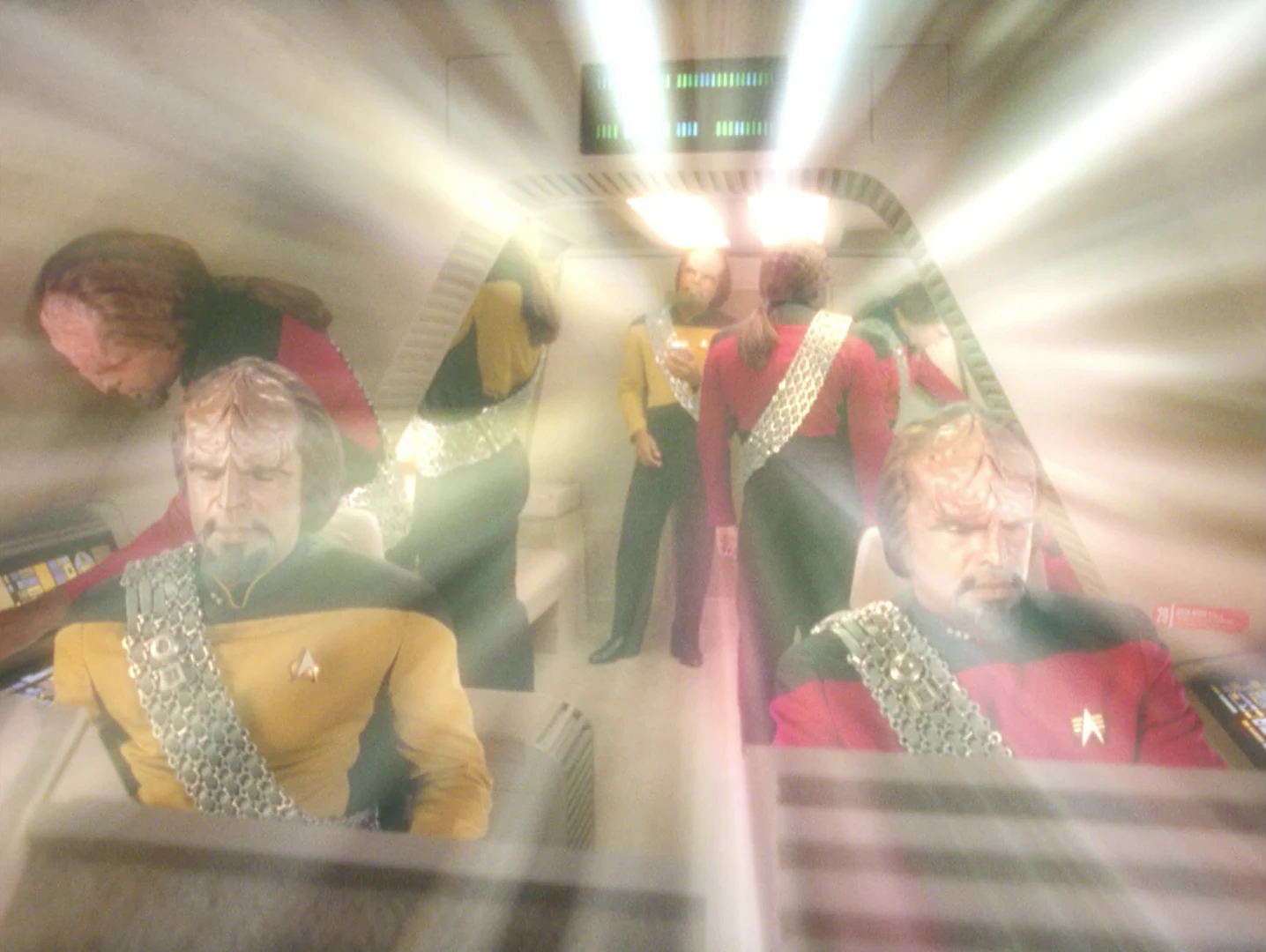
"Ahead full! Maximum Worf!" — Worf
I'm not going to lie. I was worried about this episode. Worried because when I announced that 'Little Green Men' was on the docket, I also announced how much I liked it. But when I revisited that episode, I realized that it didn't hold up to my memory. Part of this is the nature of comedy. Much of comedy relies on surprise. A set-up followed by misdirection. A classic structure of expectation and reversal. A third phrasing of that thing. A big part of my reaction to that episode was that it just wasn't all that funny. I've always found Trek better at being 'amusing' than 'funny.' 'Little Green Men' was just a little too-not-at-all-that-funny for my tastes.

That being said, I really, really remembered liking 'Parallels' and I was worried it would fall short of my expectations. After watching, I'm pleased to say it's still a great deal of fun, as Worf bounces from parallel reality to parallel reality, drifting further and further from the Enterprise he knows. As he shifts, the changes in his surroundings go from subtle (the cake is a different color!) to drastic (Riker is Captain!). It's one of those episodes that takes our familiar characters and puts them outside their comfort zones. What is at first contributed to a concussion from a bat'leth tournament messing with Worf's memories quickly escalates into him realizing that he's no longer in his home reality. Worf is lost, unsure of where he is or what's happening thanks to some shuttle accident and Geordi's visor, or something. The technobabble and technobabble solution aren't not really the problems here. Worf's motivations as a character are.

Worf rolls with the changes fairly well at first, assuming his memory is suspect thanks to the aforementioned blow to the head. But, history keeps changed around him. And not little things.  Deanna Troi is his suddenly his wife. Picard is dead at the hands of the Borg. Data has blue eyes. Dr. Crusher is no longer the Chief Medical Officer. Their combadges are slightly different. It's madness.

"Come, sit down, embace this new me-filled reality." — Deanna Troi
What I find interesting is that the reality in which Worf finally finds himself is a fairly sweet one. He's gotten a promotion to first officer of the Enterprise and is happily married to Deanna Troi with two supposedly beautiful children (we never see them). It's not until he realizes that in this reality, his son, Alexander, was never born, that Worf's drive to return home kicks in. Sirtis does a great job of handling Deanna's complex emotional roller coaster as she realizes that Worf not only has no memory of their relationship, the man she knew and loved is gone. Replaced with a man from another world. It's a completely weird thing to ask of an actor, but I think it's handled well.

If I have one major complaint about the episode (I have second but it isn't critical, and is super-nerdy) it's that the episode spends a great deal of time establishing what is essentially a non-mystery. The audience is so far ahead of the characters in this episode on what's going on, it's painful to watch the them catch up. They spend way too much time with the setup and explaining to the audience what a parallel reality is. It's a fairly well-known science-fiction trope and I feel we could skip a fair amount of this and get straight to the emotional conflict in the episode. I say a non-mystery because the reveal of what's going on is in the damned title. Doesn't take a warp-engine specialist to put two and two here.

The episode is very character heavy, where a man who is normally sure of himself, questions everything around him. There's not much driving the story forward, past the mystery we already know the answer to. So, the episode lumbers a bit. We have new, shiny things to look at, but it does drag. There are a few red herrings. Cardassians tamper with a space telescope, and aggressive Bajorans strike against intruders to their territory, but neither pay off in a satisfactory way. It's not until the barriers of reality start to break down that we have an actual threat to deal with, and Worf has any kind of decision to make.

My second complaint about the episode is far more nit-picky and about the Son of Mogh himself. In this episode, Worf comes across as the Klingoniest-Klingon-to-ever-Klingon-a-Klingon. And it bugs me. The episode starts off with Worf returning from a bat'leth tournament, which sounded an awful lot like an Olympics where competitors get impaled. Or, I imagine something akin to MMA, but with giant knives. But not only did he compete, he won with Grand Champion standing. I call shenanigans.*

Worf going off to a bat'leth tournament as a spectator I totally buy. He wasn't raised by Klingons and Worf has always struggled to connect to his heritage in a meaningful way. Worf running off to learn what it means to be a Klingon is a reoccurring character theme. But for him to go to this tournament and win, I just don't buy it. Having competed in martial arts tournaments (I have, don't laugh), I can tell you the people that win those trophies on that level are preternaturally gifted, train non-stop or both.

Worf is a capable officer and warrior, but for him to be competitive amongst natively-raised Klingon warriors, living in a society where competition pushes each of them to the extremes is not credible. I get that we need a mcguffin for him to recognize what reality he's in, and what's changed. As a symbol of the changing realities, his grand master trophy changing from 3rd place to 9th to a participatory ribbon certainly works. It just stands out as being a little too Klingoniest-Klingon to me.

As he swapped realities, it would have been great to have seen Worf in a wind up in a place where Klingons ruled the Federation, which may have been a real emotional challenge for Worf. Here we'd have a character who's struggled with connecting with his heritage, and then have to choose to give it up in order to save reality.

While it's fun to subtly change things around Worf, things never drift too far from the Enterprise-D we know and love. The changes aren't really that drastic. Worf pops into a reality where Wesley Crusher is the tactical officer (one once again questions the wisdom of Starfleet HR). And it would have been great to have Dr. Kate Pulaski show up as medical chief in a cameo. I love that there's something meta here. It's like we're looking at the series in alternate timelines. It's almost as if they're embracing the fan rumors/theories that Stewart wasn't going to return for season three after 'Best of Both Worlds.' Or looking at what if Wil Wheaton had stayed on with the series to become Lt. Crusher?

"Ugh. Pressing space buttons is so beneath my preternatural genius." — Tactical Officer, Lt. Wesley Crusher 
The mind, it boggles.

If anything, I wish they'd gone wilder with it. And weirder with it. We get hints of it with a reality where the Borg have conquered the Federation. When Worf's shuttle takes off to seal the anomaly, it's threatened by a panicked and mountain-man-bearded Riker. He's so desperate to do anything to keep from returning to his nightmare that he'd rather face the breakdown of all existence than the Borg. There's a surreal moment, when New-Reality-Riker is forced to kill Mountain-Bearded-Riker, but it's soon passed. If we had gotten to the answer to the mystery sooner, we might have had a chance to explore some of the more extreme tangents in Enterprise reality. As it is, it's a slow start and a rushed ending.


"The Borg are everywhere! There's no shaving cream or hair gel left in our reality! We won't go back!" — Riker

It's still a fun adventure, but I find myself pondering what might have been. I can't decide if that's appropriate or ironic considering the nature of story.

---

Next up, a 'Timeless' adventure with the Voyager crew. So, the Voyager crew and time travel? Again?

We'll see.

---

*I wanted to use the Klingon word for 'shenanigans' here, but, sadly there isn't one. 

Tuesday, February 24, 2015

#87, Deja Q, The Next Generation, Season 3, Episode 13

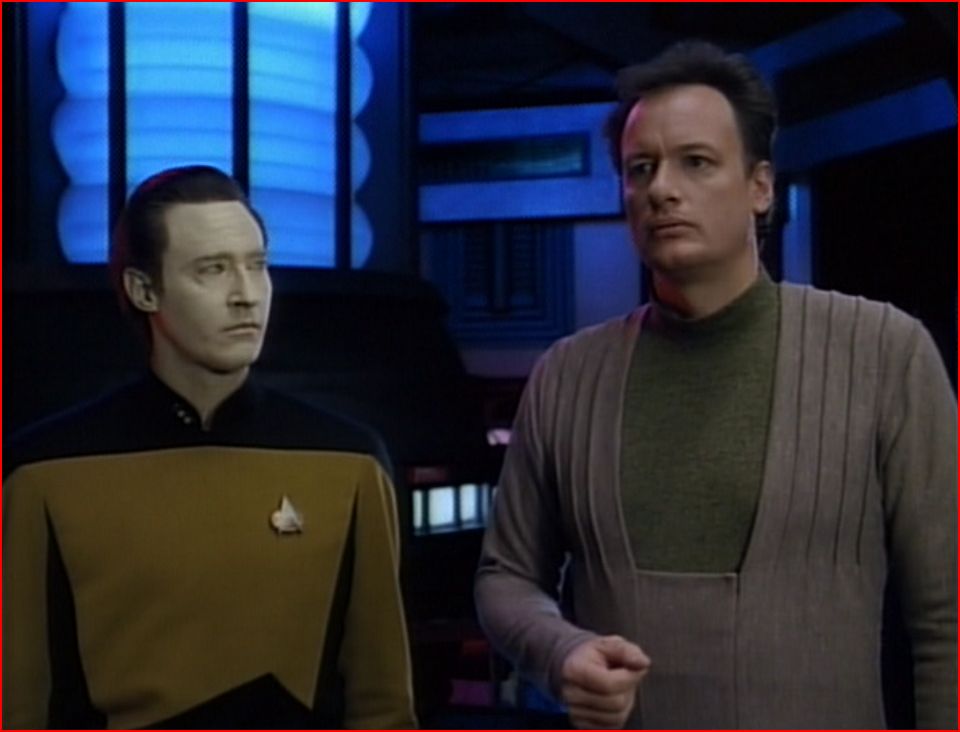
"As an android, I'm incapable of disliking you, Q, and yet, somehow, I do." — Data
Q's introduction to the series was, frankly, off putting. His first meeting with the Enterprise feels mashed together with another adventure. Two puzzle pieces that never quite connected together smoothly. Which fits, as from my understanding of the history of Encounter at Farpoint, that's very much what happened as Roddenberry and crew were launching the series. Granted, it was a pilot, and chock full of expositiony bullshit that plague many pilots. However, it seems to me that they only had a vague notion of what Q was and what they wanted him to be, but he wasn't there yet. He came to the Enterprise appearing as a 16th Century Explorer complete with thous and thees, a WWII soldier worried about Gerry, then some post-apocalyptic judge in a robe in a weird hat. It didn't help that Encounter was still figuring out literally everything about the series, and Q was as much a mouthpiece for exposition as anything. He was there to help set the status quo, explain where humanity was, and how far they had yet to go. His powers were ill defined, his mannerisms erratic, and the logic behind his encountering with humans is, shall we say, convenient with the needs of the show. Why the Enterprise and not Earth proper? Why use a weird forcefield? Why go through different eras of humanity (and appropriate accents) to communicate with Team Picard when you've reportedly been watching humans for a very long time? Eh, why the fuck not? Let's get on with the show, people, we have a fictional world to establish!

He'd appeared a few more times before this episode, Deja Q. Once to temp Riker with the god-like powers of the Q-continuum. And once to introduce the Borg and teach Picard a lesson in humility (the latter episode is not great, but the things it leads to are). DeLancie seems to relish playing Q, and he plays the smug, arrogant, and self-serving god-like being with a wink and a smile.

In many instances, Q has to stoop to humanity's intellectual level, and he seems exhausted doing it. He's a malicious scientist, poking at a mouse, trying to get the mouse to run through a maze. The mouse never understands why, it just has to run the course until it gets its cheese. Or not. Sometimes the mouse gets the cheese, sometimes, (as in the first Enterprise's first encounter with the Borg) he has to take the mouse out of the maze and reset the experiment. He's a great foil for the series, the Mr. Mxyzptlk to Picard's Superman. Logic and technobabble don't matter when he shows up. He's freaking magic. And the Enterprise crew has to cope with a power they can't understand. The Enterprise is never any real threat to him. Not ever, in the series. Except once. Here, in Deja Q.

Both figuratively and literally, Q is, for all intents and purposes, the trickster god archetype. And in this, his fourth appearance, they finally figured out that he should just be fun. Because this is a fun episode. Mostly because humans, and being human, are so effing stupid. Q is stripped of his godlike powers, turned human, and abandoned on the Enterprise to spend the rest of his limited existence as a mortal.

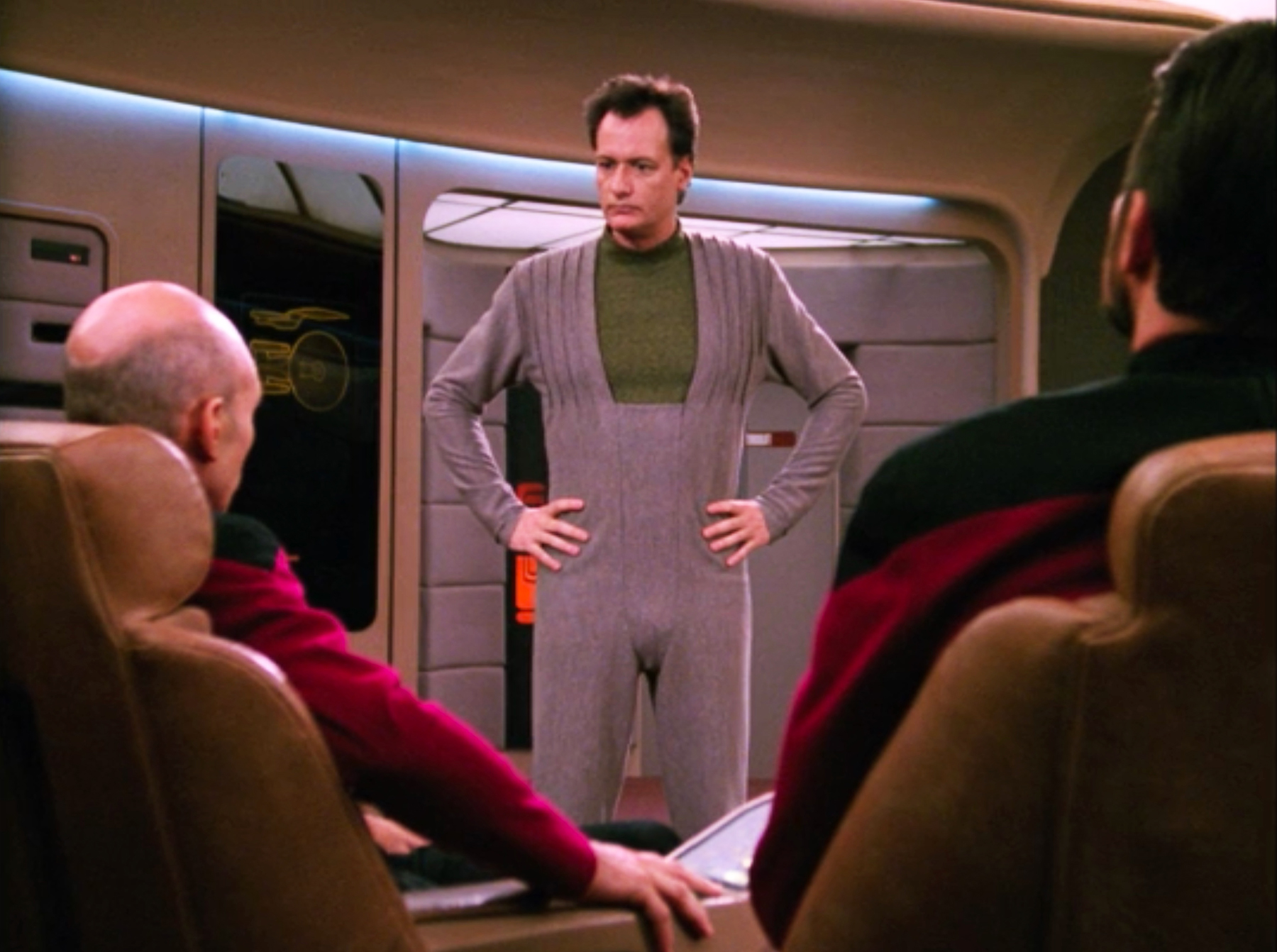
Space onesies. Mortality apparently means space onesies.
Do they trust their former tormenter? No, dear reader, they do not. Picard is facing a crisis of his own, a moon to an alien world is threatening to crash into its parent planet. Not only does he think that Q is responsible for the natural disaster, he also believes that this is some intricate ruse on Q's part to test them. Side note, only Picard can use the word 'ruse' and get away with it. I can't even type it without feeling like a fraud.

In contrast to the flamboyant DeLancie as the newly mortal Q, he's paired with Spiner's ever-quizzitive and serene Data. And while in normal circumstances it would be so completely on the nose it would be painful -- having a being who is revolted by having humanity thrust upon him, and the being for whom humanity is a goal forever out of reach -- I forgive it here because the interplay between Q and Data is just that damned entertaining. While Q learns the hardships of his newfound biological needs -- like sleeping, gross, and hunger, double-gross! -- Data is there to remind him of the gift of, if not humanity, than at least perspective. Q has spent countless millennia toying with lesser species. Now that he's vulnerable, he at least has some idea of what it means to face his mortality.

To prove his worth to Picard, Q is assigned to help Geordie and Data figure out how to stop the alien moon from crashing, which may literally be the most boring thing any Star Trek crew has ever faced ever. Even the people on the planet can't seem to muster any sense of urgency faced with the eradication of their populous. Seriously, why are these people so damned calm? The aliens appear slightly tense, but otherwise, they're just doing their jobs. Pushing the space buttons and what not. I, on the other hand, would be freaking the freak out if the moon were going to crash into the planet. And not just a little bit. I'm talking full-on, last-days-on-Earth-shenanigans-that-would-only-come-to-pass-if-society-rules-were-out-the-windows-dogs-and-cats-living-together-mass-hysteria-level fun. I would not take the end of the world well is all I'm saying.

"No, it's fine. Our planet is going to be destroyed, and we're relatively okay with that." — Doomed Aliens
In the midst of this, the most boring challenge ever in the history of space, Q is attacked by one of the species that he formally tormented. Picard makes the choice to protect Q, against all logic, because it's the right thing to do. Does Picard like having to risk his ship to protect this former god-like being? No, dear reader, he does not. But Q is now a member of his crew, and it's the right thing. There's a bemoaning hesitation on the Captain's part, but it soon passes. He's risking his ship and his crew over one person. Would he do the same for a nameless gold shirt serving on the lower decks of Engineering? I would have to say, probably. Which is why Picard is the best man suited for the chair of the Enterprise D.

Q eventually realizes that he must sacrifice himself to save the Enterprise. With that, another member of the continuum appears (LA Law's Corbin Bernsen, randomly, of all people), confirms that Q has learned his lesson, and restores Q to his former power. Q snaps his fingers and resets the moon, and all's right with the alien world below.

"Remember me? No? Maybe as the dad from Psyche? Still no? Understandable." -- Other Q
Now, if this episode totally sucked, unequivocally and inexorably, if the entire episode had lacked the wonderful exploration of humanity between Q and Data, the ending would have still have earned it a spot on the list of Top 100 Episodes of Trek of all time. Because when Q is absolved of his crimes and has his powers are restored, he celebrates is a manner fitting of a next generation trickster god. With a battle cry of "Mon Capitan!" Q presents a full-on mariachi band on the bridge. Picard and Riker are given celebratory cigars, and Data is given a glimpse at humanity in the form of uncontrollable laughter.

The best part of this is that it happened.  
Throughout the episode we're treated to the sarcastic outsider's view of the Enterprise and the world of the Federation, with Q holding up the funhouse mirror to the absurdity of what it means to be human.

Therefore, Data's laughter at the end is wholly, wholly deserved.

--

Up next, the crew of Voyager examines the morality of war with Memorial.