Showing posts with label Voyager. Show all posts

Saturday, May 12, 2018

74. Living Witness

"Please state the nature of the historical inaccuracies." — The Doctor


74. Living Witness, Voyager, Season 4, Episode 23

You could probably argue that this episode broke this blog. And you'd probably be right. It's been a while since I've written on this — nearly two years since I visited the Final Frontier in this fashion. A lot has happened since then, and I've been preposterously swamped with projects both personal and professional... But, that's just an excuse. The real reason I haven't been able to move forward on this list of the Top 100 episodes of Star Trek is this episode of Voyager. I've watched 'Living Witness' several times in preparation of this entry. I've started and stopped this article many times, and I keep coming to the same conclusion... 'Living Witness' isn't really a story. It's an hourlong premise told by a series of unreliable narrators, wrapped in a framing device inside another framing device, offers smorgasbord of 'what ifs,' and has an ending that feels less like a shocking twist and more of an oh-crap-we're-totally-out-of-time-and-need-to-wrap-this-up.

And that's frustrating as all get out, because it's a damn great premise.

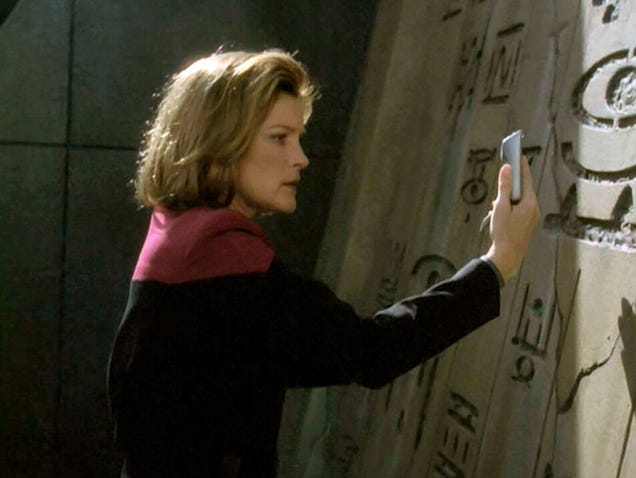
The cold open of 'Living Witness' is just... well, it's nothing short of glorious. An Evil Janeway presides over a Super-Evil crew — the Doctor as a Soong-style android, Seven of Nine in full Borg-mode, Chakotay with an even craaaazier face tattoo. The crew of the Warship Voyager portrayed as amoral genocidal militant a-holes. They find themselves in an alien civil war between generic aliens species one, the Kryians, and generic alien species two, the Vaskans. And everything about this pointed to Voyager dipping their nacelle in the Mirror Universe, until the twist! It's not real! It's a holodeck historical recreation by the Kryians, showing the events of the war — and the villainous acts of the Voyager crew — from the vantage point of 700 years in the future!

The information about the holographic crew of the Voyager is pieced from fragments of knowledge taken from the historical records, filling the holes with that they needed to fit the historian's preconceived narrative. While poking around the artifacts recovered from the incident, they accidentally reactivates the a data module, and a backup copy of the Doctor materializes, believing himself to be still in the middle of the conflict. The Doctor is a living time capsule, who tries to correct the narrative of Voyager being Eeeevil, and tries to present them as unwitting participants in a civil war.

Just like on Earth, in space, history is written by the victors. I know this only because they hit me over the head so hard with this I was knocked out for the better part of two years (as far as you know). It's one of those afforisms that makes me more or less want to projectile vomit, it's so overused. But.. as much as I love snark, let's accentuate the positive, shall we?

"Say... something... nice." — Evil Janeway

Mulgrew is great as Evil Janeway. She's dark and menacing without ever falling into mustache-twirling-terrible territory. Evil Janeway takes morally questionable actions not because she's evil, but because it's the shortest distance between the two points of where she is and where she wants to be. She supports Generic Alien Species One because it gets her closer to her ultimate goal, the safe return of her people to the Alpha Quadrant. Evil Janeway has an ends-justify-the-means-mentality so pure she places herself above morality. Evil Janeway knows what she's doing is extreme, but sees the big picture. She'll use torture, Borg assimilation, and mass genocide if it means getting her crew — nay, her family — home. Mulgrew's Evil Janeway is so great, that when the Doctor presents Actual Janeway in the simulation,* Actual Janeway seems far less interesting.

And let's give a shoutout to Robert Picardo, who always shines as the Doctor, and has to sell the outrage of the portrayal of the crew of Voyager as villains and be the voice of reason correcting the annals of history. Picardo's an outstanding actor, and this episode rests squarely on his shoulder pads. He's the single reason the Doctor is elevated beyond a Data knockoff to being among the greatest characters in all of Star Trek.

What's astoundingly prescient about the episode — especially in a time when anything that contradicts the establishment is dismissed as fake new — is how resistant the powers that be are to truth. The Doctor's more accurate representation of the facts are dismissed as being overwhelmingly biased by those who are challenged. And maybe they're right. The Doctor admits to extrapolating some parts of his recreation based on what he knows about the players involved, and not objective truth. Because this episode is presented as a layer within a layer within yet another layer with unreliable narrator telling the story of another unreliable narrator, there is no truth. Only, certain points of view.

Like a lot of entries on the list, it takes a crew we know and places them outside their norm. And this seems to be a reoccurring theme on the list. One of the reasons that Evil Janeway (and evil Voyager crew) works is that Mulgrew (and others) have crafted such a well-defined and morally stalwart character that it's okay to see them out of that norm. 

This is the fourth entry into this list by Bryan Fuller. Now, I love Fuller's work. Wonderfalls, Pushing Daisies, Hannibal, American Gods, and was executive producer and creator of Star Trek Discovery. Heck, I even liked his reimagining of the Munsters with Mockingbird Lane.** He once cited the desire to write Star Trek as the reason he became a professional writer, and that's a thing that I can absolutley relate to. However, as much as I love Fuller's work, I feel one of the reasons I struggle with this episode, is that it feels incomplete.

Once the Doctor gives the impassioned speech about the importance of truth, justice and the Federation Janeway, we cut to another historian presenting another historical recreation set in the distant future. So everything we saw was a historical recreation about a historical recreation. And for that reason, it feels two steps removed from any actual events. Ultimately, there are no consequences, either for the characters or for the show. And without consequences the whole thing falls flat.

One of the frustrating things about the episode is the unresolved nature of the story. Because the episode's rushed ending, the resolution and vindication of the Doctor's point of view feels unearned. The Doctor and we know that Janeway and crew are not Evil.*** Recorded history says otherwise. Obviously we side with the Doctor, but... would we? If we were only presented with the information in the episode, who's to say what we should believe. Okay, then, I'll say it, we might believe that the crew of Voyager were monsters. Horrible, horrible monsters.

Some with weird face tattoos.

Thanks for reading, and welcome back, dear readers.

——

Next up, the Picard brothers get into shenanigans in 'Family.' And by shenanigans, I mean they yell at each other in one of the most poignant and powerful episodes of the franchise.

——

*I know how absurd that reads, even as I type it. 


**Google that. It's fun. 

*** Boring sometimes, and overly reliant on technobabble, but not evil...


Friday, April 22, 2016

75. The Raven

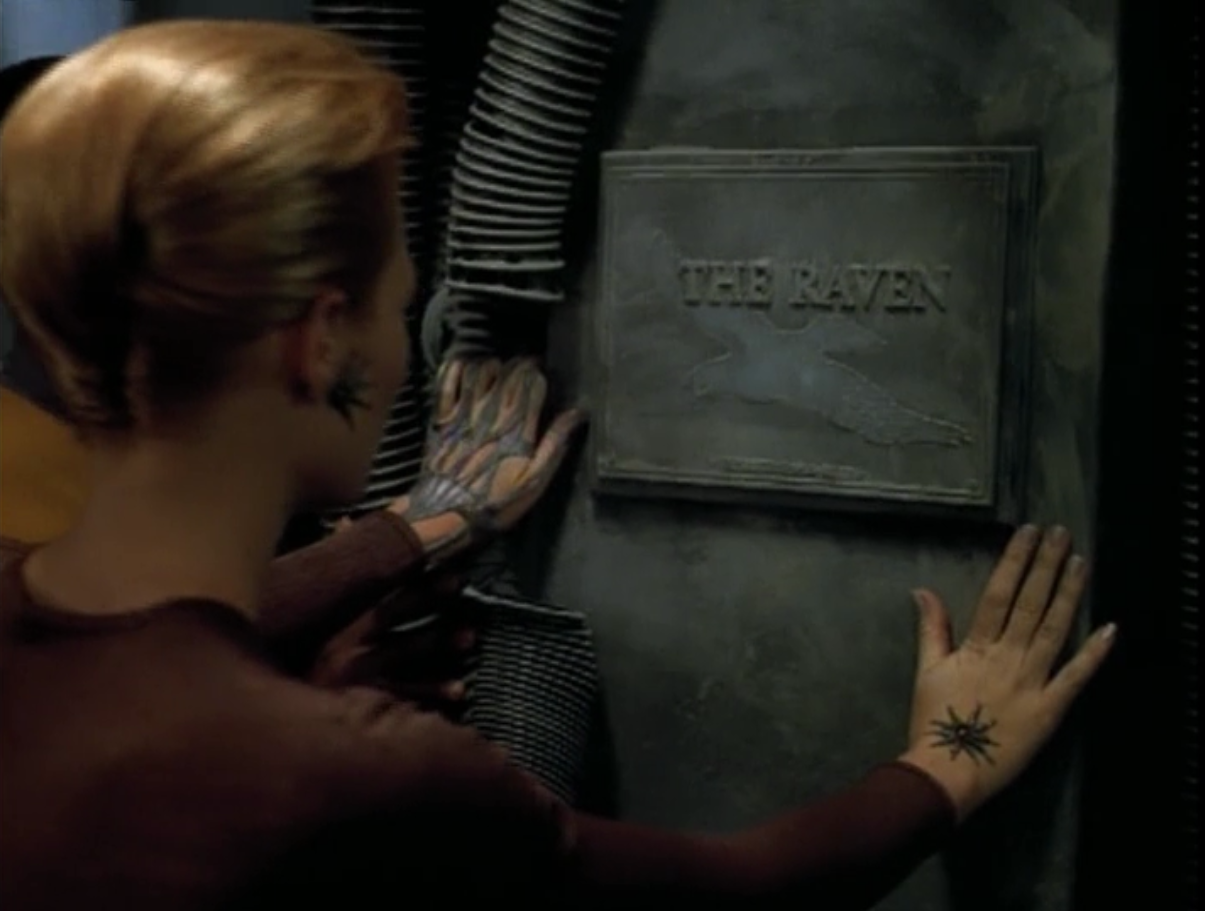
Seven, don't panic, but there's a Borg spider on your hand. Seriously, don't panic. 

75. The Raven, Voyager, Season 4, Episode 6

As you may have noticed, I've strayed from my initial mission statement of reviewing the Top 100 Star Trek Episodes of All Time, as compiled by io9. There is a very good reason for that. I took a job in Japan and one of the many, many differences between the United States and Japan is that Japanese Netflix doesn't have any of the series. In fact, the only two pieces of Trek available to me are Abram's Star Trek and Star Trek Into Darkness. While, I'll get to reviewing those films later, because I cannot stand the vacuum of Trek in my life right now, I wanted to get back on track, with at least this review that I started before I began my journey to the Land of the Rising Sun.

And now, without further ado, let's set course for the Delta Quadrant.

It's a common belief that Seven of Nine, Tertiary Adjunct of Unimatrix Zero One, 'saved' Voyager. I'm not sure that's consistent with fact. I would say that that's more to the presence of the Borg than that particular character. And though the first episode in which she appeared had relatively high ratings, it was the part two of a cliffhanger that found Voyager in the clutches of the Borg. I understand the ratings for the show went back to normal, yet Seven of Nine, Tertiary Adjunct of Unimatrix Zero One, remained pretty much the focal point of the show from the moment she arrived until the series finale.

"Excuse me, my ocular implants are up here." — Seven of Nine, Tertiary Adjunct of Unimatrix Zero One


Up until she arrived, the show had steered away from cheesecake. The show had three prominent female characters and none of them were overly sexualized. Janeway was, for all intents and purposes, Picard with better hair. B'Elanna was portrayed as a smart, strong, if sometimes cartoonishly angry character. And while there was a certain manic-pixie-dreamgirl quality to Kes, she was never really presented as a sex symbol. But Seven of Nine, Tertiary Adjunct of Unimatrix Zero One, was front and center with her silver catsuit, Borg enhancements, and characters inexplicably falling for her despite her being a flat out horrible person. Seriously, Harry, Chakotay and the Doctor all fell hard for her despite her having nothing but contempt for pretty much anyone and everything that wasn't Borg.

I guess that I was supposed to find Seven of Nine sexy. I didn't. This is not because Jeri Ryan did not have a pleasing shape that was squeezed into a skintight catsuit. She did and it was. It was because the character was a terrible person. Arrogant. Rude. Entitled. Mean-spirited. Intentionally unlikable. She was interesting, but horribly unlikable.

Worst of all, her presence changed one of the greatest villains in all of Trek history into being a non-threat. Through her, the Borg became familiar. And that familiarity bred contempt. I'll dig into this a bit deeper when we get to episodes like, I, Borg or Best of Both Worlds, but the Borg were legitimately scary. They were partially scary in that their appearances were scarce. The were a shadow threat that loomed over the Next Generation crew. The creators of the show were wise to keep their appearances few and far between. That is, they were scary until Voyager defeated them left and right using their own technology as an intergalactic cure-all for seemingly every situation. I'd love to see how many episodes were resolved by modifying Borg nanoprobes, because there were a lot. The Borg went from being the embodiment of the loss of self through technology to an irksome nuisance.

While she may be an interesting character, Seven of Nine, Tertiary Adjunct of Unimatrix Zero One,  pretty much guaranteed that any chance Voyager ever had from getting out of TNG's shadow was nil. They essentially assimilated the Borg into their cast. Don't get me wrong, I do like Voyager, and there are some great episodes on this list yet to explore. But Seven of Nine, Tertiary Adjunct to Unimatrix Zero One's addition to the cast was a fundamental shift in the show's dynamic, and I'd argue not for the better.  She became the show's new toy. Janeway was constantly trying to explore her humanity, and teach her about the importance of her free will outside the Borg Collective. I'll skip over the painful, painful irony of Janeway denying Seven's choice to rejoin the Collective because she's trying to get the former Borg to understand the concept of freewill. Over the next few seasons, their mentor-student relationship became tiresome and repetitive.

With the Raven, we get a little bit more about her backstory, and how as a child she was assimilated and raised by the Borg. A mysterious signal triggers something in her brain and she is driven to rejoin the Collective. As she traces the source of the signal what we find is the wreckage of her parent's ship, The Raven. This is where Anaka Hansen was filled with robot parts and had everything she was carved away and turned into a microscopic cog in the infinite machine that is the Borg Collective.

We're even robbed of the connection between Janeway and Seven in the resolution. And in the end, it's Tuvok, not Janeway, that shares the moment of her repressed memories of her assimilation being unleashed. Seven has a breakdown, and it reveals that Ryan's acting chops are far more suited to standing still and hating people while looking good doing it than trying to show a genuine emotion. She's clearly pushing herself as a performer, but the scene is awkward and forcing too much down our throats in terms of emotional connection to the character.

From her facial expression, I'm pretty sure Ryan can smell the clunkiness of this scene. 
This is supposed to make her sympathetic, but I felt it was too rushed. Like we're checking off a box with Seven's origin, rather than getting to a place where her origin mattered. I would have much preferred to see her explored a bit more and see a bit of her PTSD creep in over the course of a season before we rush to her origin story. This was just a few episodes after her debut, and if Janeway and crew had a better chance to care about her, her drive to rejoin the Borg would have had more weight. This would also have given the audience to better understand Janeway's drive to maintain Seven's humanity. If she cared about her as a person rather than as an intellectual and ethical exercise in preserving one's individuality. 'Assimilated as a child' is all we really needed to know about her backstory, and while this episode fills in the gaps to her tale, it doesn't have the emotional resonance that I would have expected from one of my favorite Trek and TV writers and personal heroes, Bryan Fuller.

As she evolves and develops her human side, there are great moments with Seven of Nine throughout Voyager. This is just felt too much too soon.

--

Next up, we take a trip to a museum dedicated to the most ruthless villain in Trek History, Katherine Janeway, with 'Living Witness.'


Wednesday, June 17, 2015

What This Is and What I'm Doing

When io9 posted their list of the Top 100 Episodes of Star Trek as voted on by fans, I took it as an excuse to rewatch me some Trek and to pontificate about it. I've just finished the first 20 on the list, and I'd like to take a moment to reflect. As a reminder, this is not my list. And though I love Star Trek, it is not sacred to me. There are some episodes that I just didn't connect with. Some that have been entertaining but flawed. And some that I've loved.

I'm making a few assumptions with this blog. I'm assuming, dear readers, that you've seen the episodes in question. I haven't been doing extensive recaps of the episodes, and haven't really dived into extensive descriptions of the characters and their general motivations. If you would like to see more of that, please reach out to me and let me know.

Here's the list of episodes that I've reviewed so far:

#100 Bride of Chaotica — A brilliantly madcap episode that pits Voyager against black and white serial villains.

#99 Day of the Dove — Kirk vs. the most bad ass of all bad asses, Kang.

#98 Paradise — Ben Sisko faces off against a cult leader on an alien world.

#97 Borderland, Cold Station 12 & The Augments — The Enterprise stretches an adventure that is a love-letter to Wrath of Khan a little too thin over three episodes.

#96 Lineage — A great character study of B'Elanna and Tom, if you care about either of those people.

#95 The Most Toys — Data is abducted into slavery by a crazy person.

#94 Disaster — Deanna Troi is placed in charge of the Enterprise. Hilarity ensues.

#93 Future's End — A time travel Voyager tale that couldn't end fast enough for me.

#92 The Magnificent Ferengi — A Quark comedy romp that's more entertaining than it sounds.

#91 The Killing Game — The Voyager crew fights Nazis, for some reason that eludes me.

#90 The Booby Trap — Geordi falls for a holodeck physicist, and that's his fantasy? Really?

#89 The Court Martial — Kirk is the manliest man ever to be put on trial for dereliction of duty.

#88 Favor the Bold & Sacrifice of Angels — A two-part microcosm of the best and worst that Deep Space Nine has to offer.

#87 Deja Q — Q returns to annoy the crew of the Enterprise to great effect.

#86 Memorial — The Voyager crew develops PTSD from an alien war they never participated in.

#85 Little Green Men — Quark, Rom and Nog get blasted back in time to 1947 Roswell, New Mexico and hilarity does not ensue. It tries, really hard though.

#84 Parallels — Worf bounces from reality to reality in a mystery that's solved in the episode's title.

#83 Timeless — Harry and Chakotay travel back in time to prevent the destruction of Voyager. I'm not convinced this is the best course of action.

#82 Conundrum — The crew of the Enterprise-D get their minds erased and thrown into a war they have no memory of.

#81 The Enemy Within — Where we get two Kirks for the price of one thanks to a transporter accident.

As we look towards the next twenty, I'm excited about some of the episodes on the list. Thanks for reading, and let's watch some Trek.

Sunday, June 7, 2015

#83, Timeless, Voyager, Season 5, Episode 6


An episode so time-travely they borrow Doctor Who's time vortex. 
In this episode of Voyager we get a glimpse of an alternate future, where an aged Harry Kim and Chakotay travel fifteen years back in time to undo a mistake that cost the crew of Voyager their lives. They're gruffer and grayer than we know them. They've turned their backs on the Federation, committed treason, stolen a ship and a piece of rare Borg tech, and are racing against the clock to send a message back in time to save their crew. Also, they have Captain Geordi LaForge, commanding the Galaxy Class starship Challenger, on their tail.

Harry and Chakotay have a confederate in this. Chakotay's girlfriend, Tessa, who's perfectly willing to die to help Chakotay. She faces death at the hands of the Challenger's torpedoes with a kind of blasé attitude that makes on wonder what kind of effed up relationship she has with Chakotay. Throughout Trek in it's many incarnations, there's this kind of detached calm when things are blowing up around people. Seriously, next time you watch an episode look for the 'I'm-just-doing-my-job' attitude that comes from extras and guest-stars in the show. It's kind of eerie. Tessa goes about her business as if changing time and exploding are perfectly normal.

The best moment in 'Timeless' comes at the beginning, when Voyager crashes into a planet and gets engulfed by a glacier. For a show (and series) where a lot of space action happens off screen to save money (i.e. holding on Tom Paris, for example, when he announces, "The enemy is exploding. It's spectacular! I wish you could see this!"), it's nice to see a big moment in the show. The crash looks great, and the special effects hold up well lo these many years later. The image of Chakotay and Harry, decked out in space parkas finding the englaciered Voyager is well done, and immediately sets up a the mystery. And like every mystery in the post-Seven-of-Nine era of Voyager, it's solved by Borg-technobabble. Considering how effing magic the Borg's technology is, it's astounding they haven't conquered the galaxy yet. More on that later when we get to more Borgy Voyager adventures later in this countdown.

'Let it go. Let it go.' — Elsa Janeway

Also, it's nice to see that Geordi gets a promotion to Captain in the future. It's always a treat for me when the series cross over with one another, even if it's for a glorified cameo. Although, for whatever reason, it looks like Geordi is commanding his ship from his ready room. I'm going to guess that reason is budgetary. It's a nice reminder that Voyager, despite it's premise of being lost thousands of lightyears away from home is still part of the larger fabric of Trek mythology. I've never been a fan of the extended universe for Trek. I've read a few of the novels — don't judge, I went through massive withdrawals when TNG went of the air — and find them lacking. None of the video games have ever caught my attention. So, it's fun to get to see where the next generation Enterprise crew land in the future, and fill in some of the gaps between the end of the series and 'All Good Things.' It carries massive good will to Voyager for me, and fills in the connective tissue of the universe.

"Though you might be tempted, don't read Star Trek novels." — Captain LaForge of the U.S.S. Reading Rainbow

Now, if there's one thing that Voyager, as a show, can do, it's ignore the crap out of temporal paradoxes. I'd love to see a quantitative analysis if the show, breaking down the number of episodes that deal with mucking with time as a concept. We've seen two in this list alone just from Voyager. A quick look at the list, and we've got another 15 or so that deal with time travel, or alternate timelines in some capacity, not counting any Temporal Cold War shenanigans from Enterprise. And in this episode, logic gets shoved right out an airlock as Harry and Chakotay race against the clock to save Voyager in the past. When they succeed in sending their message back in time, they erase the timeline that enabled them to save Voyager. Janeway even shrugs off the paradox with an "Eh, fuck it. Time paradoxes. What you gonna do?" I'm paraphrasing the captain, of course, but that's the gist of how 'Timeless' ends.

Then, we have a message from elder Harry Kim from an alternate future addressing his former self, and letting him know what his hubris might have cost the crew. Time logic problems aside, I wish the moment had had more gravitas. Part of the problem with putting our heroes outside their norm is that we don't get to see these new incarnations of the crew fully fleshed out. As elder Harry Kim, actor Garret Wang growls his way through the episode and I never got the sense that he was playing the truth of his situation. There are hints of PTSD and survivor's guilt, but the episode also has to shove in space battles and slip-stream-drive-technobabble, too. This truncates the character moments, and making me wish we had more time with this reality.

If there's a reoccurring theme in the episodes that I've seen on this list, it seems to be taking our characters out of their normal roles and throwing them in a situation, environment or timeline they find wholly out of the norm for a crew of a starship/space station. We've seen it in 'Parallels,' 'Little Green Men,' 'Bride of Chaotica,' 'The Killing Game,' and 'Future's End.' I'm making an observation, here, not a judgement, but that's almost a third of the episodes on the list so far. I can see the appeal from a creative standpoint. It shakes things up both for the audience and the writers and performers.  I'm going to keep an eye on this trend as the countdown continues, but for now, I'm just going to welcome 'Timeless' to that list.

--

Next up, the crew of the Enterprise-D face a 'Conundrum.'

Saturday, May 9, 2015

#86, Memorial, Voyager, Season 6, Episdoe 14

It's been too long since I journeyed — trekked if you will — back to the Delta Quadrant. I realize now that it's been a while since my last trek-realted post, and for that, I apologize, dear readers. But life gets in the way. Work took a weird turn. I directed a web series due out next month, Assassin Nine and have been busy in post. Designed a card game. Had to vent about Batman V Superman: Dawn if Justice. Which brings me to 'Memorial,' and my general dereliction of duty. But now, I'm back to it, with the latest in the Top 100 episodes of Trek according to io9 fan poll.

I had watched 'Memorial' weeks ago when I first set down to write this entry, and, well, nothing stuck. This is the second time I've watched a Voyager episode in this countdown and came away going, "Yeah, okay, fine, whatever, that happened." So, for a second time, I had to wonder if there's something in this episode that I missed. And as it gnawed at me -- what's the deal with this episode, why have fans dubbed it worthy to be on this list -- I think the point of the episode is that sometimes there is no clear answer. Voyager takes on a heavy, complex topic, but because this is a space-adventure show, it comes at it a bit sideways.

"Ugh, get on with it, already. Seriously." — Tom Paris

Tom, Harry, Chakotay and Neelix are returning from a weeks-long mission aboard the Delta Flyer. When they return to the ship they start having vivid and violent dreams about an armed, alien conflict, where they were participants. These visions go from being dreams to waking nightmares where the characters can't tell the dream from reality. Tom has a breakdown in his quarters. Neelix takes his goddaughter hostage in the mess hall. And the whatever-it-is starts to spread throughout the crew. Nightmares and visions of a way no one had fought. Even Janeway starts to feel the effects of the dreams.

As they follow the mystery and backtrack the Flyer's path, they discover an alien beacon, showing a massacre from their history with the events beamed directly into passerby's brains. They find an alien obelisk on a planet, a memorial to the event that happened centuries ago. Anyone in range relives the firefight, so that it's never forgotten.

The show tries to dive into the moral complexity of war. Showing a military police action forcibly removing colonists from their homes, and things get out of hand. The colonists fight back and someone opens fire and violent higgledy-piggeldy ensues. Other than the commander of the military rigidly following orders (which those types are wont to do) and being a dick about it, there's no clear right or wrong here. It's just people caught in the middle of a difficult situation that has spiraled out of control.

Through the characters, they explore PTSD, with Tom, Neelix, and Chakotay playing the roles of soldiers retuning from duty and trying to re-assimilate back to normal life. Tom comes home to his wife, who greets hm with beer, popcorn and television (literally). They fight. Harry returns to work, and finds tasks that should have been routine, horrifying. Neelix has a complete psychotic break and takes the aforementioned hostage, forever changing his relationship with his goddaughter, Naomi. All of this is pretty heavy stuff coming from a show with space lasers, a woman in a silver catsuit, and a Neelix.

"Don't worry, Naomi! I'll protect you from the nothing!" — Neelix

Let's talk about Nelix. Much of my initial reaction to Nelix as a character was responding to his aesthetic. He, like Quark on DS9, is the alien outsider, an excuse to exposit on the state of humanity in the 24th century. Like Quark, his appearance is over-the-top, clownish among the predominantly black uniforms of the rest of the crew. Initially, I didn't care for him. His make-up and faux-hawk hair were on the side of the ridiculous. But past his leopard-goldfish-bulldog appearance, I do like the character. He's charming, optimistic, and brings a bit of color both metaphorically and physically to the show. Ethan Phillips has to do a hell of a job acting through that makeup job, and when he emotes, it can come across as silly. Not here, though. Here, his pain and fear come off as real as a man in a leopard-goldfish-bulldog mask can.

As the crew finds the obelisk, they spend a hot second wondering whether to turn it off. To prevent others from suffering the same fate as the crew. Their decision to leave it be, at first feels like a cop out. Janeway passing the moral buck because it's not her decision to make. But, it's not. And her leaving the memorial be is the right thing to do, so that the pain and loss of the massacre won't be forgotten. The episode is a bit ham-fisted, but sometimes Star Trek is what it is, a space-adventure show.

'Tricorder is reading high-doses of heavy-handed dialog. The OTN readings are off the charts." — Janeway

Star Trek likes to ask the tough questions. Memorial shows that those tough questions don't always have answers.

--

Next up, we're off the Roswell, New Mexico, for one of my favorite episodes of Deep Space Nine, 'Little Green Men.'


Monday, December 1, 2014

#91, The Killing Game, Voyager, Season 4, Episodes 18 & 19

Don't worry, folks, it all makes sense in the end. Kinda? 
I have to be honest. I'm not 100% sure where to start with this episode. The two-part Killing Game begins in the middle,  so let's start there. A very Janeway-looking Klingon grunting and fighting off a Hirogen — one of Voyager's attempts at making their own Klingons — dressed as a Klingon warrior.

Klinganeway is wounded and it's quickly revealed that it's part of a simulation. The Hirgoen have taken Voyager, and turned the entire ship into a holodeck hunting ground so that they can practice their skills in a number of different scenarios using the Voyager crew as their prey. Memories wiped and placed into these scenarios with no knowledge of self, the crew fight for their lives, again and again. Only to be stabbed, broken, shot and stitched back together so they can do it again, and again, and again.

If there's one and only one thing we know about the Hirogen, it's that they're driven by the thrill of the hunt. The more dangerous the prey, the greater the victory. And like the Klingons they so desperately want to be, they live their lives by a code of honor. The hunt for them is more than a means of proving themselves as warriors, it's the cornerstone of their civilization. It's what drives their exploration, their technology, and their culture.

And what we have is a Hirogen Commander who's thinking about the future. He's identified that his people are in decline. They've stretched their empire as far as they can. Hunted species to extinction in their quest for the hunt. They have entire generations who strive for nothing but tracking prey. In short, they've stagnated. And a civilization in stagnation dies. The Commander has seen this, and is looking for a new path for his people.

Once upon a time in...
     ... Nazi-Occupied France.

He's using the Voyager holotechnology and the ship's computer database to satiate his people's need to hunt and allow for the possibility of other pursuits. He fires up a program set in Nazi-oppucpied France, with the Voyager crew placed in the role of French Resistance fighters and the Hirogen as SS Officers hunting them down.

So, the choice of a World War II scenario to test his men is an interesting one. And by interesting, I mean it seems entirely arbitrary. Like an excuse to mashup aliens and Nazi uniforms. He constantly has to remind his men to 'play the game' instead of resorting to their predatory nature. But why? If there's a direct metaphor between the Hirogen and the Third Reich, I can't quite put my finger on it. The Commander, by his people's standards, is progressive. An asshat who's torturing the crew, sure, but progressive.

It's the not the first or the last time Trek has directly or indirectly addressed Nazis. The Original Series used Nazi uniforms on an alien world. Enterprise will have time travelers help Nazis take over America. And the Cardassian Occupation of Bajor, introduced in the Next Generation and explored more fully in Deep Space Nine, is a direct metaphor for the horrors of WWII.

It's never explained why he chose this program. What he wanted to prove to his men with it. And even the Nazis within the program question the Commanders devotion to the mission of the 'Master Race.' Then, what's the point here? That myopic vision cannot be sustained? That blind devotion to a set of flawed ideals is futile? I'm not 100% sure. And it's bugging me.

"What's the point? How about the point my shoulder pads?" — Janeway 
While Janeway (who, once again, rocks ginormous shoulder pads) and crew regain their personalities thanks to the Doctor, they retake the ship and stop the Hirogen with holodeck characters from other simulations. WWII soldiers fighting alongside Klingon warriors in the corridors of the ship to take Voyager back from the invaders.

While its message may be a bit muddy, erring more on adventure than a moral lesson, this is the type of episode that only Voyager could attempt with a straight face.

Kinda.

--

Next up, Geordi falls for a holodeck physicist in 'The Booby Trap.'

The title is not what it sound like. 

Wednesday, November 12, 2014

#93 Future's End, Voyager, Season 3, Episodes 8 & 9

This is where I take a beat to remind everyone reading that this is not my list of the Top 100 Trek Episodes of All Time. This exercise for me is a chance (an excuse, really) to examine a brand I love and revisit some great moments of science fiction television. So, not my list. I say this because I would have never...

Neh-vher...

...Put the two-part  'Future's End' on any list of anything other than Top 100 things I don't ever need to see again. The Voyager crew travels back in the past to the 1990s to stop a catastrophe in the 29th century and... Because... Ed Begley, Jr.? There's a time paradox and a ship from Voyager's future and the crew dresses all 90s and... Ugh...

Trek is known for its comedic episodes. And this one, well, falls flat. There's a lot of forced attempts at humor in this episode. Neelix watches tabloid tv! Voyager is an UFO on the news! Ed Begley, Jr. is a villain! Janeway wears a pantsuit with giant, giant shoulder pads! The crazy homeless guy who claims to be from the future is actually from the future! Tuvok wears a hat!

"This hat hides both my alien heritage and my dignity." — Tuvok
We even lose some of the time-travel-fish-out-of-water shenanigans because Tom Paris is supposedly an expert on 20th century. And, for all that seems to be be going on with the future time ship, stealing technology from the future, trying to stop the paradox, Tom's romance with an astrophysicist...

Hold up.

Is that...?

Holy crap, that's Sarah Silverman. Mind... blown...

Okay, I digress. For all that's going on, they're seemingly spread too little episode over too much time. It's so thin, that they throw in some survivalists/government conspiracists at the end of the second episode to hold Chakotay and B'Elanna hostage seemingly to just run out the clock and provide a modicum of action. Hacker Begley, Jr.'s main threat to Voyager is taking over their computer so there was a lot of evil typing while grinning maniacally.

Silverman's character, Rain Robinson, is an astrophysicist working for Ed Begley's Harry Starling and is not having any of Tuvok's and Tom's shenanigans. She sees right through their attempts to be 90s. She calls out their odd behavior and isn't fooled by Tuvok's hat covering his ears. She's surrounded by spacemen, aliens, holograms, starships and takes it all in stride. She's written smart and it's refreshing to have someone call bullshit on the things going on around her. If there's one thing that works in this episode, it's one of the icons of the alternative comedy movement playing it straight. A feat of cosmic irony, which I calculate as making zero-point-zero sense.

Silverman makes zero filthy jokes in these episodes. What's wrong with the universe?  

According to rumor, Silverman was considered to be made a series regular, joining the crew. And one can't help but wonder what direction the show might have taken if she had been part of the retooling of Voyager and not Jeri Ryan's Seven of Nine, Tertiary Adjunct of Unimatrix Zero-One. Fewer formfitting silver catsuits, probably, but we'll never know for sure.

Speaking of casting against type, Ed Begley, Jr. plays a billionaire mogul driven to steal technological advancements from the future at any cost so he can sell them for even more billions! He's selfish, destructive, and sociopathic, and carries about as much weight as a substitute chemistry teacher. If I've noticed anything in episodes that I've not really connected with is a villain who's non-threatening or miscast (I'm looking at you Kivas Fajo).

And in complete trekkie nitpickery, there's not one single mention of the Eugenics War that was supposed to be happening on earth at the time of this episode. Not even an obligatory 'historical records must have been off by a few decades' or 'the timeline's been altered.' Come on, Trek! 

Now, it's time to say something nice. These episodes provides the show with an excuse to let the Doctor out of sickbay with a piece of technobabble from the 29th century. Something that the show will play with throughout the remainder of the series. The Doctor, as always, is fun.

Trek in all of its iterations has its ups and downs. What surprises me is how well this episode is rated.   The reviews are generally positive, citing both Begley and the time travel bits as clever. I'm here to offer the counter argument, I guess. This one was just not for me.

Sorry, Sarah.

--

Next up, it's back to Deep Space Nine with the Magnificent Ferengi.

Thursday, October 23, 2014

#96, Lineage, Voyager, Season 7, Episode 12

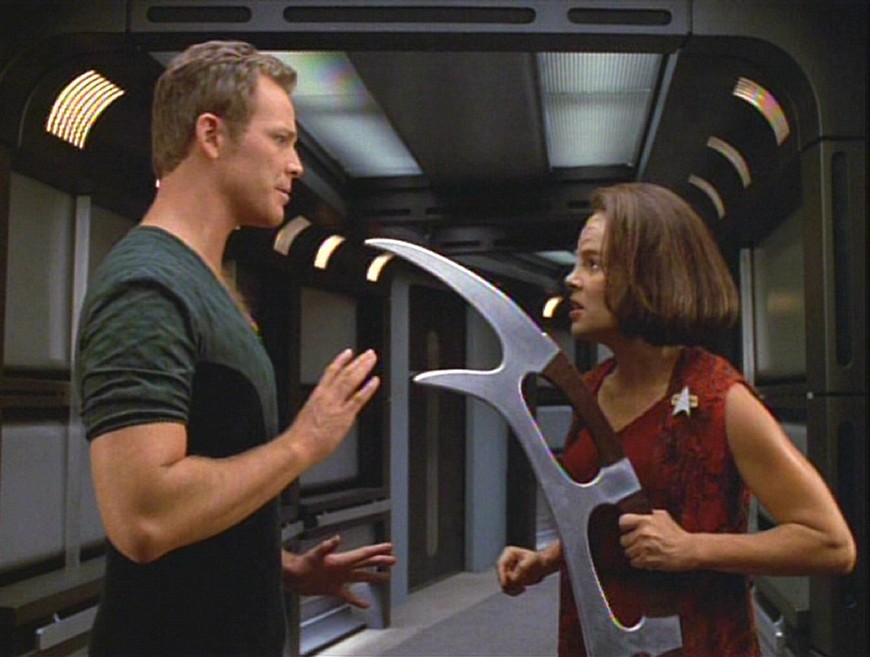
"You don't have to bring a Bat'leth to every argument, you know." — Tom Paris
Our second episode of Voyager in the countdown of the Top 100 Episodes of Trek, and the second one that is Klingon-centric.

Your enjoyment of this episode is entirely dependent on whether or not you like the characters of Tom and B'Elanna. Because pretty much all this episode is, is a character study of those two and their relationship. Particularly B'Elanna, and her self-loathing of her Klingon half.

Your milage may vary, but, I like them enough to find this episode really interesting.

B'Elanna discovers she's pregnant and upon her medical exam, comes to find that there's a complication with the pregnancy. The child has a degenerative spinal disease, passed down from her Klingon side. The Doctor can alter the child's DNA, removing the Klingon genomes causing the disease. And once she realizes that she can remove any trace of her Klingoness from her child, B'Elanna goes to a dark, dark place.

For someone who has always struggled with their mixed heritage, everything B'Elanna went through as a child — her being ostracized for her alien half, her feeling guilt for her father leaving her and her mother — she projects onto her unborn child. Her solution is extreme, to the have the Doctor rewrite the child's entire gene sequence and remove any trace of Klingon. When she learns that doing so would potentially change her daughter's personality, and entire being, B'Elanna pushes anyway. And when the Doctor refuses, B'Elanna goes so far as to reprogram the Doctor to comply (the implications of which is terrifying).

In addition predicting cellphones with the communicator, Trek also predicted the selfie? 
What they're talking about in this is the ethics of genetically modifying a child in the womb before birth. How far can you change someone before they stop being themselves? How far is too far? Where is that line? Who decides where that line is? What say does the father have? The questions proposed is not a subtle one. And, let's be clear, the episode is heavy-handed for sure. But they're tough questions. B'Elanna's diving into dangerous waters, tampering with the DNA of her child with unknown consequences, changing the fundamental personality of one of her shipmates to get what she wants.

The episode demands more of Dawson and McNeill as actors than perhaps any other Voyager episode. Are they up to the task? I'm going to say, mostly. Dawson's B'Elanna usually doesn't have more to do than growl in frustration and stomp around engineering. Granted, she does occasionally smile. But here... she pushes herself as a performer to make B'Elanna's plight sympathetic, and not just, well, crazy. McNeill has to set aside his imitation-Kirk-swagger to try and convince B'Elanna not only of the beauty of their child, but her own beauty. Their relationship has felt forced at times (I even recall an episode where the impetus for their relationship may have been the alien influence), but here it comes across as honest. Tom does love her. He does believe that B'Elanna is beautiful, not despite of but because of her Klingon side. Because it's who she is, and he loves who she is.

There's some klunkiness as the episode finds other things for the rest of the crew to do. Neelix wants to be the godfather. The Captain weighs in on the fact that she can't really weigh in because it's a family matter, and the other crew. Seven of Nine recognizes the irregularities in the doctor's program. Chakotay exists.

I'm wracking my brain to think of another episode of any Trek that is strictly a character study with no subplot to speak of. You could count the flashbacks of B'Elanna's childhood, but those tie directly to her emotional state in the rest of the story (again, this episode was not subtle). There's no exterior threat. Nothing external making the characters act out of character. No 'B' plot to speak of. Just taking these two characters, putting them in a moral conflict and seeing what happens.

And that's awesome.

--

Next up, the Next Gen with The Most Toys.


Monday, October 6, 2014

#100, "Bride of Chaotica!" Voyager, Season 5, Episode 12

'End every sentence with an exclamation point!'

I'm glad we're kicking this countdown off with an episode that I love. I mean, I love this episode.

So, you have no idea how much I hope that this was someone's first episode ever of Star Trek. Because I am fascinated by the idea of someone with no context for this show, it's characters, premise, history, or clue of what was going on, trying to parse out what was happening in "Bride of Chaotica!" Because through that lens, this episode is completely batshit. Ridiculously fun, but completely batshit.

Now, we're talking about "Bride of Chaotica!," the twelfth episode from Voyager's fifth season. It's a holodeck-gone-wrong episode. But instead of the fictional characters from the holodeck becoming sentient and running amok, we have aliens made of light from the fifth dimension in an all-out war with... you know what? If you haven't seen it, none of this is going to make any sense whatsoever. So, let's take a step back.

But first, let's assume two things. One, that you've got some familiarity with Trek in general and Voyager in specific.

Tom Paris and Harry Kim are playing a holodeck program modeled after a 1930s scifi serial where Captain Proton defends earth from evil forces of Dr. Chaotica from Planet X. Paris, playing the black-and-white hero, while in the process of fighting the evil doctor bent on nothing short of galactic domination, discovers an anomaly opening a hole to another reality opens up in the holodeck. This causes Voyager to be caught dead in it's tracks and unable to escape. Beings from the anomaly bleed into the program with the intent on making contact with our reality. But because their 'photonic' entities, they mistake the holodeck program for reality. And because Chaotica is eeeeevil, he will settle for nothing short of total domination of the fifth dimension. Chaotica's fake forces start murdering the visitors from the fifth dimension. Murdering them. A program designed to be the cartoonish villain in a pulp serial is straight-up killing these aliens, because in the holodeck, his weapons made of holograms are lethal to the beings made of light. The aliens don't realize that Chaotica is a character in a program, because he, like them, is made of light and energy, and they interpret him as a real person. And from their perspective, a crazy person with a powerful arsenal of death rays, is blasting the bejeezus out of them from behind an impenetrable lightning shield. I'm not going to lie, it's awesome.

In fact, my favorite scene is where Paris, Captain Proton himself, tries to explain the situation to Janeway. They can't stop the program for some technobabble reason, they can't move the ship for some other technobabble reason. And the only way to stop the war and save the new beings is for the crew to embrace the madness of the program, with the Doctor presenting himself as the President of Earth and Captain Janeway taking on the role of Arachnia, Queen of the Spider people, in an attempt to distract Chaotica while Paris and team take down his death ray and save Planet X, Earth, the Aliens and sanity. It's actually much crazier than I'm describing.

And it's kind of wonderful.

It's loopy, goofy, surreal, and, well, it's undeniably fun. It's bombastic and fantastically over the top.  They've dipped into the Captain Proton universe before in a couple episodes as a throw-away gag, but here they embrace the goofiness of the premise and throw caution to the wind.

I've always wanted to like Voyager more than I do, but it's always hit or miss for me. But here, it hits. They're taking a chance on something silly. Something that could have easily been a disaster of epic proportions. And in lesser hands it might have been.

This episode comes to us from Bryan Fuller, who has story credit and shares writing credit with Michael Taylor. Fuller is one of my favorite people working in television. He's a left-of-center storyteller with credits that include the magnificent Wonderfalls, Pushing Daisies, Dead Like Me, the interesting if flawed reboot of the Munsters, Mockingbird Lane, and the utterly, completely badass Hannibal. Seriously, Hannibal is about as far from Bride of Chaotica as you could possibly get and still come from the same brain.

Trek, in all of its television incarnations, has always experimented with different forms of storytelling. Different formats, different framing devices, different perspectives. Sometimes it works, sometimes it doesn't. Trek at it's heart, is about exploring. And here, they're definitely pushing themselves outside their comfort zone. This episode embraces its premise with both arms and never lets go.

For that, I am grateful.

--

Next up, Klingons, Kirk, and Spock in "Day of the Dove."