Monday, August 3, 2015

76. A Wolf In the Fold

Subtlety, thy name is Star Trek

76. 'A Wolf in the Fold,' The Original Series, Season 2, Episode 14

I had almost no memory of 'A Wolf In The Fold' when I started watching it. This episode doesn't hit my list of my personal favorites from the Original series and it hasn't risen up though the ranks of pop culture consciousness in the way that, say, one with the Gorn or the Tholian Web have. So, I was able to come into this episode with relatively fresh eyes. And what we see here is the TOS taking a stab at psychological thriller with a scifi twist. Pun intended.

On an alien pleasure planet, Argelia, where Scotty is accused of murdering women. He's literally caught red-handed with a dead body in one hand and a bloody knife in the other. He has no memory of the crime, and professes his innocence. We have here a haunting coming from the mind of the man who wrote Psycho, Robert Bloch. If that is a pedigree for exploring psychological horror, I don't know what is.

As Scotty maintains his innocence despite ridiculous evidence to the contrary, the true murderer reveals itself to be an energy being that hops from host-to-host killing women and feeding off their fear to sustain itself. Scotty was just its latest vessel on the planet at it hacked it's way through the populous. It revealed itself to be an entity that has traveled from system to system, and took credit for countless murders, and had even visited earth in the past, and that's pretty much where this passable mystery to just third-act nonsense.

You see, I've been doing my best to review the Original Series for what it is, but that's not always easy. This episode had great potential. It had a great setup, flamboyant guest stars, an interesting (and edgy for the time) alien culture that mixed hedonism with mysticism. My issue here isn't with any of the usual low-hanging-fruit complaints about the series — the stylized acting, or the limitations of the budget, or the undercurrent of blatant sexism that permeates the 60s — but the inclusion of Jack the Ripper.

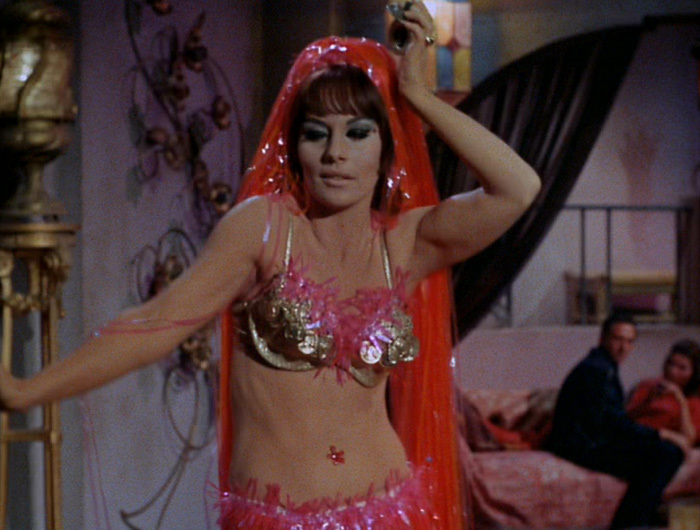
Seriously, every Argelian looked as if they stepped right out of a victorian-era magician's poster.
When the alien entity reveals itself as Jack the Ripper, it lost me. It's weirdly out of place, and seems only to exist to give the audience some kind of context for the entity. But it misses the mark. It's forced. And when the entity leaves its host and takes control of the Enterprise, it goes from weird to worse. A being that lives on terror and fear takes over one of the greatest military weapons ever built by human hands. But what should be terrifying comes across as silly. McCoy gets the crew so doped up to keep them from feeling fear and feeding the entity they sway and giggle at their stations. At that point, I'm just waiting it for 'A Wolf in the Fold' to end.

This is supposed to be about Scotty, but it's not. For an episode focused on the chief engineer, all we really learn about the character is that he can creepily leer at women, and doesn't really give a fig about local customs. We learn that Kirk is fiercely loyal to his crew. We learn that Spock has some weird opinions on the emotions of women. We learn that McCoy has a metric f-ton of drugs aboard the Enterprise, and is not afraid to use them.

"Hey, man, an alien murder thing has, like, control of the ship? Like, groovy, man." — Sulu
Now, I feel like I've just been bashing the Original Series in my last few reviews on this list* and I want to acknowledge that that's not really my intent. They just haven't connected with me.  I have great respect of the Original Series, its creators, its vision, its legacy, and the fictional world it created. The character dynamics of Kirk, Spock and McCoy are among the strongest, and smartest in the history of not just television, but all of storytelling.

But for this adventure, what's the message here? Trust each other? Kirk's always right? Scotty objectifies women? I'm not sure. For me, 'A Wolf in the Fold' lacks a strong central theme that elevates other classic episodes above the limitations of the show.

There are adventures of The Original Crew I love with all my heart. This just wasn't one of them.

--

Next up, Seven of Nine, Tertiary Adjunct of Unimatrix Zero One, faces her past in 'The Raven.'

*A reminder, that this isn't my list, but io9's Top 100 Episodes of Star Trek of All Time.

Sunday, July 12, 2015

77. Our Man Bashir

"Bashir, Julian Bashir." — Bashir, Julian Bashir


#77, Our Man Bashir, Deep Space Nine, Season 4, Episode 9

Star Trek likes playing with genres. From horror, to whodunnits, to courtroom dramas, to slapstick, to war films. The show(s) thrives when it tries something new. TOS took on gangster films. TNG took on Sherlock Holmes and the Old West. Voyager took on 1940s serials. Each one is a deconstruction of the genre, and putting a Star-Trek-y twist on it. At least, they're a break from the usual Federation fair.  Even when the results are mixed, they're usually interesting when Trek breaks itself out of its norm and allows the actors and creators to stretch their legs a bit and play. In Our Man Bashir, we take a look at the spy genre from the 60s with the title character taking on a jet-setting-super-agent based on a certain franchise known for gadgets, femme-fatals, double-crosses, and world domination.

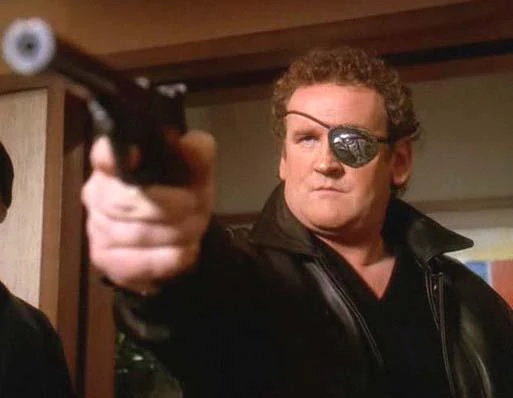
Julian Bashir likes to play James Bond, a registered trademark of MGM, and we get to go along for the ride. The episode examines the tropes of the Bond films and plays with them. 'Our Man Bashir' is far more interested in character than plot. It's more interested in fun than logic. The technobabble surrounding the transporter accident that trapped the crew in his spy-fantasy isn't important. It's background noise. An excuse to make Sisko a villain of epic proportions. To give O'Brien a falcon-based eyepatch. Kira is a Russian double-agent. Dax is the missing geologist. Worf gets to wear a tux and play cards. It's also an excuse to add genuine stakes to what is essentially Bashir playing a spy-themed adventure game.

Each of the crew trapped in the holodeck are an abstraction of their real personalities and true to their nature, yet there's also an inversion of that. Worf is the bodyguard; the gatekeeper for Dr. Noah, but uses subtlety instead of brute force to subdue Bashir and Garrak. Kira, as the Russian Agent, is the foreigner, but she's seductive and silly instead of her usual serious no-nonsenseness. Dax, as Dr. Honey Bear, is the beautiful scientist, yet unsure of her own sexuality and identity. O'Brien's Falcon is the no-nonsense fixit man, but uses violence to get what he wants. And Sisko is the charismatic leader who likes to give epic, epic speeches, yet cast in the role of the villain. The contrasts are played intentionally over the top, and the results are fun to watch.

"Don't let the glasses and the up hairdo fool you. I'm crazy sexy." — Dr. Honey Bear

Also in that abstraction, we look at Julian, and who he wants to be. His alter-ego allows him to play the hero. From his first appearance, Julian has had this desire to be a hero. He's a romantic, coming to Deep Space Nine to be a pioneer on the edge of Federation space. He's super-intelligent, and too smart for his own good. Throughout his holosuit adventures with Miles, they're constantly playing heroes. World War 2 pilots, viking warriors, soldiers art the Alamo. He's constantly playing out his heroic fantasies. Here he goes against a madman with global ambitions.

Dr. Noah's plan is simple. Activate volcanos around the world with lasers to flood the earth somehow and start civilation anew with a few hand-chosen scientists, artists and mercenaries to build a new human race on Mt. Everest. Did I say simple? Because I meant bugfuck crazy, but not necessarily any crazier than any other Bond villain's plan.  Does Avery Brooks as Dr. Noah enjoy cutting loose and giving a devious villain monolog? You bet he does, folks. Every word he utters is forced out with an excited breath, as if he can't wait to say the next line in his diabolical speech.

Because of the circumstances of the transporter accident that left the physical patters of the crew trapped in the holosuite, if he ends the game, they die. If he leaves the game they die. If a character with a crew member's pattern gets killed, their pattern gets erased.

We get the impression that Julian has played this adventure multiple times. Garrak, who joins Bashir on the adventure, mentions that he's been in the holosuite non-stop since the program arrived. Bashir knows the characters, the plot. Even the outcome. He tells Garrak that the game is rigged so that either Anastasia (Kira) or Dr. Bear (Dax) will die, and he will hook up with the other one. Garrak mentions that Dr. Bashir has been playing for hours, so I can only extrapolate that he's played through several times, trying different techniques to get to the finale. He glides through the steps of the game with ease, careful to change his play through only to make sure everyone lives.

O'Brien get to be a meaney. Get it? Puns are a requirement in Bond-parodies.
Garrak is an interesting companion on Bashir's adventure. We're reminded that Garrak has been the very thing that Bashir wants to be, an intelligence agent. Except Garrak is the real deal. He's infiltrated strongholds. Stolen information from the enemy. Tortured prisoners. Killed without remorse for his country. And he's constantly pointing out the inaccuracy and the lunacy of how espionage is portrayed in Bashir's fantasy. Bashir knows it's silly, and not realistic, he just doesn't care. This is his way to blow off steam and the turn the drama of the Dominion War off for a moment and enjoy himself.

And while Garrak provides kind of anti-Jimminy-Cricket advice to Bashir on how real spies in the real world work, Bashir knows how this fantasy-world works and what's expected of him. The Bond films (and spy television shows) of the era are very much of their time, over-the-top male fantasies with high-tech gadgets and women with both revealing clothing and loose morals. They've evolved into bombastic action films throwing realism out the window in favor of bravado, machismo, and sensationalism.*

More often than not, Star Trek is better at being clever, than funny. And this episode is both a clever look at the spy-genre and ends with a clever twist on it. In order to extend the game long enough for the crew to be rescued — beamed from the holosuite to the Defiant —he presses the big, red doomsday button. He saves the day by letting Dr. Noah destroy the world.

Which is not a thing they taught Garrak about being a spy.

--

Next up, Scotty is accused of murder in 'A Wolf in the Fold.'

*While I loved the Bond films as a kid, they have not aged well. But that's a discussion for another blog.

Sunday, June 28, 2015

78. Remember Me


'I know what I'm saying is crazy. You have to believe me, Jean-Luc; this is my 'very-serious' face." — Dr. Crusher

 Remember Me, The Next Generation, Season 4, Episode 5

I kind of feel like the Top 100 List is punishing me. Last episode, I plowed through 'I, Mudd' with great difficulty. This time, we get an episode of TNG that just didn't work for me. It's not terrible, but for me it falls in the category, of 'why is this in the list, again?' It's a Beverly-Crusher-centric episode, and that's not always a good thing. In 'Remember Me,' Dr. Crusher is trapped in a reality that's collapsing in on her, eliminating everything and everyone around her.

It starts off with a strange occurrence. Dr. Crusher starts to notice that members of the crew go missing. First, it's just an old friend of Dr. Crusher, seemingly wiped from existence. All record of his presence on the Enterprise is gone. Everyone's memory has been altered and Dr. Crusher has trouble convincing everyone that something is wrong. Others start to go missing, until the Enterprise is staffed with a skeleton crew. And Dr. Crusher fights to convince everyone that what they're experiencing is incorrect. That she's not crazy. That something is very, very wrong on the Enterprise-D.  

Space-Calgon is a very dangerous, and should not be tampered with. 
Let's talk about about Dr. Beverly Crusher. Chief Medical Officer of the Enterprise. Commander in rank. Former head of Starfleet Medical. Widow. Mother. Friend and potential love interest of Jean-Luc Picard. She's supposed to be a strong female character, but more often than not she's relegated to exposition and caretaker. Which means, more often than not, Dr. Crusher doesn't have that much to do other than wave her tricorder and speak nonsense. Unlike McCoy in the Original Series, she's not integral to the show, as demonstrated by her replacement, Dr. Pulaski, in season two. Pulaski, though her service aboard the Enterprise was brief, shook things up, constantly challenged the status quo, and showed more character development in one season than Crusher did in six.

Earlier in the series, Crusher had a will-they-won't-they thing happening with Picard, but other than that, she didn't have that well-developed of a character. She didn't really have a hook, so to speak, like the other doctors in the series. McCoy was the country doctor. Bashir was naive, inexperienced and a bit arrogant. Voyager's EMH was an artificial intelligence looking to expand his existence beyond his original programming. Phlox was an alien outsider and constant optimist. Crusher was Wesley's mom, and not much else going on. Everything about her was seemingly defined by someone else. I can't really put that on the actor, Gates McFadden. She does the best she can with the cards she's dealt.

For Dr. Crusher to carry the episode, she needed to have been a more substantial as a character, and, sadly, she's not. And we're midway through in the series, and she's still defined by her relationships with her captain and her son. We need a reason to care for her more than she's part of the ensemble.

Then there's a shift in this episode when it changes focus from Dr. Crusher to her son Wesley. In that moment, it changes from being about character to being about technobabble. And that's pretty much when 'Remember Me' loses me.

'Wait a minute! Geordie look at this! According to my calculations —which I can totally do in my head — if we can reconfigure the antimatter in the warp-matrix, and re-route auxiliary power to the starboard nacelle, we can bypass main power, and re-channel it through the main defector dish. Then once we use inverted tachyons to generate a stable graviton field, we should be able to have just enough power to do a site-to-site transport and get everyone into the final act of this episode and get my mom back. Also, EPS conduits, and jefferies tubes, or something. I can do this by speaking excitedly and pushing about three buttons on this panel. It probably won't blow up the ship at all." — Wesley Crusher
Wesley is super-duper-special with warp technology and science stuff, or so they tell us. When, it's revealed that Dr. Crusher was caught in an accident from Wesley's warp experiment, my reaction was a hearty 'whatever.' Her passing thoughts at the time of the accident create a reality around her that starts to fall apart as time goes on. I bet she's glad wasn't thinking of giant, killer, mutant spiders when the accident happened. I bet it would have made a much more exciting episode, but what the heck do I know.

The last act is chockfull of warp-speak and metaphysical pseudoscience about thought affecting reality. We even get callback to Season One with an alien who proclaimed Wesley's super-specialness. The problem is that the purpose of Wesley's experiment is vague, and the accidental disappearance of Dr. Crusher is never explained in a way that really connects.* The solution to the mystery presented feels like a cheat. Because it's not one that the audience can solve by piecing together the clues presented, the resolution felt to me like a big, fat 'uh-if-you-say-so.'

When reunited, Wesley falls asleep mid-hug.
Over the course of the series, Dr. Crusher does branch out a bit. When Wil Wheaton left the show, and Dr. Crusher was without Wesley to worry about, we learn that she's interested in command, a playwright and director, a capable leader, and one hell of a tap dancer. Dr. Crusher moves from being a protective mother and eventually evolves into the stalwart moral compass of the Enterprise.

But in this instance, she's still just Wesley's mom.

--

Next up, another doctor steps into the holosuite role of a suave, sixties, super-spy in 'Our Man Bashir.' 

* Okay, it tracks logically, I guess — if you want to get technical about the technobabble — but it comes from a place of plot not emotion, and therefore no one really cares. 

Friday, June 26, 2015

79. I, Mudd

"We meet again, Kirk. Remember me? I'm the comic relief!" — Harry F'n. Mudd

I, Mudd, The Original Series, Season 2, Episode 8

Much like my review of ‘The Enemy Within,’ I’m really going to attempt to look at this episode through the lens of when it was made, what its intent is, and what they’re trying to say with it. But I’m not sure how successful I'm going to be with that. Because, damn, this episode it completely effing nuts. For the record, that's nuts not in a way that I enjoyed.

Much like the androids who sought to overthrow the galaxy, I just can’t process this episode. I just… I just can’t. It hurts my robot brain. What I find frustrating about that is, the premise of this episode is damned terrifying. The concept of unstoppable, immortal robots who seek to supplement humanity as a step towards galactic conquest is a threat as large as any crew in Star Trek has faced. The cold open involves an android taking control of the Enterprise and delivering the crew to his home planet. He does this having infiltrated the crew, passed as human for weeks, and rigged the ship to blow itself to bits if the crew interfered with its plan. But when the ship arrives as its destination, the crew is beamed down to face hundreds of thousands of the androids.

"You. Know. I. Am. Dane. Jer. Us. Be. Hold. My. Ro. Bot. Guts." — Evil Android Norman
And one Harcourt Fenton Mudd.

And his space-handlebar mustache.

From there the adventure takes a turn for the absurd as Mudd, the ne'er-do-well space swindler that the crew had faced before. Mudd's a fan-favorite, but I don't get him. The characterization and appearance is over-the-top, scenery-chewing, wtf-is-happening and oddly out of place in the Star Trek universe. All he does for me is heighten the stylized nature of the show. While Mudd's appearance should provide a counterbalance to the dangerous nature of the threat, all it does is work to undermine it. The second Mudd appears on screen, all real danger gets thrown out the window. Kirk goes from concern to amused. The situation degenerates quickly from oh-shit-we're-all-going-to-die to oh-for-the-love-of...

Mudd prances around declaring himself Emperor, and even has a robot version of his cartoonish shrew ex-wife he can boss around, who's played with subtlety worthy of the Flintstones. The robots try to please their new human masters by provideing them with their heart's desires. Scotty gets a workshop. Checkov gets vomen to manhandle. McCoy gets an advanced medical bay. Uhura is tempted by immortal beauty in a way that is not in the slightest way horribly sexist.*

Everyone is given what they want except Kirk, who just wants to boss people around. And denied of that, he decides to ruin everyone else's fun. Kirk is really only happy when Kirk's in charge. I'm kidding, of course. Not even Kirk is that shallow. Shatner maybe, but not Kirk. The Captain sees the android planet for what it is, a prison. A nice prison, and one with very nice toys, but still a prison. Kirk knows he can't take on the androids head-on, so they devise another plan. One that does not compute.

Not in the slightest.

They defeat the machines with silliness. Bonkers, Laugh-in-style nonsense is how they define humanity for the robots in hopes that it'll overload the androids logic circuits. It’s a completely bananas plan. And it goes on forever. Like, way beyond what could be expected for either the androids or the audience to stand. The crew speak contradictions, dance to no music, profess love and hate at the same time and confuse the androids (and me) into submission. Seriously, this could not —not — end fast enough.

"You can danze iv you vant to. You can leave your friendz behind!" — Ensign Checkov

Now's the part of the review where I say something nice about the episode. All I can really think of is that it's over and I never have to watch it again. It's too harsh to say I hated this episode, but, lord, I did not enjoy it.

Yet, this episode is inarguably iconic. So much so that the premise that robots can be defeated by paradoxes and illogic has permeated everything from Futurama** and Portal 2.*** It's now a much-used trope of science fiction. Even if someone has never seen Star Trek, they probably know about this episode. If they don't, they probably know. That. Ro. Bots. Talk. Like. This.†

So, who am I to argue with history?

--

Up next, Beverly Crusher is at the center of a mystery in Remember Me.

--

*I lied, it is. 

** In all fairness, there’s not much in science fiction that Futurama hasn’t hit upon, but the point is, this episode is preposterously famous.

*** Portal 2 a thing that I love, btw. 

† But, meh, so does Shatner. 


Wednesday, June 24, 2015

80. The Wounded

The Wounded, The Next Generation, Season 4, Episode 12

'The Wounded' marks the first appearance of the Cardassians, a race that would become a huge part of the Trek mythology. I think back on how far the Klingons have come since their first appearance in 'Errand of Mercy' and look at the depiction of the Cardassians from their introduction to their final appearance, and am surprised how fully formed they were from 'The Wounded.' Aside from the aesthetics of their uniforms, they're pretty much the same here as they are when Ben Sisko takes command of Deep Space Nine a few years later. It doesn't hurt that Marc Alaimo is playing the lead Cardassian here, as he would go on to play one of the most prominent villains in Trek's history.*

Though this was the first and last appearance of these bitchin' Cardassian helmet-things.

The Cardassians are presented as an empire with enough military might to threaten Starfleet. A smaller empire than the Klingons and Romulans, perhaps, but they're the best and worst of those two races. As smart as Romulans, as merciless as Klingons, but without the honor that keeps the latter in check. They are reptilian in appearance, calculating, cruel, and brutal. They will enslave an entire planet and justify their actions because they need to preserve their Empire. In short, they are everything the Federation to are not. But the Federation isn't what it used to be.

With their fleet decimated by the Borg attack, what we have is a Federation about to enter into a conflict they may not win. The war with the Cardassians had raged long enough for Picard to tell a war story from his time aboard his previous command, the Stargazer.**

Picard is ordered to keep the peace at all costs, and has to make some hard choices. He has to hunt down one of Starfleet's own, as Captain Ben Maxwell has gone rogue and attacked Cardassian targets. This could lead the Federation back into war with a ruthless enemy. As a show of good faith, Picard takes on a Cardassian delegation, who are constantly trying to get Picard to compromise Maxwell and let them blow him and his ship to smithereens.

If nothing else, this episode has a lot of sitting and talking. 
To do that, he enlists the help of one of his crew who served with Maxwell during the war, Miles Edward O'Brien. And it turns out this petty officer is far more interesting than a guy that pushes buttons in the transporter room. O'Brien was Maxwell's tactical officer during the Cardassian War, which make this 'simple enlisted man' more complex than he'd been so far. He turns our to be clever, and resourceful.

As O'Brien is not an officer, so I can only infer that his time as a Tactical Officer aboard the Rutledge was a war-time field-commission. It also makes his position on the Enterprise a bit strange. Transporter Chief seems like a demotion from Tactical. Perhaps O'Brien sought the honor of serving on the flagship. Perhaps he needed an assignment that was less intense than Tactical, even if that assignment was on a ship in constant danger. Miles is not shy about his feelings about the Cardassians. He's not a fan. He's seen the horrors of war, and he holds the Cardassians responsible for the man he had to become to survive it. We also see the consequences of families aboard the Enterprise as O'Brien tries to process his experiences with his new wife, Keiko.

But Miles knows Maxwell, and he uses every trick up his sleeve to help Picard bring a peaceful end to Maxwell's one-man war against the Cardassians. As Picard and crew attempt to figure it out, the Cardassian representative, Gul Macet, is constantly angling for the means to end Maxwell. Assuring Picard that the only way to attain peace is through Maxwell's end.

And to do that? Endless, endless meetings. 
Maxwell is presented as a contemporary of Picard's, perhaps his equal. Maxwell is smart, determined, and pulls off some tactical maneuvers that sets him up as a formidable opponent. He commands the USS Rutledge, a ship as advanced as the Enterprise. More importantly, Maxwell is a believer. He's a man on a self-appointed mission to expose the Cardassians as the duplicitous snakes they are. He suspects that the Cardassians are using the ceasefire as an excuse to rebuild their navy for a new assault. Maxwell blows up a science station because he believes the Cardassians are using it to spy on the Federation. He assaults a Cardassian civilian freighter because he thinks the Cardassians are secretly using them to resupply their war efforts.

Picard has to stop Maxwell, and there appears to be no easy way out of it. What makes Picard's job that much harder is that Maxwell is right. Maxwell is a man who has suffered loss. Perhaps he's one a mission to avenge the death of his wife during the war. Perhaps he's attempting suicide via death-by-cop. Perhaps he is doing exactly what he says he is, exposing the Cardassians. The truth turns out to be a mix of all of these things, and it makes Maxwell a fascinating antagonist.

Picard has to choose between doing what's right, and serving the greater good and keeping the peace. He can't even entertain Maxwell's suggestions to investigate the Cardassians supply ships because if Picard has proof, he'll have no option but to drag the Federation back into a costly war.  It's a hard choice, and arguable if he made the right one.

--

Next up, it's Kirk vs. Robots and dudes with handlebar mustaches I, Mudd.


*Note, I haaaaate Marc Alaimo's Gul Dukat with a fiery passion, but not in the way that the creators of Deep Space Nine intended. For more on why he's terrible, please check out my review of #88 on the countdown.

**If I have complaints about the episode they're mostly inconsequential. The timeline suggests that the Federation and the Cardassians have been at war up until a year ago, but it's never mentioned in the first two seasons. As Picard tells his Stargazer story, it implies the war has been going on for quite quite a while. Other than the forehead makeup, the Cardassians themselves look terrible, and went through a much needed uniform upgrade before their next appearance. 

Wednesday, June 17, 2015

What This Is and What I'm Doing

When io9 posted their list of the Top 100 Episodes of Star Trek as voted on by fans, I took it as an excuse to rewatch me some Trek and to pontificate about it. I've just finished the first 20 on the list, and I'd like to take a moment to reflect. As a reminder, this is not my list. And though I love Star Trek, it is not sacred to me. There are some episodes that I just didn't connect with. Some that have been entertaining but flawed. And some that I've loved.

I'm making a few assumptions with this blog. I'm assuming, dear readers, that you've seen the episodes in question. I haven't been doing extensive recaps of the episodes, and haven't really dived into extensive descriptions of the characters and their general motivations. If you would like to see more of that, please reach out to me and let me know.

Here's the list of episodes that I've reviewed so far:

#100 Bride of Chaotica — A brilliantly madcap episode that pits Voyager against black and white serial villains.

#99 Day of the Dove — Kirk vs. the most bad ass of all bad asses, Kang.

#98 Paradise — Ben Sisko faces off against a cult leader on an alien world.

#97 Borderland, Cold Station 12 & The Augments — The Enterprise stretches an adventure that is a love-letter to Wrath of Khan a little too thin over three episodes.

#96 Lineage — A great character study of B'Elanna and Tom, if you care about either of those people.

#95 The Most Toys — Data is abducted into slavery by a crazy person.

#94 Disaster — Deanna Troi is placed in charge of the Enterprise. Hilarity ensues.

#93 Future's End — A time travel Voyager tale that couldn't end fast enough for me.

#92 The Magnificent Ferengi — A Quark comedy romp that's more entertaining than it sounds.

#91 The Killing Game — The Voyager crew fights Nazis, for some reason that eludes me.

#90 The Booby Trap — Geordi falls for a holodeck physicist, and that's his fantasy? Really?

#89 The Court Martial — Kirk is the manliest man ever to be put on trial for dereliction of duty.

#88 Favor the Bold & Sacrifice of Angels — A two-part microcosm of the best and worst that Deep Space Nine has to offer.

#87 Deja Q — Q returns to annoy the crew of the Enterprise to great effect.

#86 Memorial — The Voyager crew develops PTSD from an alien war they never participated in.

#85 Little Green Men — Quark, Rom and Nog get blasted back in time to 1947 Roswell, New Mexico and hilarity does not ensue. It tries, really hard though.

#84 Parallels — Worf bounces from reality to reality in a mystery that's solved in the episode's title.

#83 Timeless — Harry and Chakotay travel back in time to prevent the destruction of Voyager. I'm not convinced this is the best course of action.

#82 Conundrum — The crew of the Enterprise-D get their minds erased and thrown into a war they have no memory of.

#81 The Enemy Within — Where we get two Kirks for the price of one thanks to a transporter accident.

As we look towards the next twenty, I'm excited about some of the episodes on the list. Thanks for reading, and let's watch some Trek.

Tuesday, June 16, 2015

#81, The Enemy Within, Star Trek, The Original Series, Season 1, Episode 5

"I'm not a bad guy, really." — Dark Kirk
I recently got into a Facebook argument with a friend who only acknowledges the greatness of the Original Series, and feels that everything else that follows is terrible. At least, unworthy. He and I vastly disagree on this, obviously. While, I greatly respect The Original Series and the legacy it created, as I've stated before, it's not my Trek. So, if you're a fan of The Original Series (and only The Original Series), I'm going to apologize in advance for the next few reviews of the adventures of Kirk, Spock and McCoy on the Top 100 list. 'The Enemy Within,' 'I, Mudd,' 'A Piece of the Action,' these episodes are not for me. They're everything that I find off-putting about TOS, however...

However...

However, I'm going to do my best to appreciate them for what they are, the era in which they aired, and the spirit in which they're presented. I'm willing to give 'The Enemy Within' a lot of latitude because as Episode 5 of a decades-spanning franchise, the show is still figuring out what it is. Sulu and Scotty get a lot of air-time. There are a couple of firsts here, it's on this episode that Nimoy created the Vulcan nerve pinch (though an episode shot later aired earlier). We get out first look at Kirk's wrap-around captain's tunic. When a bunch of crew are trapped on a freezing planet and the transporter is inoperable, the obvious solution would be to use shuttlecraft, except they hadn't been established in the show yet.

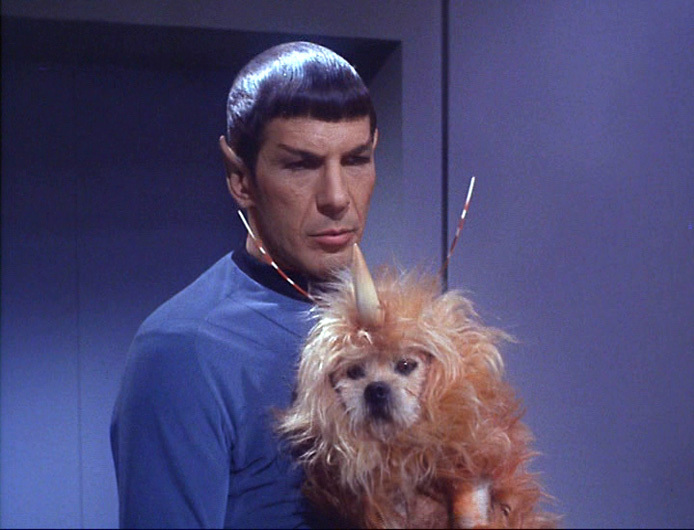
For example, after this episode, they decided against making the Space-Unicorn-Terrier a re-occuring character. 
So, let's try a compliment sandwich, shall we? I'll say something nice, I'll say something less-than-nice, and then I'll say something nice again. Let's see how that works out.

'The Enemy Within' has a fantastic premise and had amazing potential. And the vibe of the episode is far more Twilight Zone that Star Trek. And coming from scifi legend and Twilight Zone alum, Richard Matheson, this is wholly appropriate. The episode is dark, brooding, and explores not just the darker side of Kirk, but the darker side of mankind as a whole. It asks the question of what happens when we strip away our humanity, and looks at what's left. A transporter accident creates two Kirks. One, slowly losing himself in self-doubt and fear, the other, the baser animal nature of humanity. We look at a man split into two extremes, and seeing what happens when a man's psyche is metaphorically and physically thrown off balance.

Matheson keeps the division between the Kirks from being as simplistic as 'Good' and 'Evil.' They go out of their way to point out that these aspects of personality are necessary for the whole. Dark Kirk is primal, driven by desire and self-interest. Kirk-Lite spirals from being the man he once was into a man who's incapable of making a decision.

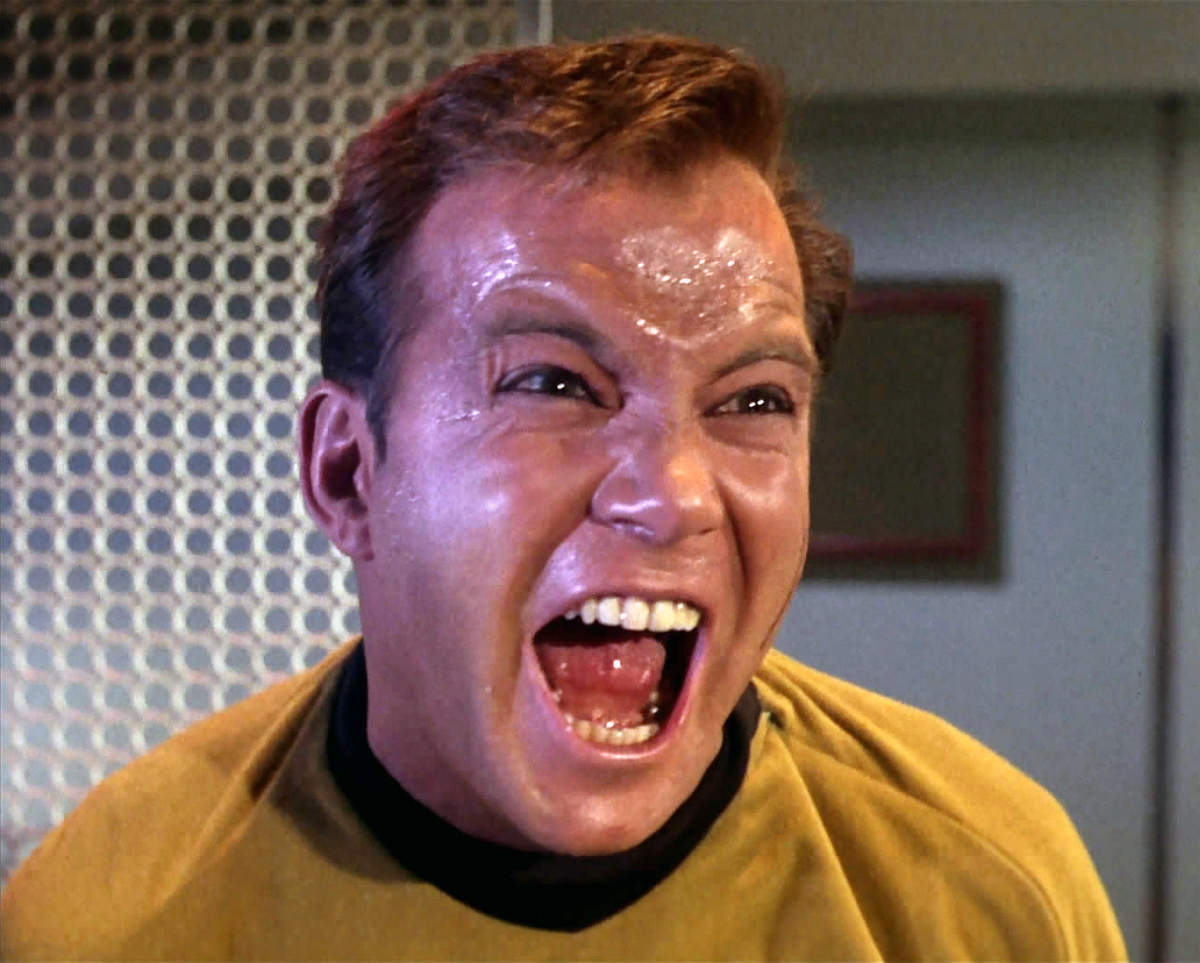
Unfortunaltely, the different aspects of Kirk that are presented, the Compassionate and Indecisive Kirk-Lite and the RAGE, RAGE and OMG-SOMEHOW-YET-EVEN-MORE-RAGE Dark Kirk are played to such extremes the results come across as more comical than poignant. Now, let's call this for what it is, it's a television show trying to communicate a story point. But even so, it's really hard for me to watch Shartner sneer and snarl his way around the Enterprise as Dark Kirk. I don't think I'm going out on a limb in saying that Shatner is not the most well-respected thespian ever to grace the small screen. But in 'The Enemy Within,' his depiction of Dark Kirk as over the top, even for him. The choices of guyliner, general sweatiness of Dark Kirk, over-dramatic music, and the lighting doesn't help the subtlety of the situation, either.

"I'm acting! I am! Acting! I'm ACTING!" - Dark Kirk
Kirk-Lite wanders around the ship, waiting for others to act, and slowly loses his ability to command the Enterprise. Kirk-Lite is far less defined than Dark Kirk. Dark Kirk's first acts are to demand booze and force himself upon Yeoman Rand. Kirk-Lite's actions are more business as usual, but he increasingly becomes incapable of commanding his ship. Where Dark Kirk's actions are clearly aggressive, the aspects of this Kirk's personality are far more vague. I have little doubt that this is unintentional, a deliberate contrast between hard and soft. But we never get a sense of that the traits Kirk-Lite are any kind of benefit. All we get is that Kirk-Lite is incomplete.

"I have no strong opinion. Whatever is fine. What do you think?" — Kirk-Lite
I'm inferring here that the darker nature of humanity is not only necessary, but vital in order to be a whole human being. I'm not sure I'm okay with that. I think I'd be more amenable to the episode if the attributes of compassion and empathy were presented in any kind of positive light. But they're not, really. Compassion here is equated with weakness. I fundamentally disagree with the overall idea that the only way to be whole is to be equal part aggressive asshole. It's quite the mixed message for a show that looks to an idealized society where humanity has evolved to a nigh-utopian state. More than the low-grade production values, more than Spock's sole function as the Exposition Officer, more than the horrible treatment of Rand, this message is this reason that I can't really connect to this episode.

Also, the alien-dog-thing looks just damned ridiculous.

Like all great Star Trek, 'The Enemy Within' asks big questions. I'm just not sure I like the answer they came up with.

--

Next up, Picard does what he does best, negotiating treaties in 'The Wounded.'