Thursday, May 28, 2015

#84, Parallels, The Next Generation, Season 7, Episode 11

"Ahead full! Maximum Worf!" — Worf
I'm not going to lie. I was worried about this episode. Worried because when I announced that 'Little Green Men' was on the docket, I also announced how much I liked it. But when I revisited that episode, I realized that it didn't hold up to my memory. Part of this is the nature of comedy. Much of comedy relies on surprise. A set-up followed by misdirection. A classic structure of expectation and reversal. A third phrasing of that thing. A big part of my reaction to that episode was that it just wasn't all that funny. I've always found Trek better at being 'amusing' than 'funny.' 'Little Green Men' was just a little too-not-at-all-that-funny for my tastes.

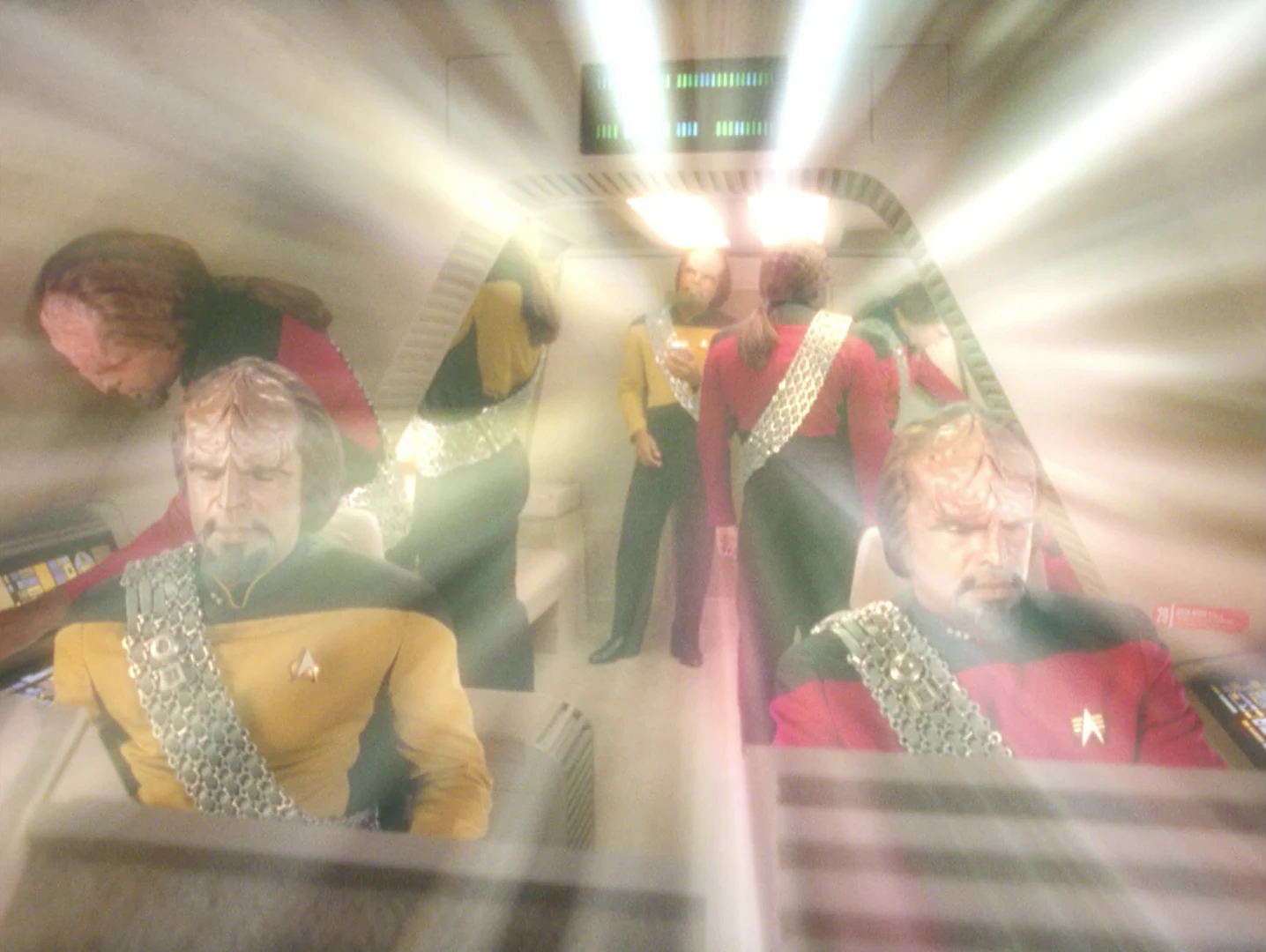
That being said, I really, really remembered liking 'Parallels' and I was worried it would fall short of my expectations. After watching, I'm pleased to say it's still a great deal of fun, as Worf bounces from parallel reality to parallel reality, drifting further and further from the Enterprise he knows. As he shifts, the changes in his surroundings go from subtle (the cake is a different color!) to drastic (Riker is Captain!). It's one of those episodes that takes our familiar characters and puts them outside their comfort zones. What is at first contributed to a concussion from a bat'leth tournament messing with Worf's memories quickly escalates into him realizing that he's no longer in his home reality. Worf is lost, unsure of where he is or what's happening thanks to some shuttle accident and Geordi's visor, or something. The technobabble and technobabble solution aren't not really the problems here. Worf's motivations as a character are.

Worf rolls with the changes fairly well at first, assuming his memory is suspect thanks to the aforementioned blow to the head. But, history keeps changed around him. And not little things.  Deanna Troi is his suddenly his wife. Picard is dead at the hands of the Borg. Data has blue eyes. Dr. Crusher is no longer the Chief Medical Officer. Their combadges are slightly different. It's madness.

"Come, sit down, embace this new me-filled reality." — Deanna Troi
What I find interesting is that the reality in which Worf finally finds himself is a fairly sweet one. He's gotten a promotion to first officer of the Enterprise and is happily married to Deanna Troi with two supposedly beautiful children (we never see them). It's not until he realizes that in this reality, his son, Alexander, was never born, that Worf's drive to return home kicks in. Sirtis does a great job of handling Deanna's complex emotional roller coaster as she realizes that Worf not only has no memory of their relationship, the man she knew and loved is gone. Replaced with a man from another world. It's a completely weird thing to ask of an actor, but I think it's handled well.

If I have one major complaint about the episode (I have second but it isn't critical, and is super-nerdy) it's that the episode spends a great deal of time establishing what is essentially a non-mystery. The audience is so far ahead of the characters in this episode on what's going on, it's painful to watch the them catch up. They spend way too much time with the setup and explaining to the audience what a parallel reality is. It's a fairly well-known science-fiction trope and I feel we could skip a fair amount of this and get straight to the emotional conflict in the episode. I say a non-mystery because the reveal of what's going on is in the damned title. Doesn't take a warp-engine specialist to put two and two here.

The episode is very character heavy, where a man who is normally sure of himself, questions everything around him. There's not much driving the story forward, past the mystery we already know the answer to. So, the episode lumbers a bit. We have new, shiny things to look at, but it does drag. There are a few red herrings. Cardassians tamper with a space telescope, and aggressive Bajorans strike against intruders to their territory, but neither pay off in a satisfactory way. It's not until the barriers of reality start to break down that we have an actual threat to deal with, and Worf has any kind of decision to make.

My second complaint about the episode is far more nit-picky and about the Son of Mogh himself. In this episode, Worf comes across as the Klingoniest-Klingon-to-ever-Klingon-a-Klingon. And it bugs me. The episode starts off with Worf returning from a bat'leth tournament, which sounded an awful lot like an Olympics where competitors get impaled. Or, I imagine something akin to MMA, but with giant knives. But not only did he compete, he won with Grand Champion standing. I call shenanigans.*

Worf going off to a bat'leth tournament as a spectator I totally buy. He wasn't raised by Klingons and Worf has always struggled to connect to his heritage in a meaningful way. Worf running off to learn what it means to be a Klingon is a reoccurring character theme. But for him to go to this tournament and win, I just don't buy it. Having competed in martial arts tournaments (I have, don't laugh), I can tell you the people that win those trophies on that level are preternaturally gifted, train non-stop or both.

Worf is a capable officer and warrior, but for him to be competitive amongst natively-raised Klingon warriors, living in a society where competition pushes each of them to the extremes is not credible. I get that we need a mcguffin for him to recognize what reality he's in, and what's changed. As a symbol of the changing realities, his grand master trophy changing from 3rd place to 9th to a participatory ribbon certainly works. It just stands out as being a little too Klingoniest-Klingon to me.

As he swapped realities, it would have been great to have seen Worf in a wind up in a place where Klingons ruled the Federation, which may have been a real emotional challenge for Worf. Here we'd have a character who's struggled with connecting with his heritage, and then have to choose to give it up in order to save reality.

While it's fun to subtly change things around Worf, things never drift too far from the Enterprise-D we know and love. The changes aren't really that drastic. Worf pops into a reality where Wesley Crusher is the tactical officer (one once again questions the wisdom of Starfleet HR). And it would have been great to have Dr. Kate Pulaski show up as medical chief in a cameo. I love that there's something meta here. It's like we're looking at the series in alternate timelines. It's almost as if they're embracing the fan rumors/theories that Stewart wasn't going to return for season three after 'Best of Both Worlds.' Or looking at what if Wil Wheaton had stayed on with the series to become Lt. Crusher?

"Ugh. Pressing space buttons is so beneath my preternatural genius." — Tactical Officer, Lt. Wesley Crusher 
The mind, it boggles.

If anything, I wish they'd gone wilder with it. And weirder with it. We get hints of it with a reality where the Borg have conquered the Federation. When Worf's shuttle takes off to seal the anomaly, it's threatened by a panicked and mountain-man-bearded Riker. He's so desperate to do anything to keep from returning to his nightmare that he'd rather face the breakdown of all existence than the Borg. There's a surreal moment, when New-Reality-Riker is forced to kill Mountain-Bearded-Riker, but it's soon passed. If we had gotten to the answer to the mystery sooner, we might have had a chance to explore some of the more extreme tangents in Enterprise reality. As it is, it's a slow start and a rushed ending.


"The Borg are everywhere! There's no shaving cream or hair gel left in our reality! We won't go back!" — Riker

It's still a fun adventure, but I find myself pondering what might have been. I can't decide if that's appropriate or ironic considering the nature of story.

---

Next up, a 'Timeless' adventure with the Voyager crew. So, the Voyager crew and time travel? Again?

We'll see.

---

*I wanted to use the Klingon word for 'shenanigans' here, but, sadly there isn't one. 

Thursday, May 21, 2015

#85, Little Green Men, Deep Space Nine, Season 4, Episode 7

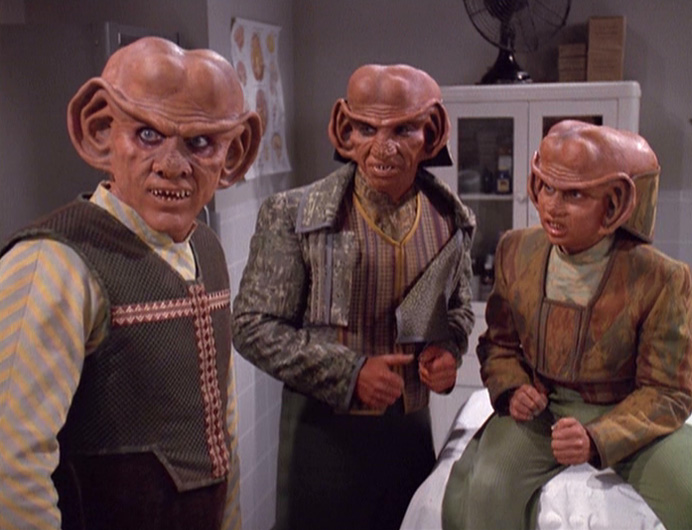
Now's where we hit the cold hard reality of memory versus actuality. I had very fond memories of 'Little Green Men,' where Quark, Rom, and Nog accidentally travel back in time and crash in Roswell, New Mexico, in 1947. Taken to Area 51, they make contact with the primitive natives. The premise is strong, and we get to see our favorite Ferengi try to hustle forties-era humans out of their planet. It's... well... It's not good. At least, not as good as I thought it was going to be.

I'd remembered it being much, much funnier. As I rewatched it, much of the humor in the episode falls more than a little flat. The jokes were expected and could be seen coming a quadrant away. Nostalgia is a dangerous thing. It convinces us that things in the past were good, when, in fact, there's a good chance they were not. I will never look upon the original Battlestar Galactica, A-Team, Dukes of Hazard, the Transformers, or Big Trouble In Little China because there's a zero-percent chance they hold up. This, however, this episode I was really looking forward to. And I was really disappointed.

Quote-hu-mor-unquote.
Maybe it's that Quark and crew are truly at their best when they're ancillary to the story. Maybe it's that this is the second Ferengi-centered comedic episode in the countdown, and much of the goodwill that I felt for Shimmerman's Quark and his compatriots has already been spent on my review of the Magnificent Ferengi. Maybe it's because that episode had Iggy Pop and this one did not. Maybe it's that nothing could possible equate to "Roswell that Ends Well" from Futurama. Both episodes had similar time-travel-to-Roswell-shenanigans, but Futurama did it a bazillion times better.

"Shut up and take my latinum!" — Fry
Maybe it's that funny is really, really hard.

Really.

So, rather than bash on the episode for not being what I remembered it to be (which in all fairness is probably more on me than it), let's accentuate the positive, shall we? Let's talk about how we got Quark from the pilot to this episode and why that's kind of cool. For all the type of bumpy foreheaded peoples in the Star Trek universe, there are few aliens that are really explored in depth. There are only a handful that break out of the monoculture formula. And through the characters of Quark, Rom and Nog, we get to explore a few different aspects of the Ferengi. The three started out as pretty much the same character, and over the course of the series we saw each of them grow into more than their sniveling, greedy, funny-looking species of origin.

'Look who's calling us funny looking. Stupid hu-mon.' — Quark

Quark here, represents the idealized Ferengi. Opportunity, profit, and thrill. Ferengi love negotiating. And here Quark throws caution to the wind, at the mercy (and gunpoint) of a military base, he sets out to conquer their planet, with no weapons, no plan, nothing really to offer. And he does this because he thinks he can. He goes for it with a bravado and fearlessness that's kind of awesome. He seeks challenge in the only way he knows how. In Ferengi society this is referred to as having the 'lobes,' but let's call it for what it is. Giant, giant brass. But throughout the series, Quark is constantly being called out by other Ferengi for not being ruthless enough. Living amongst aliens for so long, he's had to adapt to cultures outside his own, and finally finds a balance between his Ferengi ideals and those of the Federation. That is, until he unceremoniously throws away years of character development in the series finale, but we'll jump off that bridge when we come to it.

Rom, his idiot-savant brother, is far more interested in making things than money. This makes him an outcast. Because he sees more to life than the acquisition of things, he's considered an 'idiot' by his brother. He's clearly not; he's just not wired in the same way that other Ferengi are. Early in the series, Rom was always nipping at Quark's heels. Always scheming to get the bar from Quark. Not because he really wants it, but because he's lost. He's terrible at business. Terrible at negotiation. Terrible at scheming. Terrible at all the things Ferengi are supposed to be. As the character developed, Rom stops being Quark's incompetent shadow, and starts to become his own man. He marries an alien. He gets a menial job on the station, not because it will make him wealthy, but because he loves it. He follows his passions, regardless of what his kin will think of him. Rom went from being a horribly cartoonish background character to an actual person.

Nog starts the series out as Diet Quark. A ne'er-do-well, no-good-nik and a bad influence on Jake Sisko who's sole function seemed to be to create conflict between Jake and his father. He was mean-spirited, willfully ignorant, a liar, and a tiny jerk. School was dumb. Girls were to be opinionless property. Latinum was all that mattered. He was, in essence, the ideal Ferengi in training. As Nog changed, he became more than a foil for the Siskos and came to represent the future of his species. In this episode, he's off to Starfleet Academy. He sees Starfleet was a way for him to better himself. To see something greater. Not because of profit, but because, like his father, he wanted more from life than the acquisition of things. I mean, he still wants profit, don't get me wrong. But perhaps joining a society that has, in effect, no money, may not have been the ideal way to go about doing it. Nog has ambition, but not in the way that his people usually quantified it, making him a new breed of Ferengi.

These characters have changed over the years, and of all the explorations that Trek has done, it's of character that's the most challenging in interesting. The Ferengi are, after all, odd-looking creatures who may appear homogenous, but are far more complex than just their surface appearance might suggest.

Just like the rest of us.

--

Next up, Worf goes reality skipping in TNG's 'Parallels.'

I like to think, somewhere in the infinite number of parallel realities, Michael Dorn is about to write a review of my performance as Lt. Commander Worf.


Saturday, May 9, 2015

#86, Memorial, Voyager, Season 6, Episdoe 14

It's been too long since I journeyed — trekked if you will — back to the Delta Quadrant. I realize now that it's been a while since my last trek-realted post, and for that, I apologize, dear readers. But life gets in the way. Work took a weird turn. I directed a web series due out next month, Assassin Nine and have been busy in post. Designed a card game. Had to vent about Batman V Superman: Dawn if Justice. Which brings me to 'Memorial,' and my general dereliction of duty. But now, I'm back to it, with the latest in the Top 100 episodes of Trek according to io9 fan poll.

I had watched 'Memorial' weeks ago when I first set down to write this entry, and, well, nothing stuck. This is the second time I've watched a Voyager episode in this countdown and came away going, "Yeah, okay, fine, whatever, that happened." So, for a second time, I had to wonder if there's something in this episode that I missed. And as it gnawed at me -- what's the deal with this episode, why have fans dubbed it worthy to be on this list -- I think the point of the episode is that sometimes there is no clear answer. Voyager takes on a heavy, complex topic, but because this is a space-adventure show, it comes at it a bit sideways.

"Ugh, get on with it, already. Seriously." — Tom Paris

Tom, Harry, Chakotay and Neelix are returning from a weeks-long mission aboard the Delta Flyer. When they return to the ship they start having vivid and violent dreams about an armed, alien conflict, where they were participants. These visions go from being dreams to waking nightmares where the characters can't tell the dream from reality. Tom has a breakdown in his quarters. Neelix takes his goddaughter hostage in the mess hall. And the whatever-it-is starts to spread throughout the crew. Nightmares and visions of a way no one had fought. Even Janeway starts to feel the effects of the dreams.

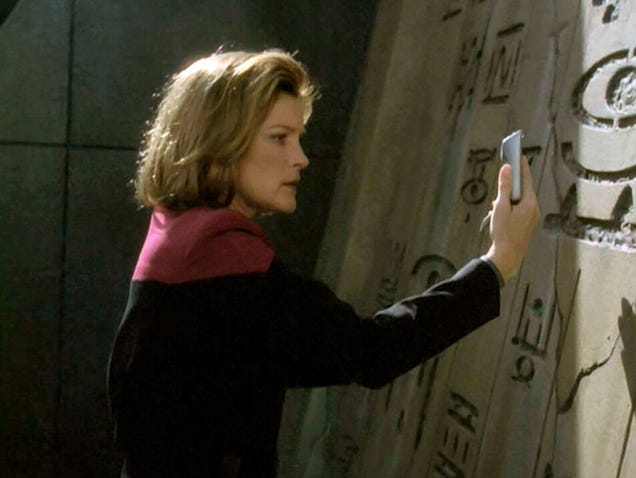
As they follow the mystery and backtrack the Flyer's path, they discover an alien beacon, showing a massacre from their history with the events beamed directly into passerby's brains. They find an alien obelisk on a planet, a memorial to the event that happened centuries ago. Anyone in range relives the firefight, so that it's never forgotten.

The show tries to dive into the moral complexity of war. Showing a military police action forcibly removing colonists from their homes, and things get out of hand. The colonists fight back and someone opens fire and violent higgledy-piggeldy ensues. Other than the commander of the military rigidly following orders (which those types are wont to do) and being a dick about it, there's no clear right or wrong here. It's just people caught in the middle of a difficult situation that has spiraled out of control.

Through the characters, they explore PTSD, with Tom, Neelix, and Chakotay playing the roles of soldiers retuning from duty and trying to re-assimilate back to normal life. Tom comes home to his wife, who greets hm with beer, popcorn and television (literally). They fight. Harry returns to work, and finds tasks that should have been routine, horrifying. Neelix has a complete psychotic break and takes the aforementioned hostage, forever changing his relationship with his goddaughter, Naomi. All of this is pretty heavy stuff coming from a show with space lasers, a woman in a silver catsuit, and a Neelix.

"Don't worry, Naomi! I'll protect you from the nothing!" — Neelix

Let's talk about Nelix. Much of my initial reaction to Nelix as a character was responding to his aesthetic. He, like Quark on DS9, is the alien outsider, an excuse to exposit on the state of humanity in the 24th century. Like Quark, his appearance is over-the-top, clownish among the predominantly black uniforms of the rest of the crew. Initially, I didn't care for him. His make-up and faux-hawk hair were on the side of the ridiculous. But past his leopard-goldfish-bulldog appearance, I do like the character. He's charming, optimistic, and brings a bit of color both metaphorically and physically to the show. Ethan Phillips has to do a hell of a job acting through that makeup job, and when he emotes, it can come across as silly. Not here, though. Here, his pain and fear come off as real as a man in a leopard-goldfish-bulldog mask can.

As the crew finds the obelisk, they spend a hot second wondering whether to turn it off. To prevent others from suffering the same fate as the crew. Their decision to leave it be, at first feels like a cop out. Janeway passing the moral buck because it's not her decision to make. But, it's not. And her leaving the memorial be is the right thing to do, so that the pain and loss of the massacre won't be forgotten. The episode is a bit ham-fisted, but sometimes Star Trek is what it is, a space-adventure show.

'Tricorder is reading high-doses of heavy-handed dialog. The OTN readings are off the charts." — Janeway

Star Trek likes to ask the tough questions. Memorial shows that those tough questions don't always have answers.

--

Next up, we're off the Roswell, New Mexico, for one of my favorite episodes of Deep Space Nine, 'Little Green Men.'


Friday, May 8, 2015

Regarding Batman v Superman: Dawn of Justice Trailer

Not overly happy with Man of Steel's redesign of Superman's outfit, I did my own. 

I went into Man of Steel with very low expectations. Snyder had never done anything that gave me any sense he had anything of substance as a director. Dawn of the Dead was mean-spirited with none of the joy of the original. 300 was a cartoon. Watchmen was a boring cartoon. And while Nolan's Batman trilogy made Warner Bros. a serious amount of money, I doubted his ability to continue a grounded super-hero vision with Superman. Pile on top of that that Man of Steel was an origin story, and the suit looked terrible, I had little hope that Man of Steel would be any good. I wasn't really interested in seeing it, I had wanted to see the movie they were going to make after Man of Steel. Now, I'm not so sure I do. 

That being said, it’s Superman. How could I not see it? After all, Snyder said all the things he needed to say with regards to his inspiration. All-Star Superman, Byrne's Man of Steel, Superman for All Seasons. But I didn't see any of that in the final product. In fact, what I saw was grim, brutal and humorless. Which says to me he may have read those books, but didn’t take anything away from them. 

I'm about to make a generalization. I find the people who complain that Superman is boring aren't people who read comics, have only a passing understanding of who Clark Kent is, and why he matters. Why he chooses to do the right thing, when he could instead pretty much do anything he wanted. It's that choice that makes Superman interesting, not his ability to leap tall buildings in a single bound. In his JLA run, Grant Morrison addresses the fact that Clark has trouble living up to the ideal that's expected of him. He has doubt. The weight of that pressure is crushing. And he doesn't always make the right or moral choice, which makes him human. 

When DC relaunched their universe with the New 52, they handed Morrison the reigns to Action Comics, and asked him to reimagine Superman for the 21st century. And holy crap, did he deliver. His run on Action examined a young man who looked at the world, at its injustice and corruption, and decided to make a difference. Because he could. He returned Superman to his origin, which says a lot to how little has truly changed in politics, greed and malice sine the Great Depression. Clark was flawed, arrogant, and so certain of his moral high-ground and his invulnerability that he threw himself into situations that he couldn’t possibly control. Morrison reinvented Clark as a modern investigative journalist, forgoing print and going straight to web, to show that a man could do as much good with his words as his fists. 

Morrison returned Lex Luthor to his roots as well, making him a sociopathic inventor, consulting the military on the existence of this alien. He established kryptonite as the radioactive fuel for the rocket that brought Clark to Earth. He laid the groundwork for Brainiac, Metallo, and even Mxyzptlyk. And it worked, beautifully. Morrison essentially handed Warner Bros. a template for reinventing Superman, making him relevant again, taking the weird corners of the mythology and making them connect. Warner Bros., instead, said, “No, thank you,” and went about to make the Man of Steel with Snyder, Goyer, and Nolan, and make it, you know, cool and ‘realistic.’  

Superman isn’t supposed to be cool. He’s supposed to be fun. He has innumerable abilities. He fights creatures of immeasurable power with ridiculous names. He wears a bright red cape. He’s not supposed to be realistic. He’s supposed to be fantasy. 

At a panel at ComicCon, Morrison postulated that Superman has always been a reflection of who we want ourselves to be. In his origin, he fought corrupt politicians and slum lords and stood up of the everyman because they couldn’t. He continued as a symbol for America's (self-perceieved, at least) indomitable-spirit during WW2. The Silver Age was full of happy-go-lucky spacey adventures with no real sense of danger. The eighties, his chief villain was reimagined to represent selfish, heartless corporate greed. In the 90s, he had a mullet for some reason. Morrison speculated that the reason we got a dark vision of a man who was supposed to be the symbol of hope is that it's what we are. We got violent destruction on a grand scale, and we cheered it, because that’s the hero we deserve. 

To my surprise, I didn't hate it. It was far more entertaining than I expected. The non-linear nature of the origin story made that tolerable. That, it was refreshing to see Superman take on a challenge on screen that wasn’t Luthor and kryptonite. And after Superman Returns And Bores The Audience To Death, it was refreshing to see a man who’s creation was in a book called Action Comics have some actual action. I really don't want to hammer the point of Zod's death at Clark's hands, but I will. Just in case there's some prize for being the one billionth nerd to do so. It felt less like a creative choice and more like a 'fuck you' to the character. 

Most of what we’ve seen from the sequel, Batman v Superman: Dawn of Justice looks like it comes straight out of Dark Knight Returns. And as revered as the book is (and it absolutely deserves it’s place in comic book history), it has not aged well. It’s been copied and aped so many times that’s it’s lost it’s impact. Its politics are horribly dated. Its vision of Batman is myopic, and not one I really enjoy. I prefer Batman as the smartest man in the room, a man who knowingly uses fear as a weapon, rather than the obsessed psychopath who likes beating criminals up because he can. Worse, Miller’s vision of Superman is mocking. It portrays Superman as nothing more than a puppet, and the complexities of the character are thrown out the window in favor of cheap shots at the 'boy scout.’ Miller not only doesn’t get Superman, he openly dislikes him. Superman sacrificing his freedom in to save his friends is somehow a thing to be ridiculed. And this is not the source material on which I want a Superman story made. And bringing Miller in as a consultant does not fill me with confidence. 

To make Batman the nemesis for Superman’s sequel speaks to Warner Bros. lack of faith in the character. It speaks to their inability to trust the decades of mythology built around the him. It speaks to their jealousy of Marvel and wanting to bums-rush into Justice League for a cash grab without earning it in the same way that Avengers did. It speaks to their fundamental misunderstanding of not just Clark, but the entire DC Universe. Stories have recently emerged about hiring multiple writers to tackle the Wonder Woman script based on an ever-changing treatment. That’s not vision. That’s design by committee.

The sad thing is, in this age of blockbusters, quality doesn’t really matter. The movie will make Warner Bros. a metric f-ton of money whether it’s any good or not based purely on the franchise name. As a writer, that saddens me greatly. The general population wants to see Batman beat up Superman, because they somehow think that a billionaire-inventor-master-stunt-driver-world’s-greatest-martial-artist-computer-programer-acrobat-detective is somehow way more realistic than an alien.

However, I’ve been wrong before, and I guess I'm willing slap down my money to find out. 

Tuesday, February 24, 2015

#87, Deja Q, The Next Generation, Season 3, Episode 13

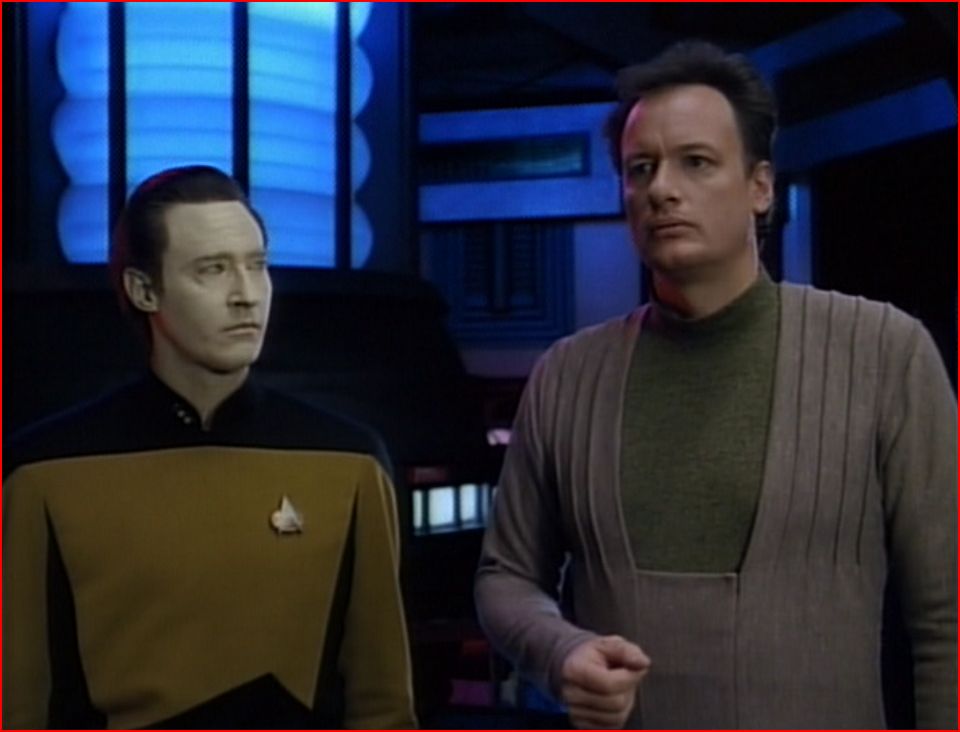
"As an android, I'm incapable of disliking you, Q, and yet, somehow, I do." — Data
Q's introduction to the series was, frankly, off putting. His first meeting with the Enterprise feels mashed together with another adventure. Two puzzle pieces that never quite connected together smoothly. Which fits, as from my understanding of the history of Encounter at Farpoint, that's very much what happened as Roddenberry and crew were launching the series. Granted, it was a pilot, and chock full of expositiony bullshit that plague many pilots. However, it seems to me that they only had a vague notion of what Q was and what they wanted him to be, but he wasn't there yet. He came to the Enterprise appearing as a 16th Century Explorer complete with thous and thees, a WWII soldier worried about Gerry, then some post-apocalyptic judge in a robe in a weird hat. It didn't help that Encounter was still figuring out literally everything about the series, and Q was as much a mouthpiece for exposition as anything. He was there to help set the status quo, explain where humanity was, and how far they had yet to go. His powers were ill defined, his mannerisms erratic, and the logic behind his encountering with humans is, shall we say, convenient with the needs of the show. Why the Enterprise and not Earth proper? Why use a weird forcefield? Why go through different eras of humanity (and appropriate accents) to communicate with Team Picard when you've reportedly been watching humans for a very long time? Eh, why the fuck not? Let's get on with the show, people, we have a fictional world to establish!

He'd appeared a few more times before this episode, Deja Q. Once to temp Riker with the god-like powers of the Q-continuum. And once to introduce the Borg and teach Picard a lesson in humility (the latter episode is not great, but the things it leads to are). DeLancie seems to relish playing Q, and he plays the smug, arrogant, and self-serving god-like being with a wink and a smile.

In many instances, Q has to stoop to humanity's intellectual level, and he seems exhausted doing it. He's a malicious scientist, poking at a mouse, trying to get the mouse to run through a maze. The mouse never understands why, it just has to run the course until it gets its cheese. Or not. Sometimes the mouse gets the cheese, sometimes, (as in the first Enterprise's first encounter with the Borg) he has to take the mouse out of the maze and reset the experiment. He's a great foil for the series, the Mr. Mxyzptlk to Picard's Superman. Logic and technobabble don't matter when he shows up. He's freaking magic. And the Enterprise crew has to cope with a power they can't understand. The Enterprise is never any real threat to him. Not ever, in the series. Except once. Here, in Deja Q.

Both figuratively and literally, Q is, for all intents and purposes, the trickster god archetype. And in this, his fourth appearance, they finally figured out that he should just be fun. Because this is a fun episode. Mostly because humans, and being human, are so effing stupid. Q is stripped of his godlike powers, turned human, and abandoned on the Enterprise to spend the rest of his limited existence as a mortal.

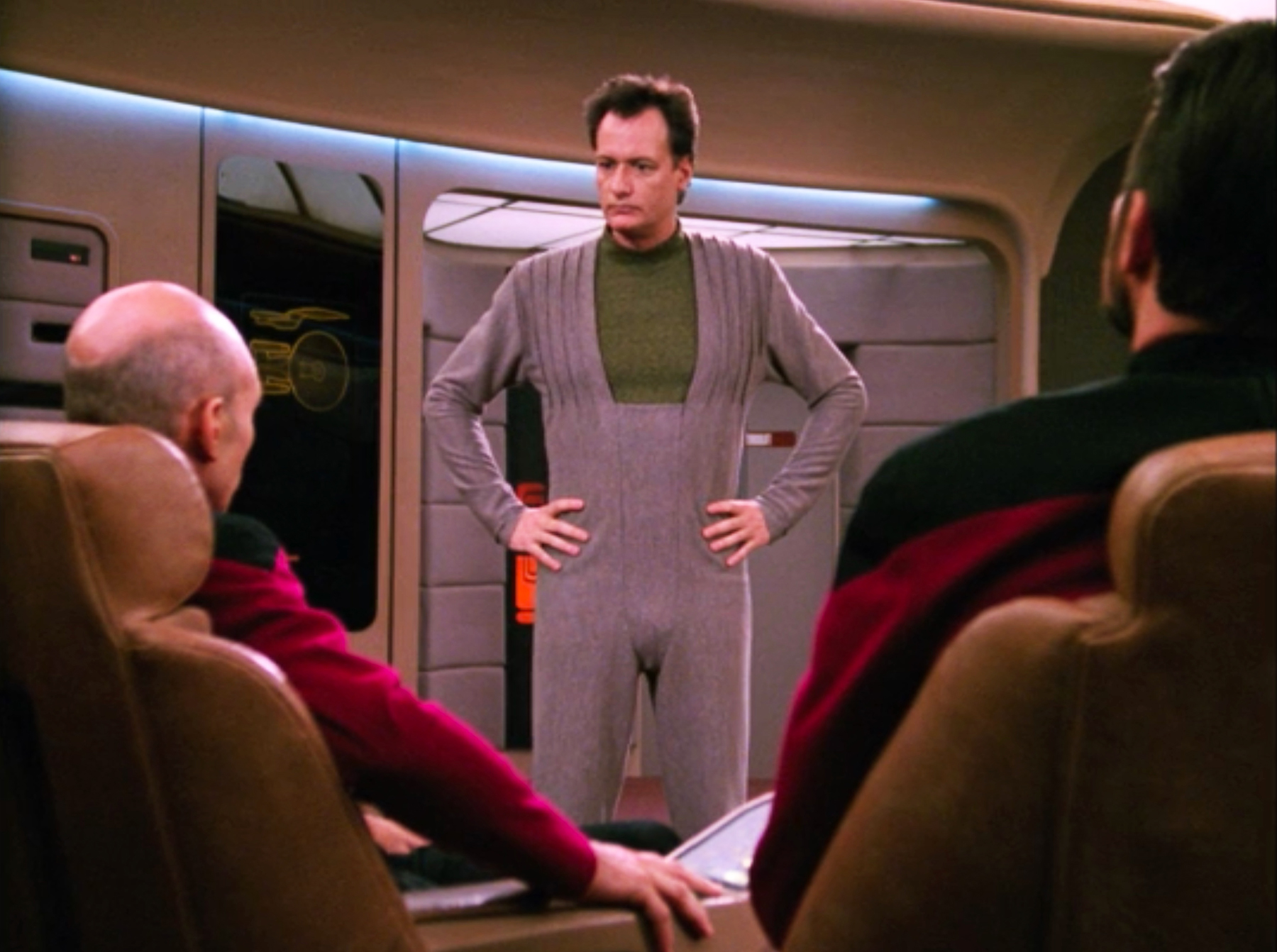
Space onesies. Mortality apparently means space onesies.
Do they trust their former tormenter? No, dear reader, they do not. Picard is facing a crisis of his own, a moon to an alien world is threatening to crash into its parent planet. Not only does he think that Q is responsible for the natural disaster, he also believes that this is some intricate ruse on Q's part to test them. Side note, only Picard can use the word 'ruse' and get away with it. I can't even type it without feeling like a fraud.

In contrast to the flamboyant DeLancie as the newly mortal Q, he's paired with Spiner's ever-quizzitive and serene Data. And while in normal circumstances it would be so completely on the nose it would be painful -- having a being who is revolted by having humanity thrust upon him, and the being for whom humanity is a goal forever out of reach -- I forgive it here because the interplay between Q and Data is just that damned entertaining. While Q learns the hardships of his newfound biological needs -- like sleeping, gross, and hunger, double-gross! -- Data is there to remind him of the gift of, if not humanity, than at least perspective. Q has spent countless millennia toying with lesser species. Now that he's vulnerable, he at least has some idea of what it means to face his mortality.

To prove his worth to Picard, Q is assigned to help Geordie and Data figure out how to stop the alien moon from crashing, which may literally be the most boring thing any Star Trek crew has ever faced ever. Even the people on the planet can't seem to muster any sense of urgency faced with the eradication of their populous. Seriously, why are these people so damned calm? The aliens appear slightly tense, but otherwise, they're just doing their jobs. Pushing the space buttons and what not. I, on the other hand, would be freaking the freak out if the moon were going to crash into the planet. And not just a little bit. I'm talking full-on, last-days-on-Earth-shenanigans-that-would-only-come-to-pass-if-society-rules-were-out-the-windows-dogs-and-cats-living-together-mass-hysteria-level fun. I would not take the end of the world well is all I'm saying.

"No, it's fine. Our planet is going to be destroyed, and we're relatively okay with that." — Doomed Aliens
In the midst of this, the most boring challenge ever in the history of space, Q is attacked by one of the species that he formally tormented. Picard makes the choice to protect Q, against all logic, because it's the right thing to do. Does Picard like having to risk his ship to protect this former god-like being? No, dear reader, he does not. But Q is now a member of his crew, and it's the right thing. There's a bemoaning hesitation on the Captain's part, but it soon passes. He's risking his ship and his crew over one person. Would he do the same for a nameless gold shirt serving on the lower decks of Engineering? I would have to say, probably. Which is why Picard is the best man suited for the chair of the Enterprise D.

Q eventually realizes that he must sacrifice himself to save the Enterprise. With that, another member of the continuum appears (LA Law's Corbin Bernsen, randomly, of all people), confirms that Q has learned his lesson, and restores Q to his former power. Q snaps his fingers and resets the moon, and all's right with the alien world below.

"Remember me? No? Maybe as the dad from Psyche? Still no? Understandable." -- Other Q
Now, if this episode totally sucked, unequivocally and inexorably, if the entire episode had lacked the wonderful exploration of humanity between Q and Data, the ending would have still have earned it a spot on the list of Top 100 Episodes of Trek of all time. Because when Q is absolved of his crimes and has his powers are restored, he celebrates is a manner fitting of a next generation trickster god. With a battle cry of "Mon Capitan!" Q presents a full-on mariachi band on the bridge. Picard and Riker are given celebratory cigars, and Data is given a glimpse at humanity in the form of uncontrollable laughter.

The best part of this is that it happened.  
Throughout the episode we're treated to the sarcastic outsider's view of the Enterprise and the world of the Federation, with Q holding up the funhouse mirror to the absurdity of what it means to be human.

Therefore, Data's laughter at the end is wholly, wholly deserved.

--

Up next, the crew of Voyager examines the morality of war with Memorial.

Friday, January 16, 2015

#88, 'Favor the Bold' & 'Sacrifice of Angels,' Deep Space Nine, Season Six, Episodes 5 & 6

I seem to remember the retaking of Deep Space Nine in Favor the Bold and Sacrifice of Angels as being a big moment in the mythology of the show. When Sisko takes back Deep Space Nine from the enemy. We're deep into a war with the Dominion, and the Federation is losing. Losing territory and ships to a vastly superior opposing force, they're outgunned, outnumbered, and falling into a pattern of attack and retreat.

Lives have been lost. Morale is low. And Sisko has decided it's time for some let's-blow-the-shit-out-of-something-big action. A go-for-broke plan that will strike the heart of the Dominion and provide the Federation with a much needed victory. They have to force a victory, or lose the war. He puts together a task force to take back his former command, Deep Space Nine.

Sone where in this armada, I like to think Picard is making it so.

As I re-watched these, I came to realize that this two-episode arc represent the best and the worst of what Deep Space Nine was. As if they are a microcosm of the series as a whole. The episodes are wildly uneven, oscillating between good and bad almost from scene to scene. Deep Space Nine is a show I like (a lot), but I have to admit that there are some elements that just never clicked for me.

On the one hand, we have Avery Brooks, who, once again, rocks it like a boss. Sisko's a man with his back against the wall, making the hard decisions. He's passionate. Earnest. Bold. And takes zero shit from zero people, aliens, or cosmic beings from another reality.

The Dominion are (with exceptions noted below) the perfect villains for the series. I'd described them in a previous post as a totalitarian anti-Federation. They're everything the Federation isn't. They seek conquest, not exploration. Jeffery Combs' Weyoun is fantastic. The show takes chances, swinging for the fences. When they decided to make the major through line of the show the Dominion War, they went for it. Throughout the series, Deep Space Nine has presented space combat on a scale not seen since the Battle of Endor, and it did it on television. Repeatedly. Certainly not on a scale seen in any other iteration of Trek.

We have great character moments. Miles and Julian bonding. Quark setting aside his self-interest for the greater good. Even Rom shines in a rare instance of not being completely annoying. Also, Worf son of Mogh. 'Nuff said.

And then, on the other end of the spectrum (for the record, the bad one), we have the prophets calling Ben "The Sisko." We have the character known only as Female Changeling, who apparently cannot have a line without saying the words 'solids' or 'great link.' We have Odo's, ugh, love affair with Major Kira, which has always felt forced and awkward. We have the logic problems of both the Bajoran gods and the Dominion changeling rules. And, then, we have Gul Dukat.

Gul Du-fucking-kat.

I swear I got eye strain from rolling them too much every time Gul Dukat was on the screen. I loathe him, but not in the way I'm meant to. He's smarmy, arrogant, self-agrandizing, and speaks with with an almost operatic rhythm — where every sentence builds in volume and intensity and is then followed by a soft coda. Once I identified this, it drove me absolutely mad. Dukat is, perhaps, the Star Trek villain with the most screen time of any other. In fairness, I didn't do any kind of quantitative analysis on that, I'm just going by memory. But holy crap is there a lot of Dukat on this show.

"Was it something I said?" -- Gul Dukat. "Pretty much everything you've ever said, ever, yes." — Me

Over the course of the series, he's been portrayed as a cold-blooded mass murderer, a misunderstood tyrant, a crazy person, a patriot, revolutionary, a cult leader, a messiah, and a vessel to evil gods. And every time he's on the screen, I'm just checking my watch until he's done being terrible. He grates me. He's mustache-twirly terrible. He stands out as cartoonishly broad and over-the-top in a show with alien forehead makeup and spaceships going kler-splode. That says something. He strives to have the gravitas to be Sisko's equal, and the failure at that is palpable. But, they keep using him. And his use keeps giving me eye strain. Ow.

However, the worst part of this particular Niner adventure is that it ends with the most blatant (and literal) deus ex machina you could possibly imagine. Sisko's bold plan has failed. The Federation strike force is unable to break the Dominion lines, except for one line ship, the Defiant. The minefield that has kept the Dominion re-enforcements at bay is taken down. Sisko and the crew of the Defiant sail into the worm hole to face off against two-thousand-plus Jem'Hadar warships alone. Their sailing into their deaths in a hollow sacrifice. They don't even say anythig like, 'we're going to technobabble the warp core and collapse the wormhole so that the Jam'Hadar can't get through and save the alpha quadrant with our noble sacrifice!' Instead, they lock phasers, and calmly accept their own deaths at the hands of alien weapony. Then, the Bajoran Prophets pull Sisko out of his reality and into their temporal dream state.

The interaction with the Bajoran Prophets is just painful. They seem to interrupt the action for the sake of interrupting. Call Sisko "the Sisko" for no apparent reason other than to just annoy me. They ramble about a 'game,' which I infer to mean the writers aren't sure what to do with these alien beings in the long term. They are dismissive of Sisko's needs until he makes an old-fashioned empassioned speech. Sisko begs them for a miracle, and they provide it. The Dominion fleet vanishes from Existence, and the Defiant returns to Deep Space Nine. Sisko and crew return the triumpant heroes to the Station, and the war goes on.

For both good and ill.

---

Next up, it's a trip to the continuum with Déjà Q.

Friday, January 2, 2015

#89, Court Martial, The Original Series, Season 1, Episode 20

As we break into the 80s of the Top 100 Trek Episodes of all time, we have our second entry from the original crew. (Well, the second original crew, not counting Pike, Number One, and the rest of the Enterprise crew from The Cage.)

I'd mentioned before how Trek likes to explore different storytelling techniques. And in 'Court Martial,' we have a courtroom drama set in the world of the Federation. Here Kirk is put on trial for negligence of duty when  crewman dies during a crisis.

"How can anyone who looks this good be guilty of anything? I mean, seriously!" — James Kirk

If this episode is any indication, the Judge Advocate General's office is really, really messed up. I will call a lot of shenanigans on space law in a bit, but first I want to share something.

I have a theory on Captain James Tiberius Kirk. I don't really expect anyone to subscribe to its lunacy, but it helps me make sense of the character. I don't think he believes he's ready for command. I believe his arrogance and overconfidence is a mask for his insecurities. He understands the weight of the responsibilities of his position. He understands that he holds the lives of hundred under his direct command, and that it's his moral compass that must guide his decisions that may affect the lives of the countless billions within the Federation. At this time, Starfleet is still exploring the quadrant. They've met countless enemies and godlike beings so advanced as to appear magical. And Kirk has faced them all with a wink and a nod and not a shred of doubt in what he's doing is right.

That doesn't mean I don't think he's ready for the job. He is. He's clearly smart, capable, decisive, talented, eloquent, and more than willing to throw a haymaker when necessary. But I think his unwavering bravado is a facade to mask his self-doubt. It's his first command. He's in uncharted territories both physically and emotionally for him. Why do I believe that? Well, I'm glad you asked.

Kirk is presented as a paragon, the best of what humanity has to offer. But I cannot accept that Kirk truly believes himself to be that man. The counter-argument to that, is that Kirk is a human being. I choose to believe that it's all an act. That he's choosing to put on this larger-than-life persona as a means to deal with his responsibility. He has to charge forth into the vast unknown and face it with out a moment's hesitation. He always has to be right. Not because of his ego, but because it's what's demanded of him in his position as captain of the Enterprise.

Otherwise, he's a completely arrogant, irredeemable asshole, and not a flawed man doing the best he can in fantastic circumstances, under extraordinary pressure, and the responsibility of the most advanced military weapon mankind has yet to build. I choose to believe that Kirk is far more complex that the aforementioned paragon of humanity. Because, if this isn't the case, he's boring. And I cannot stand being bored.

In 'Court Martial,' when Kirk is accused of his crime, negligence of duty, Kirk just can't process it. He stands firm on his story, the ship was on red alert during an ion storm, and he had to make the tough call of jettisoning a crewman in order to save the ship. The man, Finney, Kirk supposedly killed was someone with whom he'd had a history. Kirk, as a junior officer, derailed this man's career, and wound up commanding the Enterprise instead. With their former friendship dissolved, Kirk is accused of deliberately murdering the man for... Eh, the logic of it doesn't really track, so I'm going to stop while I'm ahead here instead of trying to explain it. The computer records counter his story, and computer records are never, ever wrong.

Kirk supposedly killed a man by giving him a middle finger.

Rather than take a desk job and have his mistake quietly swept under the rug, Kirk reacts the way a cornered animal would react. He fights back. Viciously. To a fault. It's inconceivable to him that he could be in error. That his memory of the act was incorrect. That his actions in a crisis were at fault. That he, James Mother-Effing Tiberius Kirk, could ever, ever, ever make a mistake or be wrong. He immediately challenges his superior officer, and demands a trial before he's seen the evidence, or even takes a beat to consider the consequences of his actions. The Commodore is taken aback, and gives Kirk exactly what he asks for, a general Court Martial to see if his actions were criminal.

When Spock and McCoy are called to the stand to testify, both hold Kirk up to that paragon standard to which they hold him. Spock believes the computer to be in error solely because it is illogical for Kirk to have make a mistake. McCoy testifies that Kirk is so far removed from human psychology that the animosity Finney had for Kirk would have no effect on his decision making. The Commodore who puts Kirk on trial opens the story with how one-in-a-million special starship captains are, and how Kirk is the best of the best of them. Even Finney's daughter, who screamed bloody murder at the site of Kirk earlier in the episode comes to understand that Kirk is just... that... damned... awesome at being better than everyone else.

Here's where I shift gears a bit and call space shenanigans on the Starfleet legal system. First, the prosecution in the case, Lt. Shaw, is an ex-lover of Kirks. While it adds dramatic tension, it's clearly a conflict of interest and she should have immediately recused herself from the case. Secondly, his attorney is a straight-up crackpot. An eccentric that believes that computers are terrible and that books are the way to go. Because you can't read the original law from a computer. Which, from a 21st century viewing perspective is just batshit insane. Kirk is amused by the man's eccentricity, but should have instead immediately asked for someone not crazy. What's more is that this eccentricity never pays off. They don't come to a conclusion that proves old-fashioned book learnin' is better than computerized, digitized information. Instead, they wind up using a computer to solve their problem. Thereby derailing the attorney's eccentricity into a futile anti-technology rant.

"But I like books, they're my only friends." — Crackpot Lawyer Person
It turns out that Finney faked his death to frame Kirk, falsifying the computer records, and hiding on the ship. It's a plan that... Eh, the logic of it doesn't really track, so I'm once again going to stop while I'm ahead. The point is Kirk was right, and Finney was an insane person.

Kirk's bravado and reckless ego are validated by all of this. The crew's assessment of him as the paragon are reset and all's right with the Enterprise once again. His actions are justified, and he's been shown to be able to do no wrong.

But he's once again proven he's the right man for the most dangerous job in the quadrant.


--

Next up, things in space go boom in the two-part DS9 epic, with Favor the Bold & Sacrifice of Angels.