Tuesday, June 16, 2015

#81, The Enemy Within, Star Trek, The Original Series, Season 1, Episode 5

"I'm not a bad guy, really." — Dark Kirk
I recently got into a Facebook argument with a friend who only acknowledges the greatness of the Original Series, and feels that everything else that follows is terrible. At least, unworthy. He and I vastly disagree on this, obviously. While, I greatly respect The Original Series and the legacy it created, as I've stated before, it's not my Trek. So, if you're a fan of The Original Series (and only The Original Series), I'm going to apologize in advance for the next few reviews of the adventures of Kirk, Spock and McCoy on the Top 100 list. 'The Enemy Within,' 'I, Mudd,' 'A Piece of the Action,' these episodes are not for me. They're everything that I find off-putting about TOS, however...

However...

However, I'm going to do my best to appreciate them for what they are, the era in which they aired, and the spirit in which they're presented. I'm willing to give 'The Enemy Within' a lot of latitude because as Episode 5 of a decades-spanning franchise, the show is still figuring out what it is. Sulu and Scotty get a lot of air-time. There are a couple of firsts here, it's on this episode that Nimoy created the Vulcan nerve pinch (though an episode shot later aired earlier). We get out first look at Kirk's wrap-around captain's tunic. When a bunch of crew are trapped on a freezing planet and the transporter is inoperable, the obvious solution would be to use shuttlecraft, except they hadn't been established in the show yet.
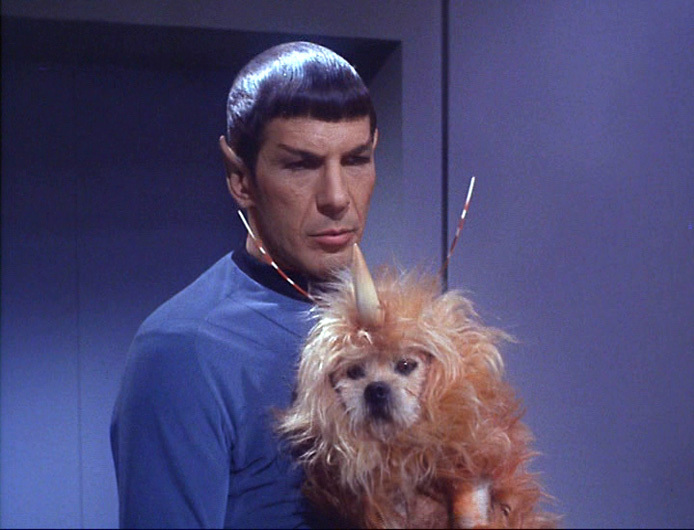
For example, after this episode, they decided against making the Space-Unicorn-Terrier a re-occuring character. 
So, let's try a compliment sandwich, shall we? I'll say something nice, I'll say something less-than-nice, and then I'll say something nice again. Let's see how that works out.

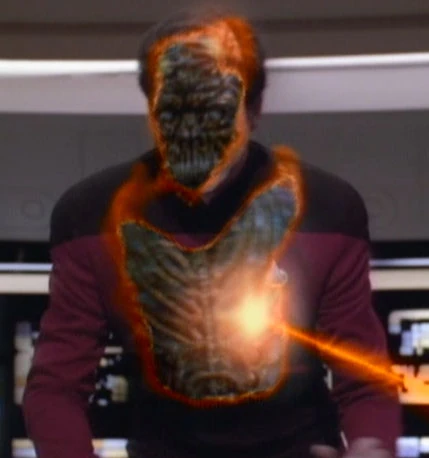
'The Enemy Within' has a fantastic premise and had amazing potential. And the vibe of the episode is far more Twilight Zone that Star Trek. And coming from scifi legend and Twilight Zone alum, Richard Matheson, this is wholly appropriate. The episode is dark, brooding, and explores not just the darker side of Kirk, but the darker side of mankind as a whole. It asks the question of what happens when we strip away our humanity, and looks at what's left. A transporter accident creates two Kirks. One, slowly losing himself in self-doubt and fear, the other, the baser animal nature of humanity. We look at a man split into two extremes, and seeing what happens when a man's psyche is metaphorically and physically thrown off balance.

Matheson keeps the division between the Kirks from being as simplistic as 'Good' and 'Evil.' They go out of their way to point out that these aspects of personality are necessary for the whole. Dark Kirk is primal, driven by desire and self-interest. Kirk-Lite spirals from being the man he once was into a man who's incapable of making a decision.

Unfortunaltely, the different aspects of Kirk that are presented, the Compassionate and Indecisive Kirk-Lite and the RAGE, RAGE and OMG-SOMEHOW-YET-EVEN-MORE-RAGE Dark Kirk are played to such extremes the results come across as more comical than poignant. Now, let's call this for what it is, it's a television show trying to communicate a story point. But even so, it's really hard for me to watch Shartner sneer and snarl his way around the Enterprise as Dark Kirk. I don't think I'm going out on a limb in saying that Shatner is not the most well-respected thespian ever to grace the small screen. But in 'The Enemy Within,' his depiction of Dark Kirk as over the top, even for him. The choices of guyliner, general sweatiness of Dark Kirk, over-dramatic music, and the lighting doesn't help the subtlety of the situation, either.
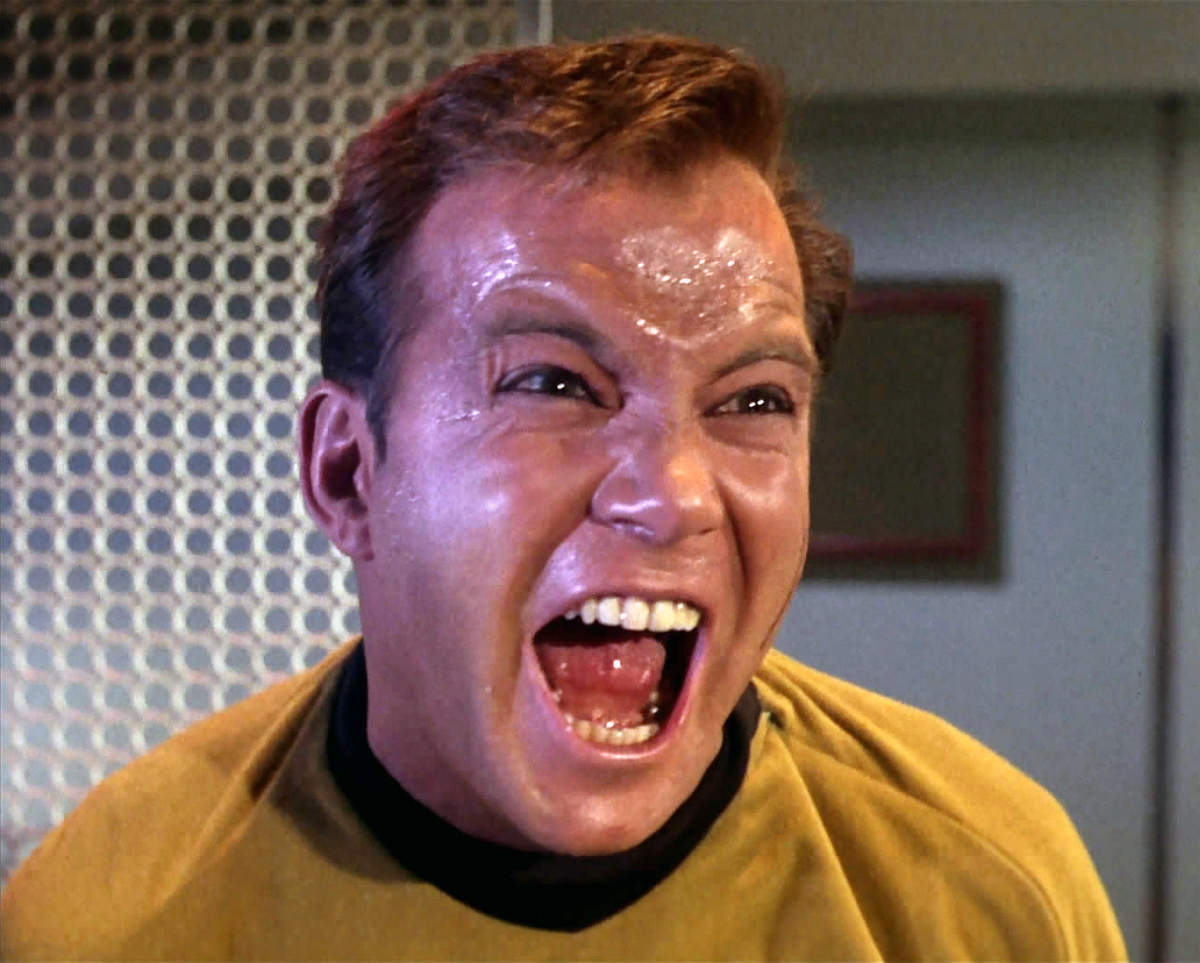
"I'm acting! I am! Acting! I'm ACTING!" - Dark Kirk
Kirk-Lite wanders around the ship, waiting for others to act, and slowly loses his ability to command the Enterprise. Kirk-Lite is far less defined than Dark Kirk. Dark Kirk's first acts are to demand booze and force himself upon Yeoman Rand. Kirk-Lite's actions are more business as usual, but he increasingly becomes incapable of commanding his ship. Where Dark Kirk's actions are clearly aggressive, the aspects of this Kirk's personality are far more vague. I have little doubt that this is unintentional, a deliberate contrast between hard and soft. But we never get a sense of that the traits Kirk-Lite are any kind of benefit. All we get is that Kirk-Lite is incomplete.

"I have no strong opinion. Whatever is fine. What do you think?" — Kirk-Lite
I'm inferring here that the darker nature of humanity is not only necessary, but vital in order to be a whole human being. I'm not sure I'm okay with that. I think I'd be more amenable to the episode if the attributes of compassion and empathy were presented in any kind of positive light. But they're not, really. Compassion here is equated with weakness. I fundamentally disagree with the overall idea that the only way to be whole is to be equal part aggressive asshole. It's quite the mixed message for a show that looks to an idealized society where humanity has evolved to a nigh-utopian state. More than the low-grade production values, more than Spock's sole function as the Exposition Officer, more than the horrible treatment of Rand, this message is this reason that I can't really connect to this episode.

Also, the alien-dog-thing looks just damned ridiculous.

Like all great Star Trek, 'The Enemy Within' asks big questions. I'm just not sure I like the answer they came up with.

--

Next up, Picard does what he does best, negotiating treaties in 'The Wounded.'

Friday, June 12, 2015

#82, Conundrum, The Next Generation, Season Five, Episode 14

"Wait. What's happening? I have zero idea." — Jean-Luc Picard
I'm of two minds of this episode.

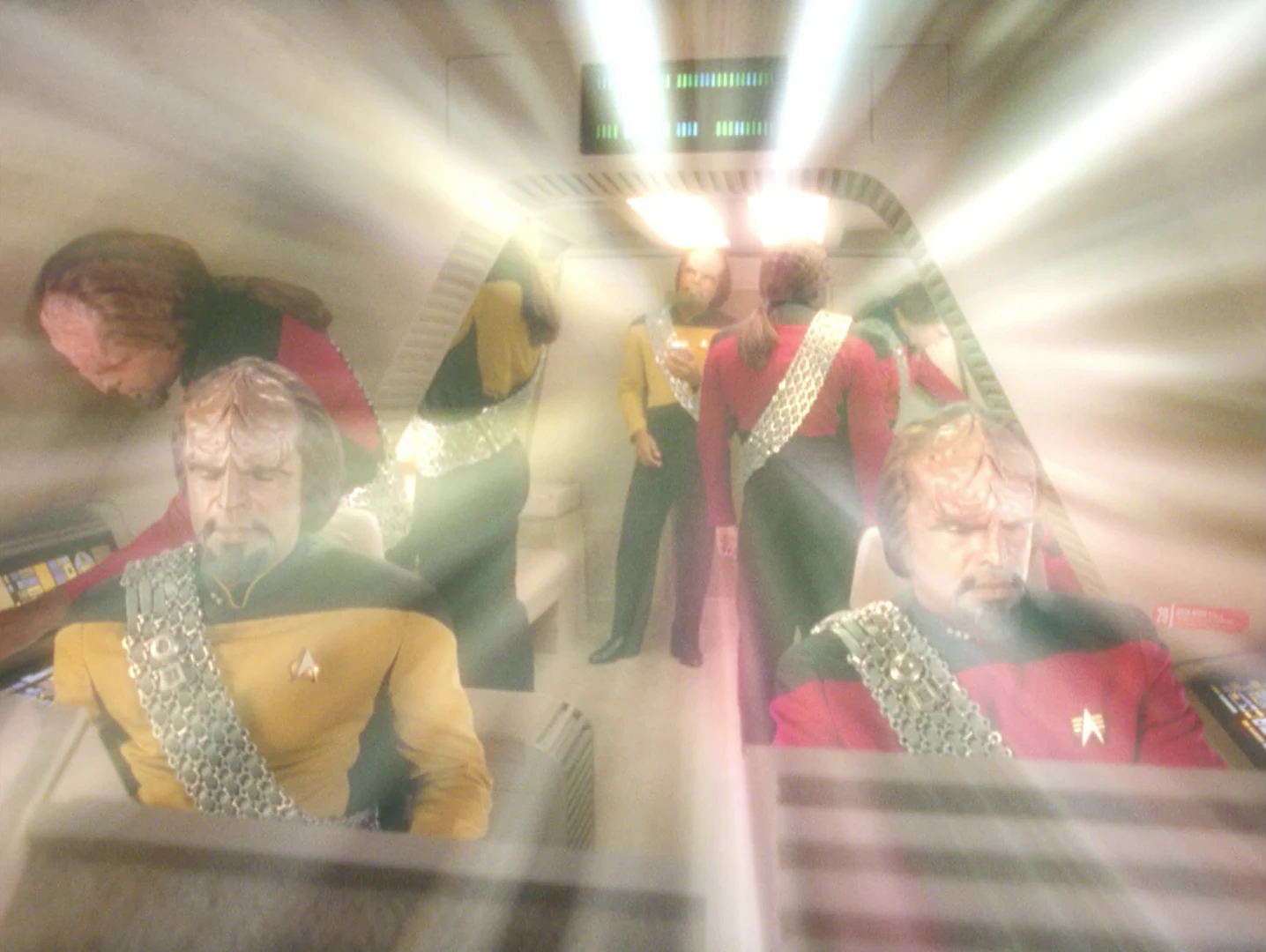
On the one hand, hot damn, 'Conundrum' is just great. I mentioned in the previous post about taking the familiar and putting them in an unfamiliar surrounding, and in this episode we get an inversion of that motif. We take the familiar setting and put new characters in it. Well, not really new, per se. We still have Worf, Riker, Picard and Data, but their memories have been erased. They have no idea who they are, or what their purpose was. Just a bunch of people on a giant space ship, wearing snazzy uniforms, and wondering whiskey tango foxtrot is going on.

Too often we've seen mystery set up on Star Trek where we the viewing audience is a step or twelve ahead of the crew (for example, 'Parallels'), but here, we're just as clueless as the crew themselves. As the crew realizes none of them know who they are, there's an unfamiliar face on the bridge of the Enterprise. Commander MacDuff, the ship's First Officer. Whuuuuuuuuuut? And it's on like Ferengi Kong.  We know that something is horribly wrong, but the characters do not. MacDuff is a metaphorical bomb and we're just waiting to for him to go off. As he manipulates the crew, thwarting their attempts to get to truth, we're just waiting for the payoff.

The clues are well paced as the crew pieces together what's going on, with bread crumbs of information doled out in tiny chunks. The Enterprise is supposedly on a secret mission to take out an enemy base to end a bloody war. The enemy has a new secret weapon, which explains the memory loss. The Enterprise burns through the enemy lines, they grossly overpower their supposed mortal enemy.

There are some great character moments as the crew figure out who they are. What we have here are the characters stripped down to their cores. Riker is pure swagger. Ro is impulsive, looking to make her own rules. Deanna states the obvious. Beverly is there, I guess. Data tries to figure out who and what he is. Worf is pure warrior. Picard is wisdom incarnate. The Captain has some great verbal explorations of the moral dilemma of his mission. When they encounter their enemy, they discover  they're no match to them, he doubts the moral certainty of the conflict.

The episode is not without fun. Data and Geordie wonder if Data is unique or part of a ship's standard equipment, which is a fascinating concept. Ro and Riker put aside their usual animosity and replace it with amorousness.* And Worf thinks he's captain for a good chunk of the first act and no one bothers to stop him.

When everyone realizes that no one has their memories, Worf decides he's captain, because why not. With no one with any information to contradict him, he takes charge. His instincts tell him that they've been attacked and he starts ordering the rest of the crew to get the ship battle-ready. Picard shows patience and diplomacy as the young Klingon takes over his ship, and immediately slides into the role of the experienced advisor. It's great to see the contrast between the characters. Worf's single-mindedness and Picard's big picture view. It's the difference between inexperience and experience.  Worf's mea culpa to Picard is great when he discovers that he's the junior-most bridge officer.

"One day, I'll be Captain of my own ship, I swear. Computer, activate crowdfunding." — 'Captain' Worf. 
As they make it to their destination, the mystery is revealed, the MacDuff has been manipulating the Enterprise into destroying the base of his species' enemies, ending their war using the Enterprise's vastly superior firepower. Picard can't reconcile what he's been ordered to do and decides to talk to their 'enemy' rather than blow the shit out of their space station. When MacDuff forces his the issue, the crew stops him from murdering thousands using the Enterprise as his weapon. MacDuff shows his true colors, and those colors are alien and gross.

Apparently MacDuff belonged to the same species of  aliens as the ones from 'They Live.'
On the other hand, holy crap, the alien plot is just damned nonsensical. If they can take down the crew of the Enterprise in one shot, why not replace all of them with their own people? Why just the one guy? Why put your agent as the first officer and not the captain? The aliens that take over the ship, the Satarrans, are supposedly a hundred years behind the Enterprise in technology, but can reprogram Data and the ship's computer? The structure of the mystery is well done, but the reveal is a huge let down. and the episode begins with Troi beating Data a chess, a thing that no one ever would find plausible. However, I'm willing to give it a lot of latitude because the rest of the episode is so strong.

What's the verdict? In my opinion — and it's the official opinion of this blog — the strengths of 'Conundrum' far outweigh its weaknesses. So, in the end, 'Conundrum' is great. Flawed, but great.

--

Next up, we get two Kirks for the price of one within 'The Enemy Within.'

--

*They get it on, is what I'm saying. 

Sunday, June 7, 2015

#83, Timeless, Voyager, Season 5, Episode 6


An episode so time-travely they borrow Doctor Who's time vortex. 
In this episode of Voyager we get a glimpse of an alternate future, where an aged Harry Kim and Chakotay travel fifteen years back in time to undo a mistake that cost the crew of Voyager their lives. They're gruffer and grayer than we know them. They've turned their backs on the Federation, committed treason, stolen a ship and a piece of rare Borg tech, and are racing against the clock to send a message back in time to save their crew. Also, they have Captain Geordi LaForge, commanding the Galaxy Class starship Challenger, on their tail.

Harry and Chakotay have a confederate in this. Chakotay's girlfriend, Tessa, who's perfectly willing to die to help Chakotay. She faces death at the hands of the Challenger's torpedoes with a kind of blasé attitude that makes on wonder what kind of effed up relationship she has with Chakotay. Throughout Trek in it's many incarnations, there's this kind of detached calm when things are blowing up around people. Seriously, next time you watch an episode look for the 'I'm-just-doing-my-job' attitude that comes from extras and guest-stars in the show. It's kind of eerie. Tessa goes about her business as if changing time and exploding are perfectly normal.

The best moment in 'Timeless' comes at the beginning, when Voyager crashes into a planet and gets engulfed by a glacier. For a show (and series) where a lot of space action happens off screen to save money (i.e. holding on Tom Paris, for example, when he announces, "The enemy is exploding. It's spectacular! I wish you could see this!"), it's nice to see a big moment in the show. The crash looks great, and the special effects hold up well lo these many years later. The image of Chakotay and Harry, decked out in space parkas finding the englaciered Voyager is well done, and immediately sets up a the mystery. And like every mystery in the post-Seven-of-Nine era of Voyager, it's solved by Borg-technobabble. Considering how effing magic the Borg's technology is, it's astounding they haven't conquered the galaxy yet. More on that later when we get to more Borgy Voyager adventures later in this countdown.

'Let it go. Let it go.' — Elsa Janeway

Also, it's nice to see that Geordi gets a promotion to Captain in the future. It's always a treat for me when the series cross over with one another, even if it's for a glorified cameo. Although, for whatever reason, it looks like Geordi is commanding his ship from his ready room. I'm going to guess that reason is budgetary. It's a nice reminder that Voyager, despite it's premise of being lost thousands of lightyears away from home is still part of the larger fabric of Trek mythology. I've never been a fan of the extended universe for Trek. I've read a few of the novels — don't judge, I went through massive withdrawals when TNG went of the air — and find them lacking. None of the video games have ever caught my attention. So, it's fun to get to see where the next generation Enterprise crew land in the future, and fill in some of the gaps between the end of the series and 'All Good Things.' It carries massive good will to Voyager for me, and fills in the connective tissue of the universe.

"Though you might be tempted, don't read Star Trek novels." — Captain LaForge of the U.S.S. Reading Rainbow

Now, if there's one thing that Voyager, as a show, can do, it's ignore the crap out of temporal paradoxes. I'd love to see a quantitative analysis if the show, breaking down the number of episodes that deal with mucking with time as a concept. We've seen two in this list alone just from Voyager. A quick look at the list, and we've got another 15 or so that deal with time travel, or alternate timelines in some capacity, not counting any Temporal Cold War shenanigans from Enterprise. And in this episode, logic gets shoved right out an airlock as Harry and Chakotay race against the clock to save Voyager in the past. When they succeed in sending their message back in time, they erase the timeline that enabled them to save Voyager. Janeway even shrugs off the paradox with an "Eh, fuck it. Time paradoxes. What you gonna do?" I'm paraphrasing the captain, of course, but that's the gist of how 'Timeless' ends.

Then, we have a message from elder Harry Kim from an alternate future addressing his former self, and letting him know what his hubris might have cost the crew. Time logic problems aside, I wish the moment had had more gravitas. Part of the problem with putting our heroes outside their norm is that we don't get to see these new incarnations of the crew fully fleshed out. As elder Harry Kim, actor Garret Wang growls his way through the episode and I never got the sense that he was playing the truth of his situation. There are hints of PTSD and survivor's guilt, but the episode also has to shove in space battles and slip-stream-drive-technobabble, too. This truncates the character moments, and making me wish we had more time with this reality.

If there's a reoccurring theme in the episodes that I've seen on this list, it seems to be taking our characters out of their normal roles and throwing them in a situation, environment or timeline they find wholly out of the norm for a crew of a starship/space station. We've seen it in 'Parallels,' 'Little Green Men,' 'Bride of Chaotica,' 'The Killing Game,' and 'Future's End.' I'm making an observation, here, not a judgement, but that's almost a third of the episodes on the list so far. I can see the appeal from a creative standpoint. It shakes things up both for the audience and the writers and performers.  I'm going to keep an eye on this trend as the countdown continues, but for now, I'm just going to welcome 'Timeless' to that list.

--

Next up, the crew of the Enterprise-D face a 'Conundrum.'

Thursday, May 28, 2015

#84, Parallels, The Next Generation, Season 7, Episode 11

"Ahead full! Maximum Worf!" — Worf
I'm not going to lie. I was worried about this episode. Worried because when I announced that 'Little Green Men' was on the docket, I also announced how much I liked it. But when I revisited that episode, I realized that it didn't hold up to my memory. Part of this is the nature of comedy. Much of comedy relies on surprise. A set-up followed by misdirection. A classic structure of expectation and reversal. A third phrasing of that thing. A big part of my reaction to that episode was that it just wasn't all that funny. I've always found Trek better at being 'amusing' than 'funny.' 'Little Green Men' was just a little too-not-at-all-that-funny for my tastes.

That being said, I really, really remembered liking 'Parallels' and I was worried it would fall short of my expectations. After watching, I'm pleased to say it's still a great deal of fun, as Worf bounces from parallel reality to parallel reality, drifting further and further from the Enterprise he knows. As he shifts, the changes in his surroundings go from subtle (the cake is a different color!) to drastic (Riker is Captain!). It's one of those episodes that takes our familiar characters and puts them outside their comfort zones. What is at first contributed to a concussion from a bat'leth tournament messing with Worf's memories quickly escalates into him realizing that he's no longer in his home reality. Worf is lost, unsure of where he is or what's happening thanks to some shuttle accident and Geordi's visor, or something. The technobabble and technobabble solution aren't not really the problems here. Worf's motivations as a character are.

Worf rolls with the changes fairly well at first, assuming his memory is suspect thanks to the aforementioned blow to the head. But, history keeps changed around him. And not little things.  Deanna Troi is his suddenly his wife. Picard is dead at the hands of the Borg. Data has blue eyes. Dr. Crusher is no longer the Chief Medical Officer. Their combadges are slightly different. It's madness.

"Come, sit down, embace this new me-filled reality." — Deanna Troi
What I find interesting is that the reality in which Worf finally finds himself is a fairly sweet one. He's gotten a promotion to first officer of the Enterprise and is happily married to Deanna Troi with two supposedly beautiful children (we never see them). It's not until he realizes that in this reality, his son, Alexander, was never born, that Worf's drive to return home kicks in. Sirtis does a great job of handling Deanna's complex emotional roller coaster as she realizes that Worf not only has no memory of their relationship, the man she knew and loved is gone. Replaced with a man from another world. It's a completely weird thing to ask of an actor, but I think it's handled well.

If I have one major complaint about the episode (I have second but it isn't critical, and is super-nerdy) it's that the episode spends a great deal of time establishing what is essentially a non-mystery. The audience is so far ahead of the characters in this episode on what's going on, it's painful to watch the them catch up. They spend way too much time with the setup and explaining to the audience what a parallel reality is. It's a fairly well-known science-fiction trope and I feel we could skip a fair amount of this and get straight to the emotional conflict in the episode. I say a non-mystery because the reveal of what's going on is in the damned title. Doesn't take a warp-engine specialist to put two and two here.

The episode is very character heavy, where a man who is normally sure of himself, questions everything around him. There's not much driving the story forward, past the mystery we already know the answer to. So, the episode lumbers a bit. We have new, shiny things to look at, but it does drag. There are a few red herrings. Cardassians tamper with a space telescope, and aggressive Bajorans strike against intruders to their territory, but neither pay off in a satisfactory way. It's not until the barriers of reality start to break down that we have an actual threat to deal with, and Worf has any kind of decision to make.

My second complaint about the episode is far more nit-picky and about the Son of Mogh himself. In this episode, Worf comes across as the Klingoniest-Klingon-to-ever-Klingon-a-Klingon. And it bugs me. The episode starts off with Worf returning from a bat'leth tournament, which sounded an awful lot like an Olympics where competitors get impaled. Or, I imagine something akin to MMA, but with giant knives. But not only did he compete, he won with Grand Champion standing. I call shenanigans.*

Worf going off to a bat'leth tournament as a spectator I totally buy. He wasn't raised by Klingons and Worf has always struggled to connect to his heritage in a meaningful way. Worf running off to learn what it means to be a Klingon is a reoccurring character theme. But for him to go to this tournament and win, I just don't buy it. Having competed in martial arts tournaments (I have, don't laugh), I can tell you the people that win those trophies on that level are preternaturally gifted, train non-stop or both.

Worf is a capable officer and warrior, but for him to be competitive amongst natively-raised Klingon warriors, living in a society where competition pushes each of them to the extremes is not credible. I get that we need a mcguffin for him to recognize what reality he's in, and what's changed. As a symbol of the changing realities, his grand master trophy changing from 3rd place to 9th to a participatory ribbon certainly works. It just stands out as being a little too Klingoniest-Klingon to me.

As he swapped realities, it would have been great to have seen Worf in a wind up in a place where Klingons ruled the Federation, which may have been a real emotional challenge for Worf. Here we'd have a character who's struggled with connecting with his heritage, and then have to choose to give it up in order to save reality.

While it's fun to subtly change things around Worf, things never drift too far from the Enterprise-D we know and love. The changes aren't really that drastic. Worf pops into a reality where Wesley Crusher is the tactical officer (one once again questions the wisdom of Starfleet HR). And it would have been great to have Dr. Kate Pulaski show up as medical chief in a cameo. I love that there's something meta here. It's like we're looking at the series in alternate timelines. It's almost as if they're embracing the fan rumors/theories that Stewart wasn't going to return for season three after 'Best of Both Worlds.' Or looking at what if Wil Wheaton had stayed on with the series to become Lt. Crusher?

"Ugh. Pressing space buttons is so beneath my preternatural genius." — Tactical Officer, Lt. Wesley Crusher 
The mind, it boggles.

If anything, I wish they'd gone wilder with it. And weirder with it. We get hints of it with a reality where the Borg have conquered the Federation. When Worf's shuttle takes off to seal the anomaly, it's threatened by a panicked and mountain-man-bearded Riker. He's so desperate to do anything to keep from returning to his nightmare that he'd rather face the breakdown of all existence than the Borg. There's a surreal moment, when New-Reality-Riker is forced to kill Mountain-Bearded-Riker, but it's soon passed. If we had gotten to the answer to the mystery sooner, we might have had a chance to explore some of the more extreme tangents in Enterprise reality. As it is, it's a slow start and a rushed ending.


"The Borg are everywhere! There's no shaving cream or hair gel left in our reality! We won't go back!" — Riker

It's still a fun adventure, but I find myself pondering what might have been. I can't decide if that's appropriate or ironic considering the nature of story.

---

Next up, a 'Timeless' adventure with the Voyager crew. So, the Voyager crew and time travel? Again?

We'll see.

---

*I wanted to use the Klingon word for 'shenanigans' here, but, sadly there isn't one. 

Thursday, May 21, 2015

#85, Little Green Men, Deep Space Nine, Season 4, Episode 7

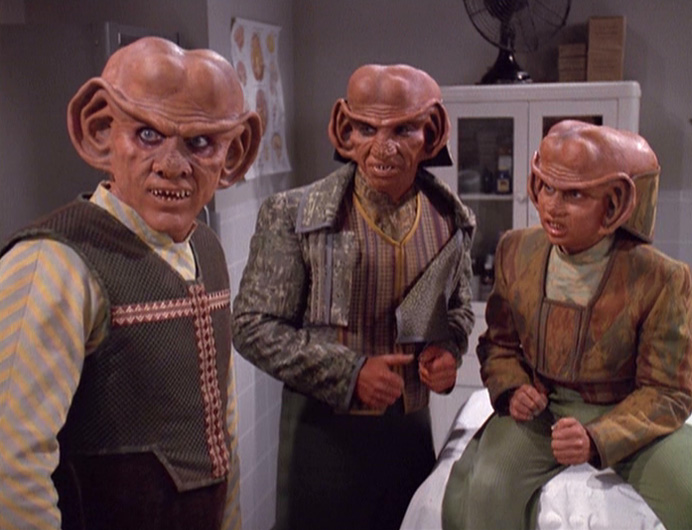
Now's where we hit the cold hard reality of memory versus actuality. I had very fond memories of 'Little Green Men,' where Quark, Rom, and Nog accidentally travel back in time and crash in Roswell, New Mexico, in 1947. Taken to Area 51, they make contact with the primitive natives. The premise is strong, and we get to see our favorite Ferengi try to hustle forties-era humans out of their planet. It's... well... It's not good. At least, not as good as I thought it was going to be.

I'd remembered it being much, much funnier. As I rewatched it, much of the humor in the episode falls more than a little flat. The jokes were expected and could be seen coming a quadrant away. Nostalgia is a dangerous thing. It convinces us that things in the past were good, when, in fact, there's a good chance they were not. I will never look upon the original Battlestar Galactica, A-Team, Dukes of Hazard, the Transformers, or Big Trouble In Little China because there's a zero-percent chance they hold up. This, however, this episode I was really looking forward to. And I was really disappointed.

Quote-hu-mor-unquote.
Maybe it's that Quark and crew are truly at their best when they're ancillary to the story. Maybe it's that this is the second Ferengi-centered comedic episode in the countdown, and much of the goodwill that I felt for Shimmerman's Quark and his compatriots has already been spent on my review of the Magnificent Ferengi. Maybe it's because that episode had Iggy Pop and this one did not. Maybe it's that nothing could possible equate to "Roswell that Ends Well" from Futurama. Both episodes had similar time-travel-to-Roswell-shenanigans, but Futurama did it a bazillion times better.

"Shut up and take my latinum!" — Fry
Maybe it's that funny is really, really hard.

Really.

So, rather than bash on the episode for not being what I remembered it to be (which in all fairness is probably more on me than it), let's accentuate the positive, shall we? Let's talk about how we got Quark from the pilot to this episode and why that's kind of cool. For all the type of bumpy foreheaded peoples in the Star Trek universe, there are few aliens that are really explored in depth. There are only a handful that break out of the monoculture formula. And through the characters of Quark, Rom and Nog, we get to explore a few different aspects of the Ferengi. The three started out as pretty much the same character, and over the course of the series we saw each of them grow into more than their sniveling, greedy, funny-looking species of origin.

'Look who's calling us funny looking. Stupid hu-mon.' — Quark

Quark here, represents the idealized Ferengi. Opportunity, profit, and thrill. Ferengi love negotiating. And here Quark throws caution to the wind, at the mercy (and gunpoint) of a military base, he sets out to conquer their planet, with no weapons, no plan, nothing really to offer. And he does this because he thinks he can. He goes for it with a bravado and fearlessness that's kind of awesome. He seeks challenge in the only way he knows how. In Ferengi society this is referred to as having the 'lobes,' but let's call it for what it is. Giant, giant brass. But throughout the series, Quark is constantly being called out by other Ferengi for not being ruthless enough. Living amongst aliens for so long, he's had to adapt to cultures outside his own, and finally finds a balance between his Ferengi ideals and those of the Federation. That is, until he unceremoniously throws away years of character development in the series finale, but we'll jump off that bridge when we come to it.

Rom, his idiot-savant brother, is far more interested in making things than money. This makes him an outcast. Because he sees more to life than the acquisition of things, he's considered an 'idiot' by his brother. He's clearly not; he's just not wired in the same way that other Ferengi are. Early in the series, Rom was always nipping at Quark's heels. Always scheming to get the bar from Quark. Not because he really wants it, but because he's lost. He's terrible at business. Terrible at negotiation. Terrible at scheming. Terrible at all the things Ferengi are supposed to be. As the character developed, Rom stops being Quark's incompetent shadow, and starts to become his own man. He marries an alien. He gets a menial job on the station, not because it will make him wealthy, but because he loves it. He follows his passions, regardless of what his kin will think of him. Rom went from being a horribly cartoonish background character to an actual person.

Nog starts the series out as Diet Quark. A ne'er-do-well, no-good-nik and a bad influence on Jake Sisko who's sole function seemed to be to create conflict between Jake and his father. He was mean-spirited, willfully ignorant, a liar, and a tiny jerk. School was dumb. Girls were to be opinionless property. Latinum was all that mattered. He was, in essence, the ideal Ferengi in training. As Nog changed, he became more than a foil for the Siskos and came to represent the future of his species. In this episode, he's off to Starfleet Academy. He sees Starfleet was a way for him to better himself. To see something greater. Not because of profit, but because, like his father, he wanted more from life than the acquisition of things. I mean, he still wants profit, don't get me wrong. But perhaps joining a society that has, in effect, no money, may not have been the ideal way to go about doing it. Nog has ambition, but not in the way that his people usually quantified it, making him a new breed of Ferengi.

These characters have changed over the years, and of all the explorations that Trek has done, it's of character that's the most challenging in interesting. The Ferengi are, after all, odd-looking creatures who may appear homogenous, but are far more complex than just their surface appearance might suggest.

Just like the rest of us.

--

Next up, Worf goes reality skipping in TNG's 'Parallels.'

I like to think, somewhere in the infinite number of parallel realities, Michael Dorn is about to write a review of my performance as Lt. Commander Worf.


Saturday, May 9, 2015

#86, Memorial, Voyager, Season 6, Episdoe 14

It's been too long since I journeyed — trekked if you will — back to the Delta Quadrant. I realize now that it's been a while since my last trek-realted post, and for that, I apologize, dear readers. But life gets in the way. Work took a weird turn. I directed a web series due out next month, Assassin Nine and have been busy in post. Designed a card game. Had to vent about Batman V Superman: Dawn if Justice. Which brings me to 'Memorial,' and my general dereliction of duty. But now, I'm back to it, with the latest in the Top 100 episodes of Trek according to io9 fan poll.

I had watched 'Memorial' weeks ago when I first set down to write this entry, and, well, nothing stuck. This is the second time I've watched a Voyager episode in this countdown and came away going, "Yeah, okay, fine, whatever, that happened." So, for a second time, I had to wonder if there's something in this episode that I missed. And as it gnawed at me -- what's the deal with this episode, why have fans dubbed it worthy to be on this list -- I think the point of the episode is that sometimes there is no clear answer. Voyager takes on a heavy, complex topic, but because this is a space-adventure show, it comes at it a bit sideways.

"Ugh, get on with it, already. Seriously." — Tom Paris

Tom, Harry, Chakotay and Neelix are returning from a weeks-long mission aboard the Delta Flyer. When they return to the ship they start having vivid and violent dreams about an armed, alien conflict, where they were participants. These visions go from being dreams to waking nightmares where the characters can't tell the dream from reality. Tom has a breakdown in his quarters. Neelix takes his goddaughter hostage in the mess hall. And the whatever-it-is starts to spread throughout the crew. Nightmares and visions of a way no one had fought. Even Janeway starts to feel the effects of the dreams.

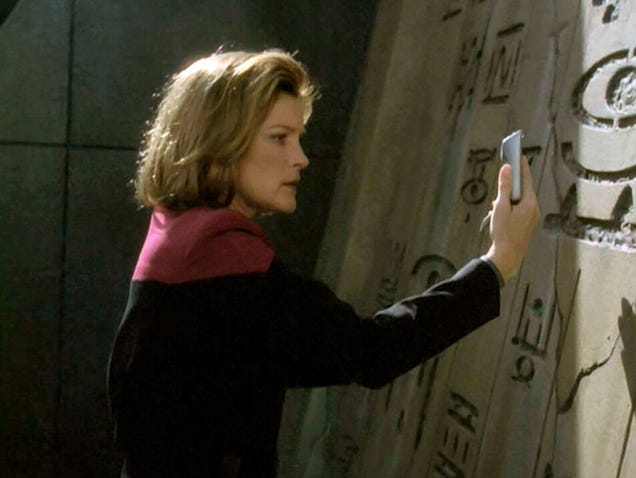
As they follow the mystery and backtrack the Flyer's path, they discover an alien beacon, showing a massacre from their history with the events beamed directly into passerby's brains. They find an alien obelisk on a planet, a memorial to the event that happened centuries ago. Anyone in range relives the firefight, so that it's never forgotten.

The show tries to dive into the moral complexity of war. Showing a military police action forcibly removing colonists from their homes, and things get out of hand. The colonists fight back and someone opens fire and violent higgledy-piggeldy ensues. Other than the commander of the military rigidly following orders (which those types are wont to do) and being a dick about it, there's no clear right or wrong here. It's just people caught in the middle of a difficult situation that has spiraled out of control.

Through the characters, they explore PTSD, with Tom, Neelix, and Chakotay playing the roles of soldiers retuning from duty and trying to re-assimilate back to normal life. Tom comes home to his wife, who greets hm with beer, popcorn and television (literally). They fight. Harry returns to work, and finds tasks that should have been routine, horrifying. Neelix has a complete psychotic break and takes the aforementioned hostage, forever changing his relationship with his goddaughter, Naomi. All of this is pretty heavy stuff coming from a show with space lasers, a woman in a silver catsuit, and a Neelix.

"Don't worry, Naomi! I'll protect you from the nothing!" — Neelix

Let's talk about Nelix. Much of my initial reaction to Nelix as a character was responding to his aesthetic. He, like Quark on DS9, is the alien outsider, an excuse to exposit on the state of humanity in the 24th century. Like Quark, his appearance is over-the-top, clownish among the predominantly black uniforms of the rest of the crew. Initially, I didn't care for him. His make-up and faux-hawk hair were on the side of the ridiculous. But past his leopard-goldfish-bulldog appearance, I do like the character. He's charming, optimistic, and brings a bit of color both metaphorically and physically to the show. Ethan Phillips has to do a hell of a job acting through that makeup job, and when he emotes, it can come across as silly. Not here, though. Here, his pain and fear come off as real as a man in a leopard-goldfish-bulldog mask can.

As the crew finds the obelisk, they spend a hot second wondering whether to turn it off. To prevent others from suffering the same fate as the crew. Their decision to leave it be, at first feels like a cop out. Janeway passing the moral buck because it's not her decision to make. But, it's not. And her leaving the memorial be is the right thing to do, so that the pain and loss of the massacre won't be forgotten. The episode is a bit ham-fisted, but sometimes Star Trek is what it is, a space-adventure show.

'Tricorder is reading high-doses of heavy-handed dialog. The OTN readings are off the charts." — Janeway

Star Trek likes to ask the tough questions. Memorial shows that those tough questions don't always have answers.

--

Next up, we're off the Roswell, New Mexico, for one of my favorite episodes of Deep Space Nine, 'Little Green Men.'


Friday, May 8, 2015

Regarding Batman v Superman: Dawn of Justice Trailer

Not overly happy with Man of Steel's redesign of Superman's outfit, I did my own. 

I went into Man of Steel with very low expectations. Snyder had never done anything that gave me any sense he had anything of substance as a director. Dawn of the Dead was mean-spirited with none of the joy of the original. 300 was a cartoon. Watchmen was a boring cartoon. And while Nolan's Batman trilogy made Warner Bros. a serious amount of money, I doubted his ability to continue a grounded super-hero vision with Superman. Pile on top of that that Man of Steel was an origin story, and the suit looked terrible, I had little hope that Man of Steel would be any good. I wasn't really interested in seeing it, I had wanted to see the movie they were going to make after Man of Steel. Now, I'm not so sure I do. 

That being said, it’s Superman. How could I not see it? After all, Snyder said all the things he needed to say with regards to his inspiration. All-Star Superman, Byrne's Man of Steel, Superman for All Seasons. But I didn't see any of that in the final product. In fact, what I saw was grim, brutal and humorless. Which says to me he may have read those books, but didn’t take anything away from them. 

I'm about to make a generalization. I find the people who complain that Superman is boring aren't people who read comics, have only a passing understanding of who Clark Kent is, and why he matters. Why he chooses to do the right thing, when he could instead pretty much do anything he wanted. It's that choice that makes Superman interesting, not his ability to leap tall buildings in a single bound. In his JLA run, Grant Morrison addresses the fact that Clark has trouble living up to the ideal that's expected of him. He has doubt. The weight of that pressure is crushing. And he doesn't always make the right or moral choice, which makes him human. 

When DC relaunched their universe with the New 52, they handed Morrison the reigns to Action Comics, and asked him to reimagine Superman for the 21st century. And holy crap, did he deliver. His run on Action examined a young man who looked at the world, at its injustice and corruption, and decided to make a difference. Because he could. He returned Superman to his origin, which says a lot to how little has truly changed in politics, greed and malice sine the Great Depression. Clark was flawed, arrogant, and so certain of his moral high-ground and his invulnerability that he threw himself into situations that he couldn’t possibly control. Morrison reinvented Clark as a modern investigative journalist, forgoing print and going straight to web, to show that a man could do as much good with his words as his fists. 

Morrison returned Lex Luthor to his roots as well, making him a sociopathic inventor, consulting the military on the existence of this alien. He established kryptonite as the radioactive fuel for the rocket that brought Clark to Earth. He laid the groundwork for Brainiac, Metallo, and even Mxyzptlyk. And it worked, beautifully. Morrison essentially handed Warner Bros. a template for reinventing Superman, making him relevant again, taking the weird corners of the mythology and making them connect. Warner Bros., instead, said, “No, thank you,” and went about to make the Man of Steel with Snyder, Goyer, and Nolan, and make it, you know, cool and ‘realistic.’  

Superman isn’t supposed to be cool. He’s supposed to be fun. He has innumerable abilities. He fights creatures of immeasurable power with ridiculous names. He wears a bright red cape. He’s not supposed to be realistic. He’s supposed to be fantasy. 

At a panel at ComicCon, Morrison postulated that Superman has always been a reflection of who we want ourselves to be. In his origin, he fought corrupt politicians and slum lords and stood up of the everyman because they couldn’t. He continued as a symbol for America's (self-perceieved, at least) indomitable-spirit during WW2. The Silver Age was full of happy-go-lucky spacey adventures with no real sense of danger. The eighties, his chief villain was reimagined to represent selfish, heartless corporate greed. In the 90s, he had a mullet for some reason. Morrison speculated that the reason we got a dark vision of a man who was supposed to be the symbol of hope is that it's what we are. We got violent destruction on a grand scale, and we cheered it, because that’s the hero we deserve. 

To my surprise, I didn't hate it. It was far more entertaining than I expected. The non-linear nature of the origin story made that tolerable. That, it was refreshing to see Superman take on a challenge on screen that wasn’t Luthor and kryptonite. And after Superman Returns And Bores The Audience To Death, it was refreshing to see a man who’s creation was in a book called Action Comics have some actual action. I really don't want to hammer the point of Zod's death at Clark's hands, but I will. Just in case there's some prize for being the one billionth nerd to do so. It felt less like a creative choice and more like a 'fuck you' to the character. 

Most of what we’ve seen from the sequel, Batman v Superman: Dawn of Justice looks like it comes straight out of Dark Knight Returns. And as revered as the book is (and it absolutely deserves it’s place in comic book history), it has not aged well. It’s been copied and aped so many times that’s it’s lost it’s impact. Its politics are horribly dated. Its vision of Batman is myopic, and not one I really enjoy. I prefer Batman as the smartest man in the room, a man who knowingly uses fear as a weapon, rather than the obsessed psychopath who likes beating criminals up because he can. Worse, Miller’s vision of Superman is mocking. It portrays Superman as nothing more than a puppet, and the complexities of the character are thrown out the window in favor of cheap shots at the 'boy scout.’ Miller not only doesn’t get Superman, he openly dislikes him. Superman sacrificing his freedom in to save his friends is somehow a thing to be ridiculed. And this is not the source material on which I want a Superman story made. And bringing Miller in as a consultant does not fill me with confidence. 

To make Batman the nemesis for Superman’s sequel speaks to Warner Bros. lack of faith in the character. It speaks to their inability to trust the decades of mythology built around the him. It speaks to their jealousy of Marvel and wanting to bums-rush into Justice League for a cash grab without earning it in the same way that Avengers did. It speaks to their fundamental misunderstanding of not just Clark, but the entire DC Universe. Stories have recently emerged about hiring multiple writers to tackle the Wonder Woman script based on an ever-changing treatment. That’s not vision. That’s design by committee.

The sad thing is, in this age of blockbusters, quality doesn’t really matter. The movie will make Warner Bros. a metric f-ton of money whether it’s any good or not based purely on the franchise name. As a writer, that saddens me greatly. The general population wants to see Batman beat up Superman, because they somehow think that a billionaire-inventor-master-stunt-driver-world’s-greatest-martial-artist-computer-programer-acrobat-detective is somehow way more realistic than an alien.

However, I’ve been wrong before, and I guess I'm willing slap down my money to find out.